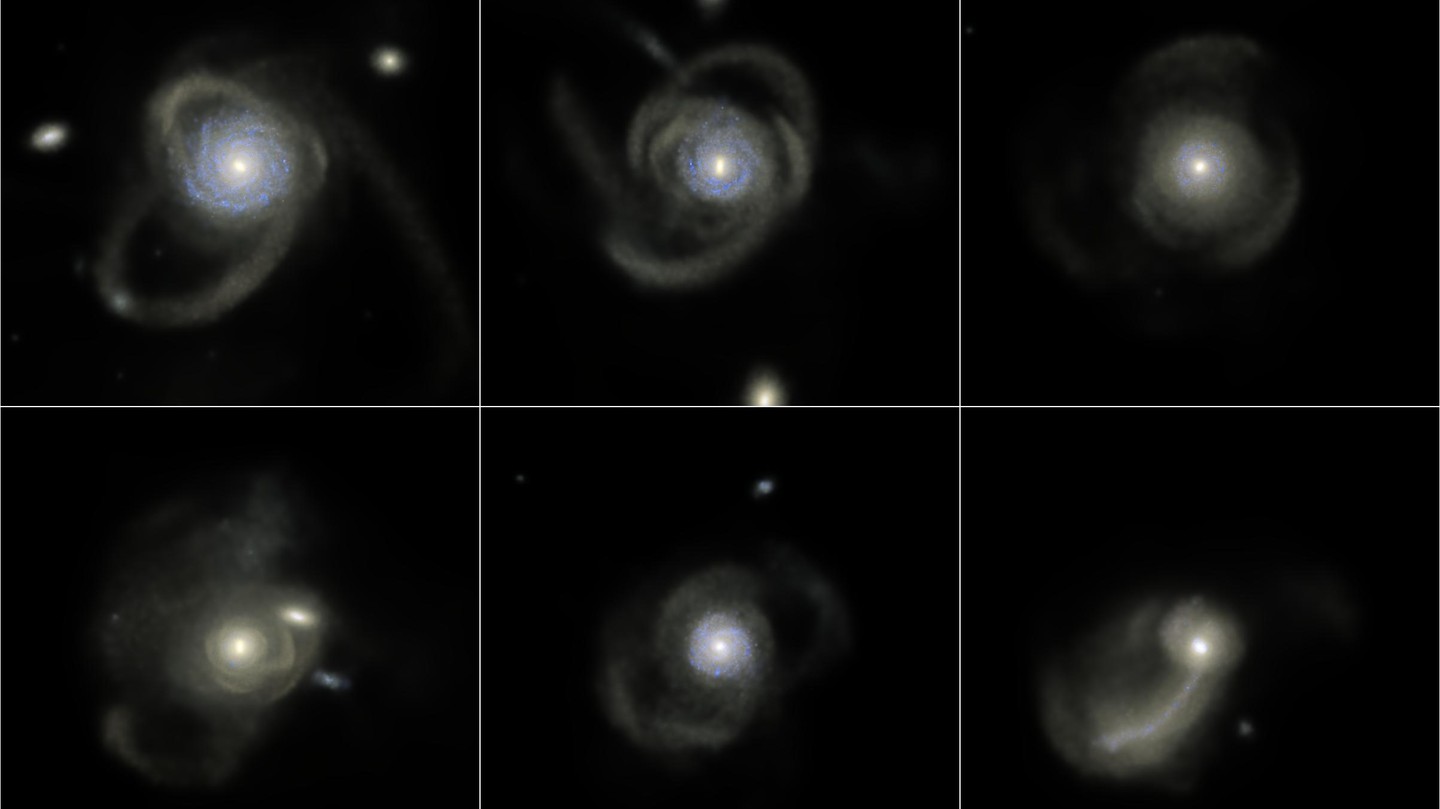
Researchers at EPFL will help shape and prepare ARRAKIHS, a European Space Agency mission that will launch in 2030 to observe how galaxies grow and provide new insights into the nature of dark matter.The European Space Agency's ARRAKIHS mission will be the first space mission dedicated to exploring the ultra-low surface brightness Universe. By studying the diffuse stellar halos and streams, as well as other faint structures surrounding nearby galaxies, it will help astronomers reconstruct billions of years of cosmic history and test test key predictions of the standard cosmological model.Design of the ARRAKIHS payload model. Credit: ARRAKIHS Instrument TeamPiecing together the history of galaxiesAccording to the standard cosmological model, large galaxies such as the Milky Way grow by gradually absorbing smaller ones. These ancient mergers leave behind extremely faint stellar streams and diffuse halos that preserve a record of a galaxy's past.Because these structures are so dim, they are difficult to observe from Earth. ARRAKIHS, short for “Analysis of Resolved Remnants of Accreted galaxies as a Key Instrument for Halo Surveys”, has been designed specifically to detect them.By observing around one hundred nearby Milky Way-like galaxies, the mission will address one of the central questions of modern astrophysics: how galaxies assemble their mass and structure through hierarchical accretion over cosmic time. The results will directly test key predictions of the standard cosmological model and provide new constraints on the properties of dark matter.Members of the ARRAKIHS instrument team working on the scientific payload. Credit: Satlantis, IDR, UPMThree EPFL researchers are members of the of the mission consortium. Yves Revaz at LASTRO and Michaela Hirschmann are part of the core team. Revaz also serves on the ARRAKIHS Science Committee and leads the Galaxy Models (GAL) work package. David Harvey, also at LASTRO, is in charge of exploring alternative dark matter models.“EPFL is internationally recognized for its leading research in observational cosmology and in the formation and evolution of galaxies, studied from from numerical simulations,” says Revaz. “Through a combination of numerical simulations and observations, we aim to place stronger constraints on the cosmological model and on the nature of dark matter.”Predicting what ARRAKIHS will seeWhile the spacecraft is still being built, EPFL researchers are already preparing for the mission. The GAL team is developing realistic mock ARRAKIHS images by bridging state-of-the-art simulations of galaxy formation with future observations.Using different sets of numerical simulations, the team predicts the low surface brightness environments surrounding Milky Way-like galaxies, including diffuse stellar halos and other faint structures. By comparing these simulated observations with the underlying properties of the virtual galaxies, the researchers will assess how accurately ARRAKIHS will be able to reconstruct a galaxy's accretion history.“These predictions will be essential for interpreting the mission's results," says Revaz. “If low surface brightness features are not detected or are found to have different properties than predicted, this could reveal limitations in the current cosmological model, point to shortcomings in numerical simulations, or indicate that important physical processes are still missing from current models.”ARRAKIHS Binocular Breadboard developed by the AMC Instrument Team, with workers of Satlanits, Instrument Prime. Credit: Satlantis and AMCStrengthening EPFL's role in international astronomyEPFL's involvement in ARRAKIHS demonstrates its ability not only to contribute to major international space missions, but also to help define and lead their scientific objectives.The mission has already fostered new collaborations between EPFL and international partners, relationships that are expected to grow throughout the project's lifetime and create new opportunities to attract competitive national and international research funding.With launch planned for 2030, EPFL researchers are already laying the groundwork for a mission that will explore one of the faintest regions of the Universe and help help reveal how galaxies like our own Milky Way came to be.ESA press release
EPFL joins ESA mission to probe dark matter
Researchers at EPFL will help shape and prepare ARRAKIHS, a European Space Agency mission that will launch in 2030 to observe how galaxies grow and provide new insights into the nature of dark matter.
619 words~3 min read