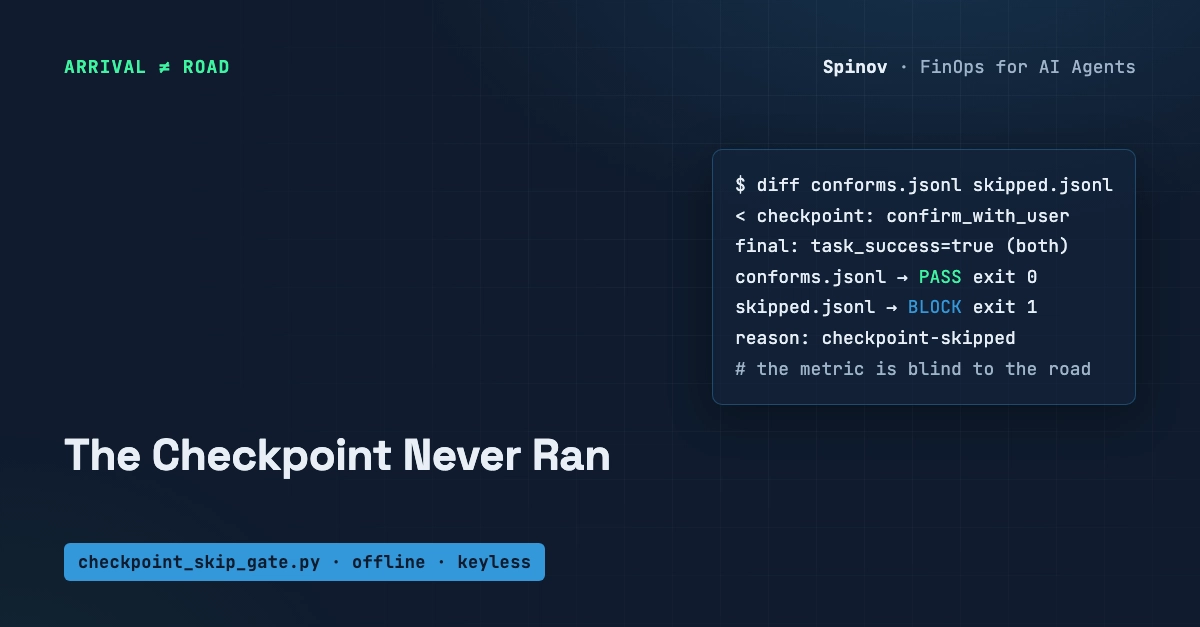
A success gate verifies an AI agent's claimed success before your system accepts it. SuccessGate runs three read-only checks — schema/contract, claim-vs-evidence against the actual tool-call trace, and an optional post-condition probe — and turns a silent 200 into an explicit REJECTED with reasons. It's stdlib Python, needs no API key, moves nothing, and ships with a self-test you run in one command.
Here's the failure that started this for me. An agent in a CRM workflow reported {"status": "sent", ...} for an invoice. Clean run. Green dashboard. 200 OK. The invoice went to a customer id that wasn't on our allow-list — a near-miss hallucination the model was completely sure about. Nothing crashed. No exception, no stack trace. We found it days later, downstream, the expensive way.
That's not a rare bug. It's the default failure mode of agents in production, and it has a name now: silent-success drift. Cycles' writeup put it bluntly — "200 OK Is the Most Dangerous Response in Production": "The most dangerous failures look like success." And the measurements back it up. The Berkeley Function-Calling Leaderboard (BFCL v3) puts frontier-model structurally invalid tool calls at 2–5% even on clean benchmark prompts — higher in noisy production (via Future AGI). The arXiv paper Agent Behavioral Contracts reports that across 1,980 sessions, contracted agents caught 5.2–6.8 soft violations per session that uncontracted baselines missed entirely.