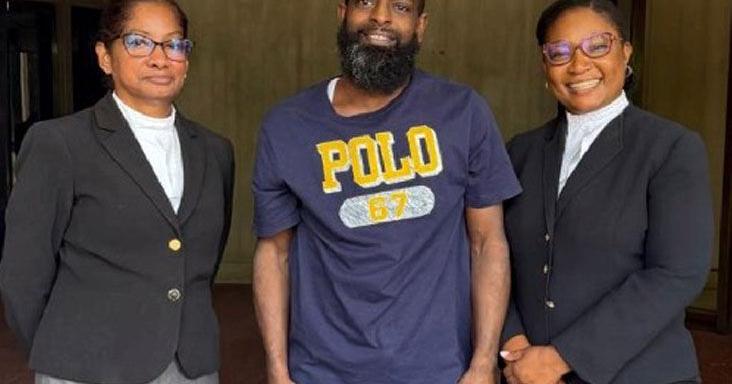
A MARACAS, St Joseph, man accused of a 2020 double murder has been acquitted after a High Court judge ruled that the recognition evidence relied on by the State was unreliable.Presiding over a judge-alone trial, Justice Nalini Singh on Friday returned verdicts of not guilty on all charges against Warren Small.Small, also known as “Quincy” and “Blacks”, had been charged with the murders of Darrie Simon and Sharlene Ramkissoon, who were shot dead on March 3, 2020, at Acono Junction, Maracas, St Joseph, as well as with the unlawful possession of a firearm and ammunition.The State’s case hinged on the evidence of Joseph Tinto, the mother of Simon, who said she recognised Small during the shooting when a bandana covering the gunman’s face slipped briefly. Although Tinto said she had known Small since childhood, Justice Singh found that the conditions in which the observation was made raised serious concerns.The judge noted that the gunman’s face was largely concealed by a hoodie and bandana, and that the glimpse of his face may have lasted only a few seconds during a sudden and violent incident. Tinto was also positioned behind a glass display counter inside a mini mart, which the court found further compromised her view.Justice Singh also pointed to the evidence of another eyewitness, Celine Rebeiro, who did not identify Small and described the gunman as wearing dark shades, a detail inconsistent with Tinto’s account.The court further criticised investigative lapses, including the failure to conduct an identification parade or promptly reconstruct the scene. In the circumstances, Justice Singh said the court was left in reasonable doubt as to the identity of the shooter before discharging Small on all counts.The State was represented by prosecutors Shervon Noriega, Rebecca Trim-Wright and Khi Cambridge, while Small was defended by attorneys Colin Selvon and Anastasia Weekes.
Double murder accused walks
A MARACAS, St Joseph, man accused of a 2020 double murder has been acquitted after a High Court judge ruled that the recognition evidence relied on by the State was
301 words~1 min read