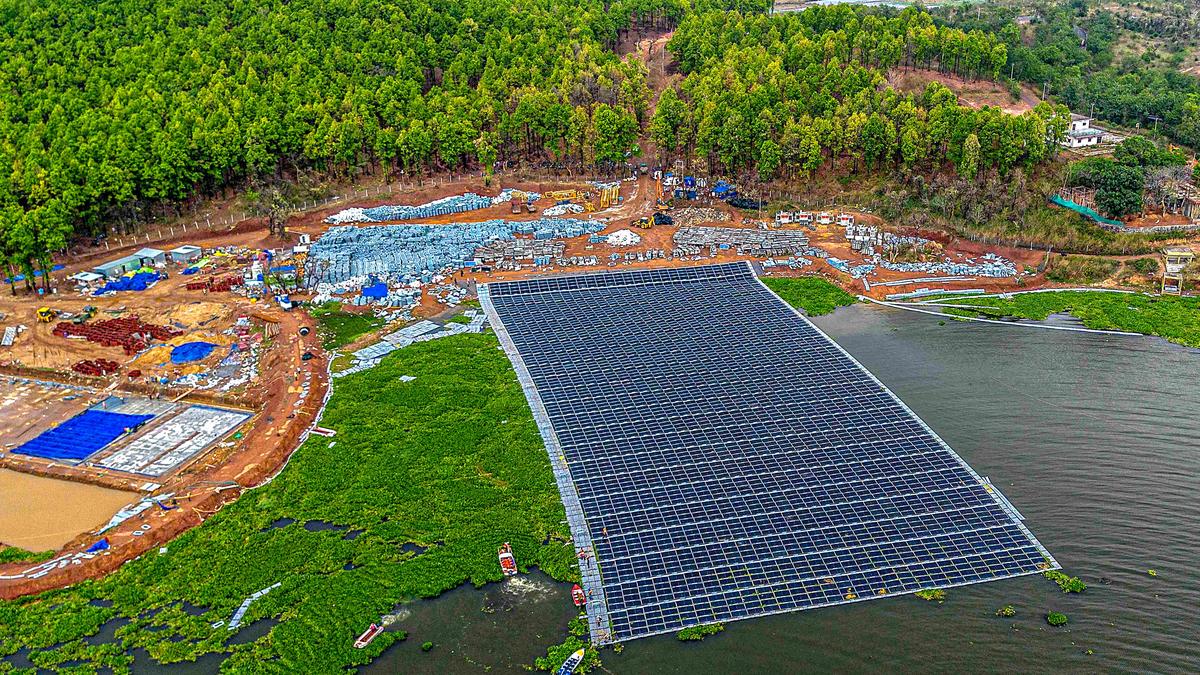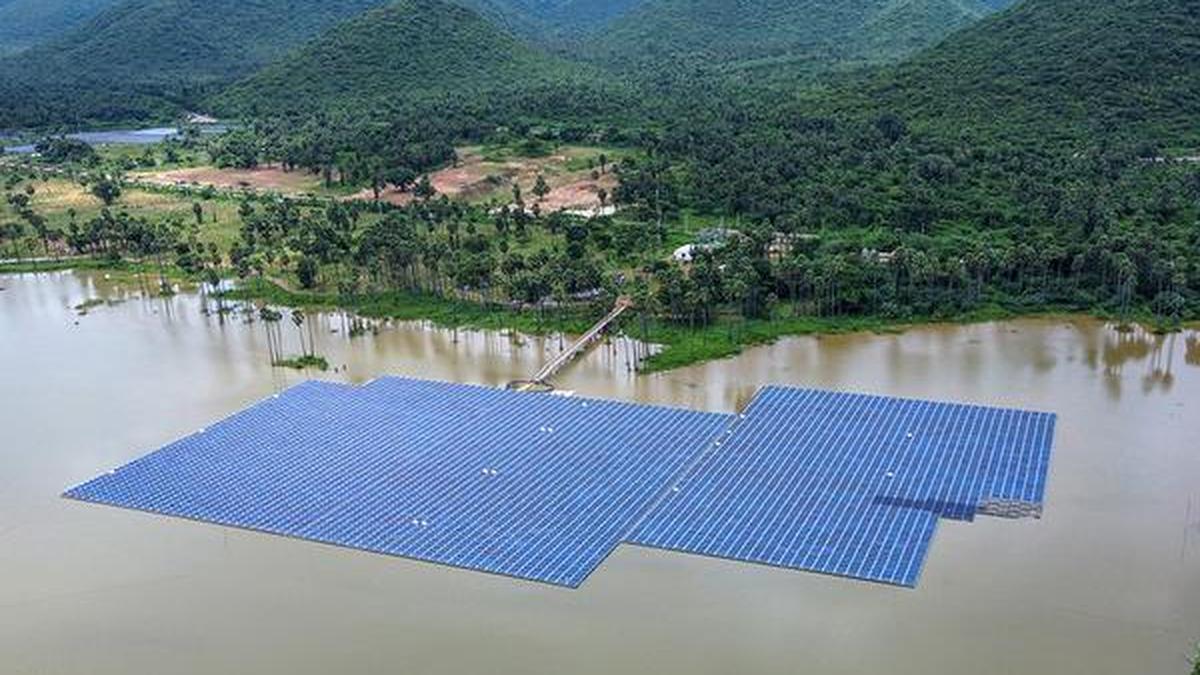
An aerial view of the floating solar panels on the Mudasarlova reservoir in Visakhapatnam
| Photo Credit:
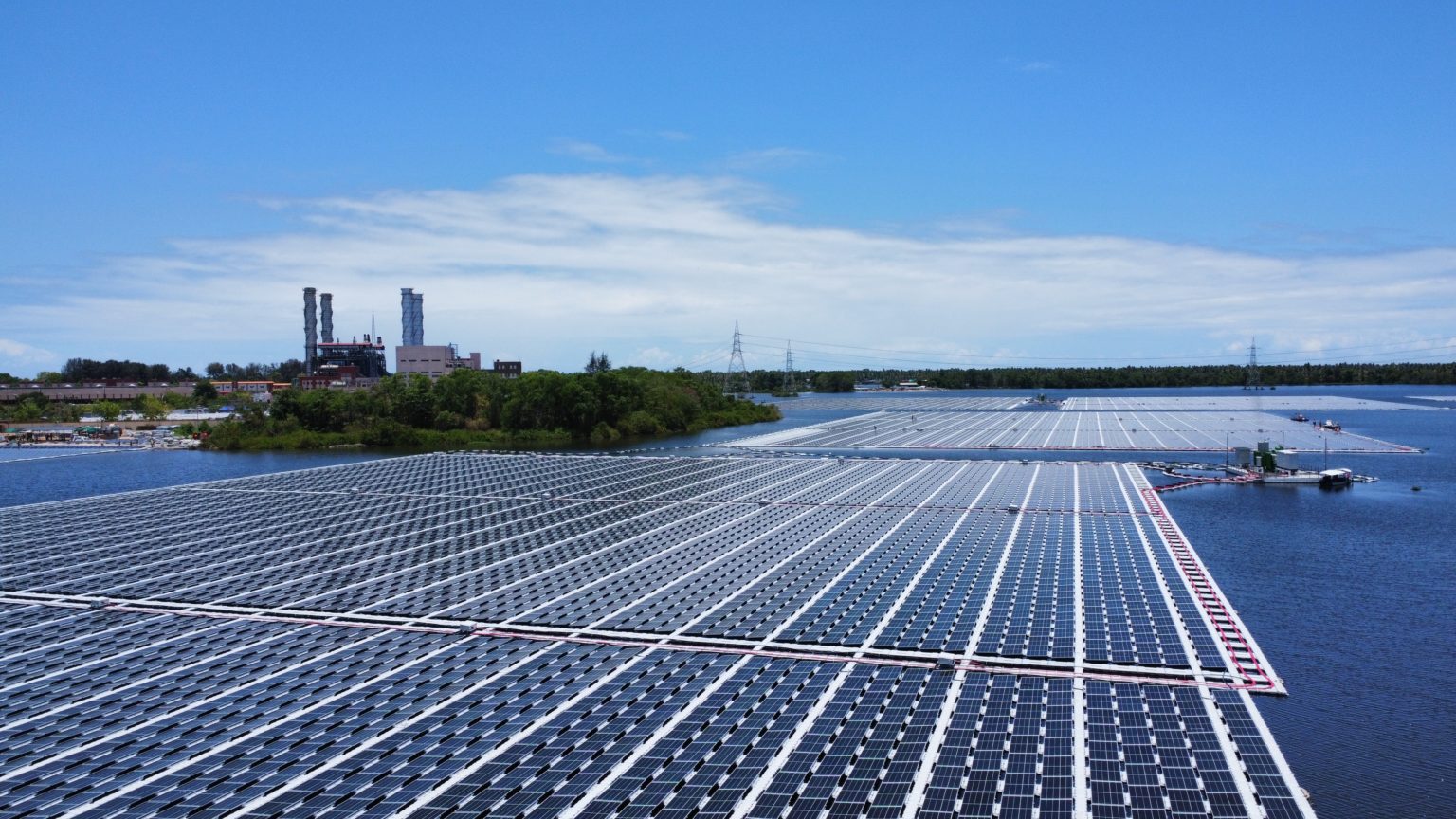
The Minister for New & Renewable Energy Pralhad Joshi on Wednesday said that India’s has a potential for more than 100 GW of floating solar power projects, which not only suitable for densely populated countries such as India, but also helps in conserving water.Releasing a report on floating solar photovoltaics (FSPV) potential in India by the state-run National Institute of Solar Energy (NISE) on Wednesday, the Minister said that reservoirs and other water bodies are emerging as important assets for clean energy generation through floating solar projects.The NISE study estimates India’s total floating solar potential at around 102.18 GW, with a constraint of using only 20 per cent of the reservoir area.FSPV involves setting up solar PV systems over water bodies and ponds. Last year, The Energy and Resources Institute (TERI) in a report estimated that India has 100 GW potential for FSPVs.The NISE report points out that the potential is unevenly distributed across States, with particularly high concentrations in Maharashtra, Madhya Pradesh, Karnataka, Odisha, Telangana and Gujarat, reflecting the availability of large, technically suitable reservoirs and inland water bodies.Smaller and shallow water bodies have been deliberately excluded to avoid overestimation and to align the results with practical deployment considerations.Overall, the findings highlight floating solar as a significant and scalable complement to ground-mounted PV in India’s renewable energy portfolio.By optimising the use of underutilised water surfaces, floating solar can help overcome land constraints, enhance energy security, support water conservation objectives, and accelerate progress toward national renewable energy and climate targets.“A significant technical benefit of FSPV lies in its higher energy yield compared to ground-mounted systems. Solar panels mounted over water operate at lower temperatures due to the cooling effects of wind and water, which improves photovoltaic efficiency,” NISE report noted.Besides, FSPV also contributes to water conservation by shading water bodies, thereby reducing evaporation by 30–60 per cent. Large scale projects demonstrate the impact of saving nearly 19.5 million cubic meters of water per year.“From an environmental perspective, FSPV can reduce algae growth and improve water quality, though shading may affect aquatic ecosystems by limiting photosynthesis. The long-term impact on fisheries, biodiversity and water chemistry warrants careful study and ongoing monitoring,” the report highlighted.Economically, FSPV systems are currently approximately 25 per cent more expensive upfront than land-based solar due to floating structures, anchoring, and waterproofing. However, higher efficiency, land savings, water conservation, reduced transmission costs, and hybrid integration improve long-term financial viability, it added.Published on June 10, 2026