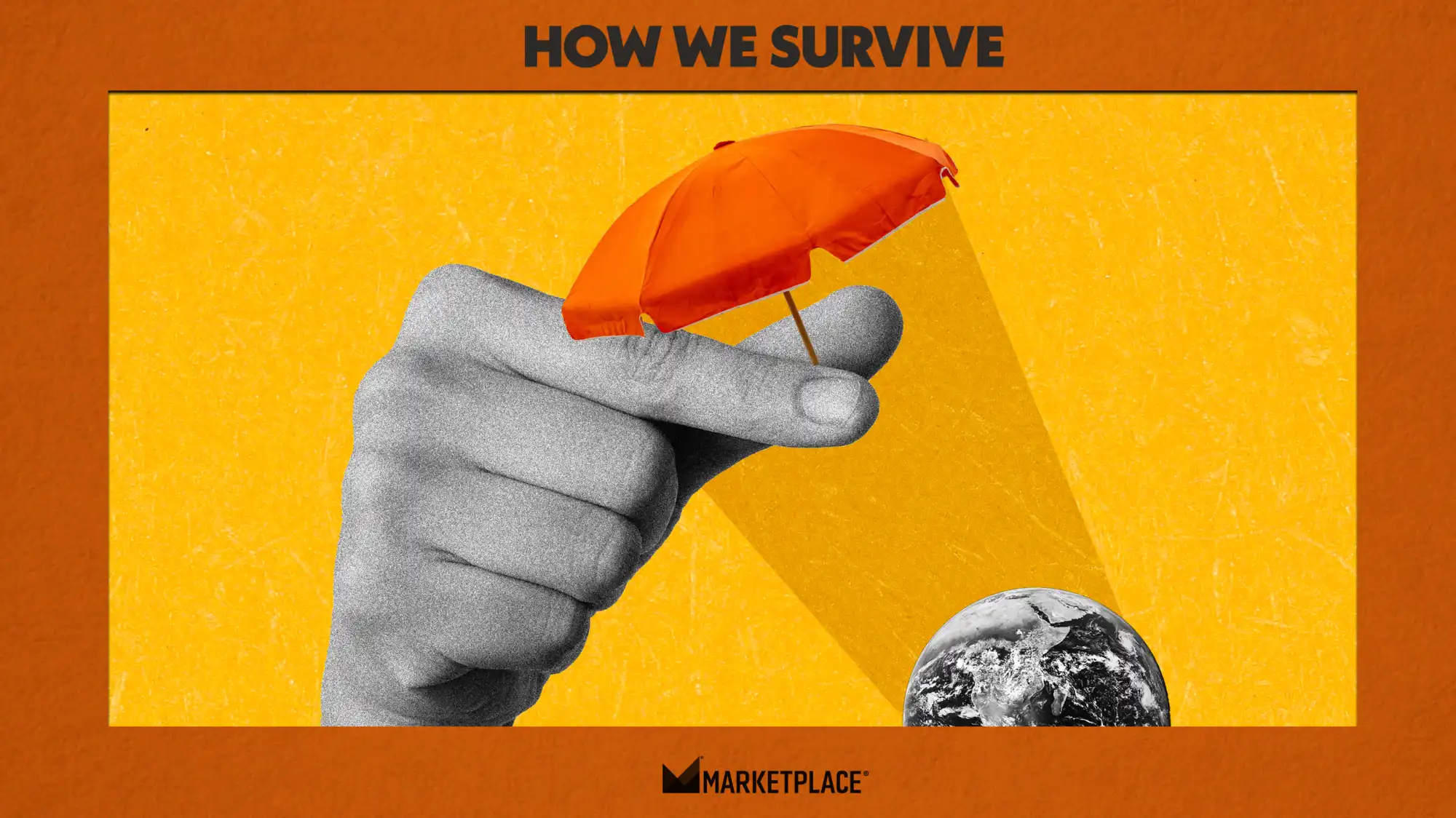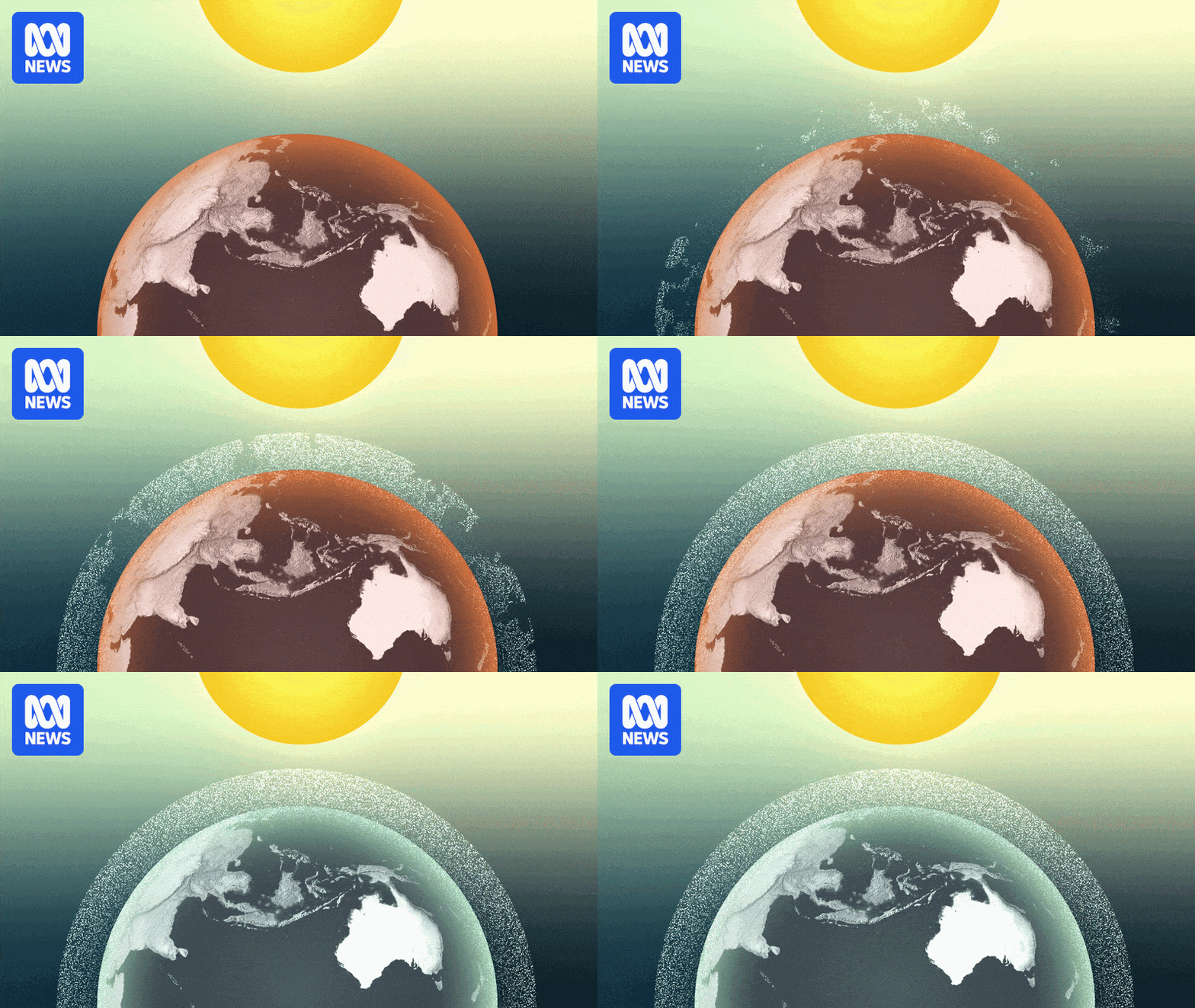
This story originally aired May 27, 2026 on the Marketplace podcast “How We Survive.”On an unseasonably hot March day in Venice Beach, California, beachgoers sought refuge from the sun under bright umbrellas.Morgan Goodwin, executive director of the Planetary Sunshade Institute, thinks that maybe we could cool the earth the same way.“If we're too hot out here and we want a little bit less sunlight, we can put up the shade, block some of the sun and cool us off,” he said. “Obviously, the technology would be different in space, but the concept is exactly the same.”Goodwin’s organization brings together climate scientists, aerospace engineers, and governance experts to study how we could cool earth by reflecting sunlight from space using a planetary sunshade. The sunshade could be one object or a group of objects, and it could take different forms — like space mirrors or space bubbles, or a constellation of solar sails or parasols — but would work essentially the same way as an umbrella by creating shade on earth.The idea still hasn’t gained much traction. And, just like stratospheric aerosol injection, another form of solar geoengineering, it is difficult to imagine that there could be global consensus on a project like this.If this sounds like the stuff of science fiction, it’s a genre that has wrestled with the potential global consequences of solar geoengineering. As the climate crisis intensifies, world leaders will face increased pressure to act, said Neal Stephenson, an author who has written about solar geoengineering. A mass wet bulb event, for example, in which the combination of high temperatures and humidity made it impossible for humans to survive outside, could force world leaders to make difficult decisions.“There's going to be intense political pressure on the governments of those countries to do something about it in the form of geoengineering,” Stephenson said. “People are going to say, … ’It's not that expensive to implement one of these programs. Why are we just sitting on our hands and letting hundreds of thousands, or millions of people die when it's preventable?’”Stephenson is a prolific and prescient writer, known for envisioning technologies like cryptocurrency and generative AI before they arrive. In his book “Termination Shock,” a rogue billionaire decides to deploy solar geoengineering, and world governments must navigate the consequences.Many people interviewed by “How We Survive” who are involved in the world of geoengineering, like Goodwin, have read Stephenson’s book.“The ideas in the book in “Termination Shock” are not fundamentally new ideas,” Stephenson said. “If there's a kind of new wrinkle or take on it in the book, it’s the idea of someone going out and just doing it on their own as a kind of private initiative without waiting for the say-so, or the approval, of any kind of governmental apparatus.”It’s a persuasive idea: Make Sunsets, the startup releasing balloons full of sulfur into the stratosphere, has cited Stephenson as their inspiration.In this episode of “How We Survive,” Amy travels to Los Angeles to learn about the sci fi-sounding solution that, if used in tandem with stratospheric aerosol injection, could mitigate some of the biggest risks of solar geoengineering, and speaks with Neal Stephenson about how he sees science fiction bleeding into our reality.
A climate change solution from science fiction
Amy Scott, host of the podcast "How We Survive," reports on a California non-profit that wants to deploy umbrella-like shades into space to reflect sunlight to cool the earth.
535 words~2 min read