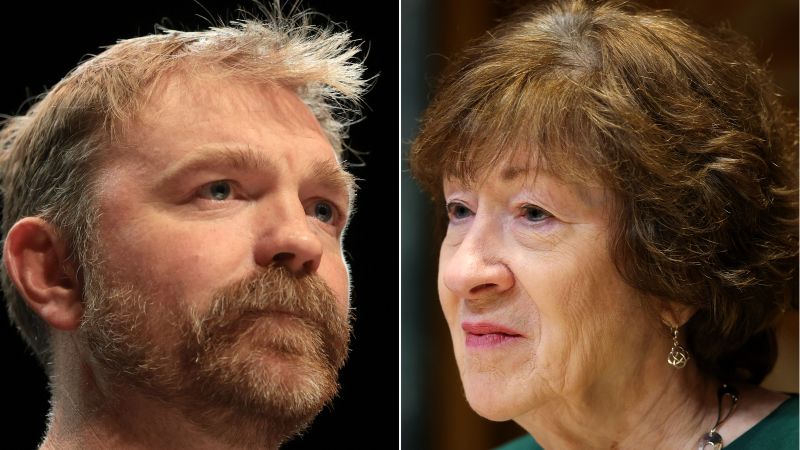
Graham Platner, who has advocated for government-funded healthcare, free education and a wealth tax, has won the Maine Democratic primary for the United States Senate. He will take on Republican Senator Susan Collins in a high-stakes race in November.Platner, a veteran turned oyster farmer initially backed by the progressive Democrats, was accepted by the establishment Democrats after his rival, Maine Governor Janet Mills, dropped out in April amid dismal ratings.Primary results for Nevada, South Carolina and North Dakota were also announced on Tuesday.Here is more on the latest resultsWhat are the key takeaways from the recent primaries?Platner won in MaineDemocrats have high hopes of capturing a US Senate seat from Republicans in Maine, where five-term Senator Collins is running for re-election at a time when voters are soured by high consumer prices and the US-Israeli war on Iran.Platner built momentum with a “man of the people” pitch that resonated with moderates and progressives, drew substantial campaign funding and put him so far ahead that Democratic Governor Mills suspended her own Senate bid in April.Although she remained on the ballot, Platner was leading her by about 72 percent to roughly 20 percent, and another Democrat, David Costello, trailed in single digits with 42 percent of precincts reporting.“In November, Maine voters will elect Graham Platner, and we will win a Senate majority,” Senate Democratic Leader Chuck Schumer said in a joint statement with Senator Kirsten Gillibrand, who chairs the Democratic Senatorial Campaign Committee. Schumer had initially backed Mills.Platner’s mother took the stage before he spoke. She declared: “I am very, very proud of my son. I’m proud of who he is.”Trump’s endorsements yield limited victory in South CarolinaDuring the South Carolina race, US President Donald Trump appears to have ended the political career of South Carolina’s Representative Nancy Mace, who helped release the Jeffrey Epstein files, straining her ties with the US president.She failed to advance to the June 23 gubernatorial run-off as Trump-backed South Carolina Lieutenant Governor Pamela Evette, who ran on an “America First” platform, will face second-place finisher Attorney General Alan Wilson.Already in this year’s primary elections, Trump-backed candidates have defeated Republican Senators Bill Cassidy of Louisiana, John Cornyn of Texas and Representative Thomas Massie of Kentucky.Massie has opposed parts of the president’s agenda, including military action against Iran, and sponsored a bill that resulted in the release of files linked to convicted paedophile Epstein.Evette is expected to also win the November general election, as it has been nearly three decades since a Democrat has been elected governor in this Republican-leaning state.However, Trump’s endorsement for Evette yielded a limited victory as she was unable to secure a majority of the vote in the five-candidate field needed to avoid a run-off. She won 28.9 percent of the vote against Alan Wilson’s 26.2 percent. The two will have a run-off on June 23.Trump also endorsed four-term Senator Lindsey Graham in South Carolina for the US Senate primary. Graham faced several primary challengers, including from hard-right Greenville-area businessman Mark Lynch, whom Trump called a “lunatic”. Graham will avoid a run-off, as he captured nearly 58 percent of the vote with 90 percent of votes counted.Longtime South Carolina Representative James Clyburn, who holds significant national political clout as the state’s lone Democratic House member, easily fended off a little-known primary challenger on Tuesday.Just weeks ago, it was unclear if Clyburn would make it to an 18th term in office. Republican lawmakers, backed by Trump, considered a congressional map that would have significantly altered Clyburn’s majority-Black district and made it harder for him to hold onto the seat. But the Republican-led state Senate rejected the effort, leaving his district largely intact.Two Republicans are still competing for the chance to face Clyburn in November, but he is expected to be the overwhelming favourite in the general election. A win would likely ensure he plays a significant role in the lead-up to the 2028 presidential race.Trump-backed Republican won in NevadaMarty O’Donnell, backed by Trump, won the Republican primary for Nevada’s 3rd Congressional District with 42.4 percent of the vote share. The 3rd Congressional District is a Las Vegas-area battleground that could help decide control of the US House of Representatives in November, US media projected.The seat, held by Democrat Susie Lee, is among a handful across the country expected to be decisive in determining the balance of power in Congress, with Republicans currently holding a narrow House majority.The Republican primary featured a competitive, largely self-funded field, including Trump-endorsed video game composer O’Donnell, neurosurgeon Aury Nagy and former US ambassador to Iceland Jeff Gunter. A fourth candidate is businesswoman Tera Anderson.The Republican nominee will now challenge Lee or her Democratic rival in a race expected to draw national attention and significant campaign spending ahead of November’s elections.Who is Graham Platner and what are his positions on key issues?Platner, 41, who focused on issues facing people, ran a grassroots campaign attracting voters.His campaign prioritised the rising cost of living, housing affordability and healthcare, and secured early endorsements from progressive figures, including Senator Bernie Sanders.But Governor Mills, who withdrew from the race citing fundraising difficulties, has yet to endorse him.
Who is Graham Platner, the Democratic primary winner who slammed Gaza war?
Platner wins in Maine, Republican Nancy Mace loses in S Carolina. Results for Nevada and North Carolina also announced.
1,247 words~6 min read