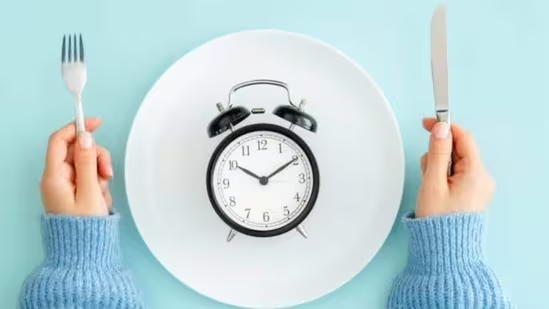
ByDR. MAYA ROSMANJUNE 10, 2026 12:00How many times have you heard the phrase "You must not eat at night"? And how many times has it happened that you ate a proper dinner, felt completely full, and then at 10:00 PM found yourself standing in front of the refrigerator again?For many people, this is a frustrating moment. On the one hand, they feel they have already "finished eating for the day." On the other hand, the body, the mind, or habit craves something else. Sometimes it is real hunger, sometimes it is fatigue, sometimes it is the relaxation hour in front of the television, and sometimes it is simply a dinner that arrived too early relative to bedtime. In my opinion, you do not have to fight this by force.Not every evening eating habit is a problem, and not every late-night toast is a "diet breaker." The more important question is what you eat, how much you eat, and especially whether it is planned in advance or happens by chance, out of fatigue and accumulated hunger.One of my simplest and most effective methods in the courses I teach is splitting dinner. In other words, not adding another meal on top of what we have already eaten, but rather dividing the same ingredients over the course of several hours.Not just what to eat, but also when to eat (credit: SHUTTERSTOCK)Nighttime hunger is not always a weaknessIt is important to start from this point, because many people interpret evening hunger as a lack of control.In practice, the body does not work according to phrases like "After eight in the evening you must not eat." If we ate dinner at 6:30 PM, went to sleep only at midnight, and during the day ate too little or not enough protein, it makes complete sense that we will feel the need to eat again. In addition, the evening hours are times when people are less busy, more relaxed, and sometimes more attentive to bodily sensations. Therefore, the hunger is felt more intensely.But, despite all this – It is forbidden to ignore the health effect – There are also studies showing that very late eating, especially when it is large, unplanned, and rich in calories, may be linked to weight gain and undesirable changes in metabolism.A review published in Nutrients examined in depth the connection between meal timing and weight gain and obesity, and showed, That the hour of eating has significance, especially when a large portion of the daily calories is postponed to late hours.In other words, the problem is not the mere fact that one eats something in the evening, but rather the general pattern: Late, large, unplanned, and often also high-sugar and high-fat eating.What do I mean by splitting dinner?Splitting a meal is a very simple idea: Instead of eating the entire dinner all at once, you divide it into two or three parts. The goal is to extend the feeling of satiety, reduce the desire for random snacking, and also allow for "a little something at night" without exceeding the caloric framework.For example, in the first stage, you eat the protein and vegetables of the dinner: An omelet, white cheese, tuna, lean pastrami, or a protein-rich yogurt, along with a large salad, cut vegetables, a little avocado, or tahini.At this stage, you can skip the bread or carbohydrate, not because a carbohydrate is forbidden, but because you are saving it for the next stage.About two hours later comes the second stage: The carbohydrate of that same meal. This could be two slices of light bread with cheese, half a light pita with a spread, a small toast, or rice cakes with cottage cheese and vegetables. This is not an addition beyond the menu, but rather a transfer of a part of dinner to an hour when we would usually look for something to eat anyway.In the third stage, if there is still a need or if it is part of the daily planning, you can leave room for a small night snack.For instance, another toast made of light bread, half a light pita with light yellow cheese, yogurt, or even dark chocolate in a defined amount. The difference is that here it is not a case of "I fell for something," but a structured part of the day.Combine protein with carbohydrate, and do not eat carbohydrate alone (credit: SHUTTERSTOCK)Why does it work better than a total ban?I assume most of us have already experienced this personally: Total bans work excellently in theory, but less well in real life. Those who say to themselves "I must not eat at night" may hold out for a few days, and then arrive at an evening tired or stressed and open the refrigerator without a plan.In contrast, when there is a planned stage of evening eating in advance, the sense of control actually increases. There is less of a sense of deprivation, less "I ruined everything," and more of a routine that can be maintained.The great advantage of my method, in my opinion, is psychological and also physiological. From a psychological standpoint, there is a sense of abundance: You feel that "I ate dinner," and there is something small afterward, and if necessary, also a defined snack. From a physiological standpoint. The meal does not disappear all at once, but rather spreads out over several hours, which helps some people feel a more stable satiety.Combine protein with carbohydrate, and do not eat carbohydrate aloneOne of the important principles in splitting the meal is not to leave the carbohydrate alone. Bread, pita, crackers, or rice cakes can fit wonderfully into the menu, but it is desirable to eat them together with protein, fat, or fiber. For example, bread with cheese, egg, tuna, avocado, or tahini, and not just bread with jam or a large sweet snack.The reason for this is that combining protein, fat, and fiber with a carbohydrate can moderate the rise in blood sugar levels after the meal.Many studies over the past decades have shown that when protein, fat, and fiber are also added to the carbohydrate part of the meal, a more moderate glycemic response is obtained compared to eating a simpler carbohydrate. The practical meaning is that a mixed meal can contribute to more stable satiety and fewer sharp fluctuations in the sensation of hunger.A study published in The Journal of Nutrition in 2024 also examined the effect of adding protein to a meal containing a carbohydrate, and found that in people without diabetes, the addition of protein from various sources can reduce the post-meal sugar response, although the effect varies among individuals and also depends on the health status and the type of protein.Therefore, even those who have a tendency toward diabetes or borderline sugar values can in many cases benefit from this principle, of course in accordance with the personal guidelines they received. The idea is not to eat more carbohydrates at night, but rather to eat them in a smarter way, with a correct combination, and in a pre-known quantity.The late eating and weight gain mythHere it is important to be precise. Eating at night is not fattening due to the hour alone. What is fattening is a caloric surplus over time.But in practice, for many people, unplanned nighttime eating is exactly where unnecessary calories enter: Another slice, another cookie, another handful of nuts, another small thing while standing in the kitchen. Each of them looks small, but together they accumulate.A study published in Cell Metabolism found that later eating affected mechanisms related to hunger, energy expenditure, and adipose tissue.This does not mean that it is forbidden to eat at night, but it does reinforce the understanding that it is advisable to avoid large and heavy meals very close to sleep, and certainly from an unplanned snack that repeats itself every evening.Practical recommendations for summaryOne option is to eat an omelet or cheese with a large salad, vegetables, and a teaspoon of tahini or a little avocado at 7:00 PM. At 9:00 PM, eat two slices of light bread with cheese and cut vegetables.If room is left in the menu, at 10:30 PM you can eat a small toast or yogurt, or choose in advance dark chocolate squares in an amount that fits the daily framework.Those who love sweets can combine yogurt with a small fruit, or leave a defined sweet snack for the end of the day.The key is not to open up all options every evening, but rather to decide in advance what enters the framework and what does not. This is not a dramatic method, but it is very practical.Ultimately, in daily nutrition, it is precisely the practical things that work over time.Follow us on Google
This is the method to prevent snacking after dinner | The Jerusalem Post
Do you also eat dinner and feel hungry again before bed? Dr. Maya Rosman has a method that will help you avoid unnecessary snacking.
1,448 words~7 min read