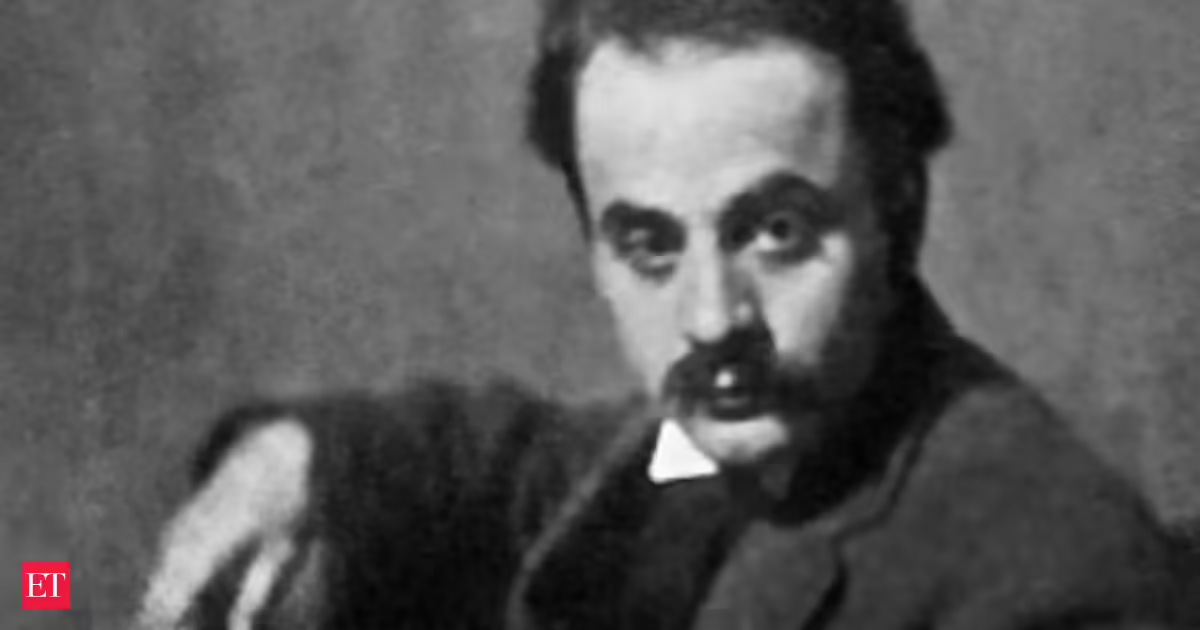
It will be fatuous to limit Christopher Nolan's Interstellar only for its breathtaking visuals, black holes, and mind-bending theories about space and time. With the science-fiction spectacle lies a deeply human story, that of a father trying to protect his children while accepting that he cannot always be there to shape their future. As Cooper embarks on a mission that could save humanity, he is forced to leave behind the people he loves most, trusting that they will one day find their own path without him.And among the Earthly pleasures tied to the sentiment, few relationships in life are as joyful and as difficult as the one between parents and their children. Every mother and father wants to protect, guide, and prepare their child for the future. Yet there comes a moment that almost every parent struggles with: How do you hold on to someone you are ultimately meant to let go? Before cinema explored this timeless question, Lebanese-American poet and philosopher Kahlil Gibran offered a poem with a profound reflection on the delicate balance between nurturing a child and giving them the freedom to become who they are meant to be.Quote of the Day by Kahlil Gibran: “Your children are not your children.They are sons and daughters of Life's longing for itself.They come through you but not from you.And though they are with you yet they belong not to you.”Also Read: Quote of the Day by Takeo Doi, the Japanese psychoanalyst behind ‘Amae’: ‘Every language is a vast pattern-system, different from…’ - how The Anatomy of Dependence author explained the hidden link between language and consciousnessIt continues like, “You may give them your love but not your thoughts,For they have their own thoughts.You may house their bodies but not their souls,For their souls dwell in the house of tomorrow, which you cannot visit, not even in your dreams.You may strive to be like them, but seek not to make them like you.For life goes not backward nor tarries with yesterday.You are the bows from which your children as living arrows are sent forth.The archer sees the mark upon the path of the infinite, and He bends you with His might that His arrows may go swift and far.Let your bending in the archer's hand be for gladness.For even as He loves the arrow that flies, so He also loves the bow that is stable.”Why Kahlil Gibran’s quote on parenting and unconditional love matters todayKahlil Gibran's words have remained relevant for generations because they challenge one of the oldest assumptions about family, that parents own or control the lives of their children. Instead, Gibran presents parenthood as an act of guidance rather than possession.In a time when many families navigate academic pressure, career expectations, social media influence, and changing values, the quote serves as a reminder that children are individuals with their own identities, dreams, and destinies. It encourages parents to offer support and wisdom without trying to shape every aspect of a child's future.What Kahlil Gibran’s quote means in real lifeAt its core, the quote suggests that love should not be confused with control. Parents can provide care, education, and emotional security, but they cannot, and should not, dictate every thought or decision their children make. Every generation grows up in a different world, facing new opportunities and challenges that their parents may never fully understand.The famous metaphor of the "bow and arrow" captures this idea beautifully. Gibran imagines parents as the bow that gives strength and direction, while children are the arrows that travel into the future. A good parent helps a child launch with confidence but accepts that the journey ahead belongs to the child. In everyday life, this can mean supporting a son's career choice that differs from family tradition or respecting a daughter's unique beliefs and ambitions rather than expecting her to mirror those of her parents.Kahlil Gibran’s quotesKahlil Gibran's writings often explored love, freedom, longing, spirituality, and the human condition. Some of his most widely remembered quotes include:“Out of suffering have emerged the strongest souls; the most massive characters are seared with scars.”“Beauty is not in the face; beauty is a light in the heart.”“You give but little when you give of your possessions.It is when you give of yourself that you truly give.” “I have learned silence from the talkative, toleration from the intolerant, and kindness from the unkind; yet strange, I am ungrateful to these teachers.” “Work is love made visible.”“We are all like the bright moon, we still have our darker side.” Who was Kahlil Gibran?Kahlil Gibran, known in Arabic as Gibran Khalil Gibran, was born on January 6, 1883, in Bsharri, Lebanon, then part of the Ottoman Empire. The youngest son of Khalil Sa'd Jubran and Kamila Jubran, he experienced hardship from an early age. His father, a tax collector, was imprisoned for embezzlement, and in 1885 his mother emigrated with her children to the United States, settling in the thriving Syrian and Lebanese immigrant community in Boston, Massachusetts.In Boston, Gibran learned English and began studying art while his mother worked as a seamstress and linen peddler to support the family. At the age of 15, he returned to Beirut to attend a Maronite school before coming back to Boston in 1902. Around this time, he suffered devastating personal losses, with his sister Sultana, half-brother Bhutros, and mother all dying within a short period. His surviving sister, Marianna, worked as a dressmaker to support both herself and Gibran as he pursued his artistic and literary ambitions.Gibran's career took shape after he began publishing articles in an Arabic-language newspaper and held his first public exhibition of drawings in 1904. His artwork attracted the attention of educator and patron Mary Haskell, who funded his studies at the Académie Julian in Paris in 1908. There, he met the renowned sculptor Auguste Rodin, who reportedly described him as “the William Blake of the twentieth century.”In 1911, Gibran moved to New York City's Greenwich Village, where he became part of a vibrant literary and artistic community. His 1918 collection The Madman introduced English-language readers to his unique blend of poetry, parables, and spiritual reflection. But it was 1923's The Prophet that transformed him into one of the world's most beloved writers. Although it was not an immediate commercial success, the book eventually sold more than ten million copies and became one of the best-selling works of poetry ever published.Kahlil Gibran’s legacyKahlil Gibran's influence extends far beyond literature. As a member of the New York-based Arab American literary group known as the Pen League and part of the Mahjar movement, he helped bridge Eastern and Western traditions through his writing. Across nine books in Arabic and eight in English, he explored universal themes such as love, longing, grief, faith, freedom, and the search for meaning.Arguably his most famous work, The Prophet, found a particularly devoted audience during the 1960s, when many readers sought a more personal and less dogmatic approach to spirituality. Rather than offering strict rules, Gibran encouraged compassion, self-reflection, and non-judgment, making his ideas accessible across cultures and religions.Gibran died of cirrhosis of the liver on April 10, 1931, in New York City, but nearly a century later, his message still resonates: the greatest acts of love often come not from holding on, but from helping others fly.
Quote of the Day by Kahlil Gibran: ‘Your children are not your children; they are sons and daughters of…’ - The Prophet author’s iconic passage on why every parents must learn to let go
Quote of the Day by Kahlil Gibran's poem offers wisdom on parenting. It states children are not possessions but life's own. Parents guide, not control. This message resonates today, encouraging support for individual dreams. Gibran's legacy lives on, emphasizing love through enabling others to fly.
1,214 words~6 min read