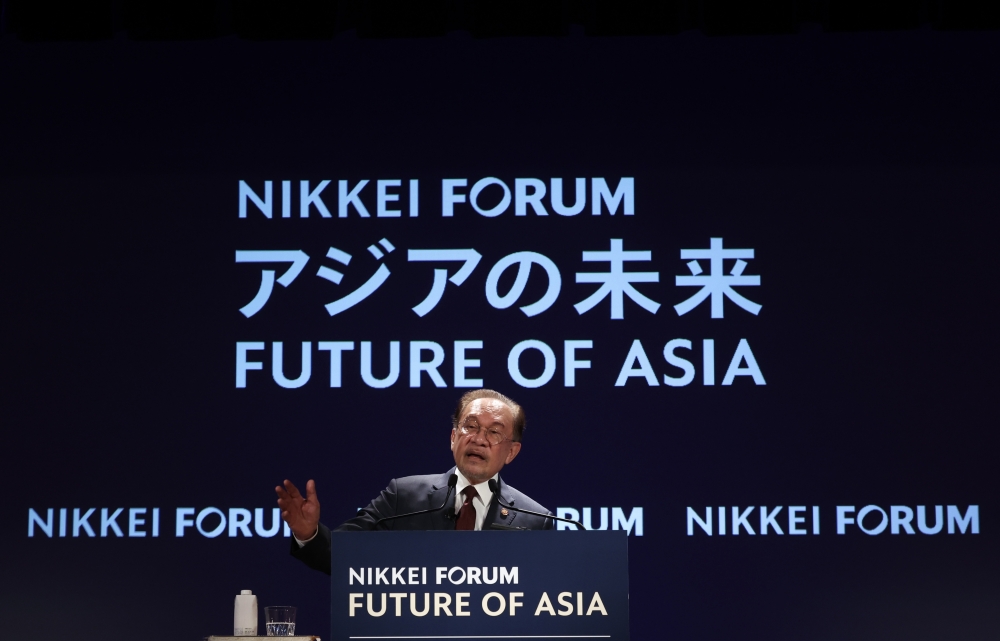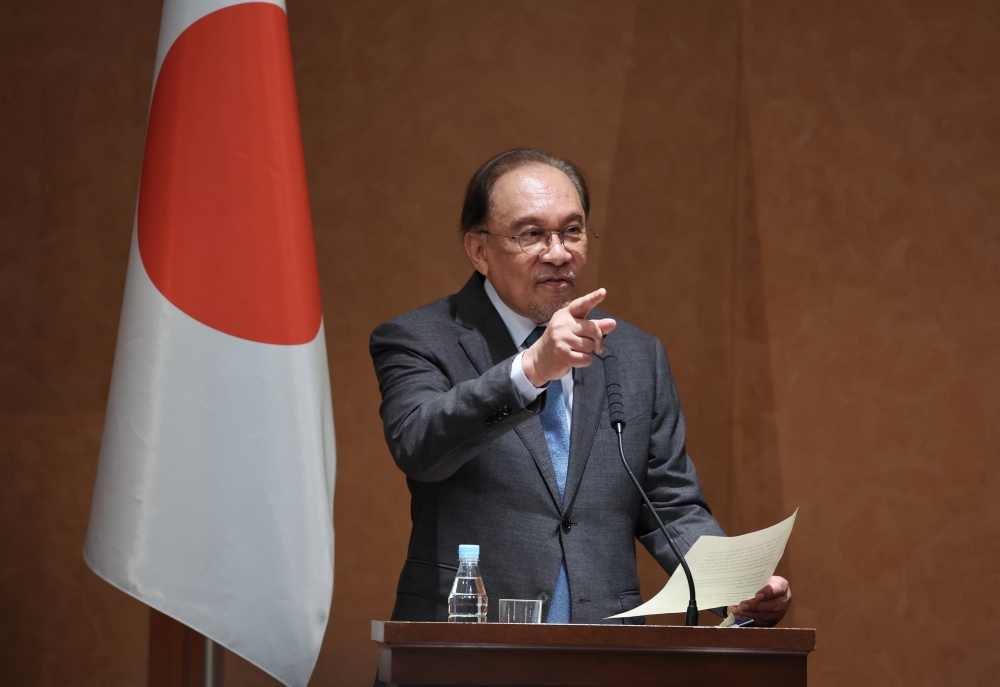
Prime Minister Datuk Seri Anwar Ibrahim says the world is facing a leadership clarity crisis rather than a lack of power. — Bernama pic (New users only) It's tax relief season! Get up to RM300 when you save with Versa! Plus, enjoy an additional FREE RM10 when you sign up using code VERSAMM10 with a min. cash-in of RM100 today. T&Cs apply. Wednesday, 10 Jun 2026 10:57 AM MYT KUALA LUMPUR, June 10 — Sovereign countries should not be timid in defending free trade and opposing punitive tariffs or discriminatory policies, said Prime Minister Datuk Seri Anwar Ibrahim.Anwar said as a sovereign interdependent country, Malaysia took its position on tariffs very clearly, and has been appealing to countries to be more affirmative and more pronounced in their views on free trade and multilateralism.“Do we agree that there should be punitive tariffs or discriminatory policies? (No,) we don’t. Do we support free trade? (If yes), then say it as a policy.“Of course, you know the limits, but you (still) have to say it. Otherwise, you are not contributing to this new thinking,” he said during a question-and-answer session following his keynote address at the Nikkei Forum in Tokyo, Japan today.The session was broadcast live on television and social media.Anwar was asked how Asean could effectively address protectionist policies by major powers and internal differences among member states, including whether engagement with groups such as Brics — comprising Brazil, Russia, India, China, and South Africa — form part of a broader strategic diversification.Anwar said it is of critical importance for Asean to continue engaging vibrantly and aggressively with all countries while maintaining its centrality and independent stance.In Malaysia, he said the country enjoys excellent relations with the United States, its largest trading and investment partner. However, Malaysia disagrees with the unilateral imposition of tariffs.“Did I say it to President Donald Trump? Of course, although very politely during the (Asean Summit) meeting I hosted. We expect the same from other countries, so that we can build consensus.“Of course, countries will have their own priorities, but it is not a zero-sum game,” he said, adding that it is not true that he is tilting towards any particular country, as perceived by some in the media.Anwar emphasised that Malaysia’s participation in Brics does not mean abandoning its strong trade and investment ties with the US.Malaysia will continue to deepen cooperation with Brics, as well as the Gulf Cooperation Council (GCC), which he described as a vibrant grouping with significant progress in technology and energy transition. Anwar said the current strategic uncertainty has been building over time rather than emerging overnight, warranting a closer examination of its root causes as many leaders remain bound by an outdated geopolitical mindset.He noted that in this mindset, realpolitik and hegemonic considerations continue to fuel the pursuit of power under the guise of strategic security.Anwar pointed out that the continuing tragedy in Gaza, tensions across West Asia and their compounding global effects, as well as the prolonged war in Ukraine, underscore the fragility of peace and the limits of international consensus.“These are urgent and pressing concerns directly impacting the very fabric of international order. But this is not all,” he said, adding that great-power rivalry in the region, particularly disputes in the South China Sea, threatens maritime stability and keeps Southeast Asia on edge.Anwar also highlighted the multilayered threat posed by North Korea, citing its nuclear programme and significant conventional and cyber warfare capabilities.He said leaders must have the courage to confront injustice and champion a more proactive approach to peace and progress, noting that long before the emergence of modern states, the peoples of the Malay world and the Japanese archipelago had already learned to navigate uncertain waters.“As maritime civilisations, we came to understand a simple truth: prosperity did not come from turning inward, but from engaging the wider world through trade, dialogue and cooperation,” he said.Anwar said middle powers today face steep and cumulative challenges amid an increasingly complex strategic landscape, adding that while not all geopolitical currents can be controlled or disruptions predicted, countries possessing credibility must remain guided by clear principles to navigate the path ahead.“We understand the aspirations of developing nations and the concerns of advanced economies. We are uniquely positioned to build bridges where others see divides, and build consensus where others see discord,” he explained.On Artificial Intelligence (AI), Anwar warned that the future of AI must not be shaped by a handful of technological powers or private corporations alone, cautioning against new forms of “digital colonisation” or technological domination.He said developing countries must have a stronger voice in global rule-making, rejecting what he described as modern forms of technological domination.“The answer lies in collaboration, grounded in cooperation, trust and institutions capable of bringing together diverse interests,” he said. — Bernama
At Nikkei Forum, Anwar calls for leadership with clear sense of direction
KUALA LUMPUR, June 10 — Sovereign countries should not be timid in defending free trade and opposing punitive tariffs or discriminatory policies, said Prime Minister Datuk Seri...
797 words~4 min read