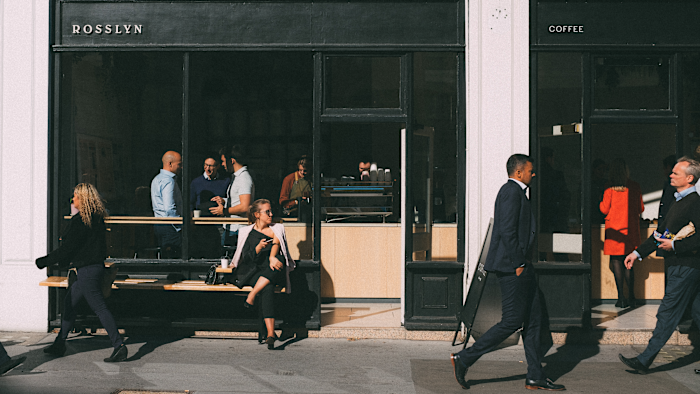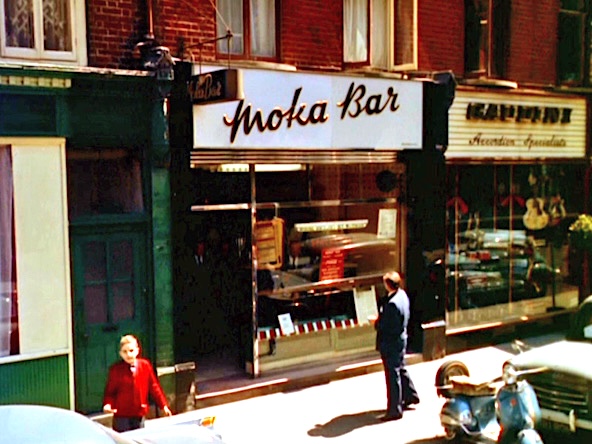
As we’ve noted before, the English coffeehouse has served as a staging ground for radical, sometimes revolutionary social change. Certainly this was the case during the Enlightenment, as it was with the salons in France. And yet, by the early 20th century it seems, coffee shops in London had grown scarcer and more humdrum. That is until 1953 when the Moka Bar, the UK’s first Italian espresso bar, opened in Soho. On his blog The Great Wen, Peter Watts describes its arrival as “a momentous event”:
London’s first proper coffee shop—one equipped with a Gaggia coffee machine—opened at 29 Frith Street. This was a place where teenagers too young for pubs could come and gather, and it is said by some that the introduction of this coffee bar prompted the youth culture explosion that soon changed social life in Britain forever.
“By 1972,” Watts writes, “coffee bars were everywhere and the teenage revolution was firmly established.” Places like the Moka Bar might seem like the ideal place for countercultural maven William S. Burroughs—a London resident from the late sixties to early seventies—to hobnob with young dissidents and outsiders. Burroughs, who so approvingly refers to the possibly apocryphal anarchist pirate colony of Libertatia in his Cities of the Red Night, would, one might think, appreciate the budding anarchism of British youth culture, which would flower into punk soon enough.