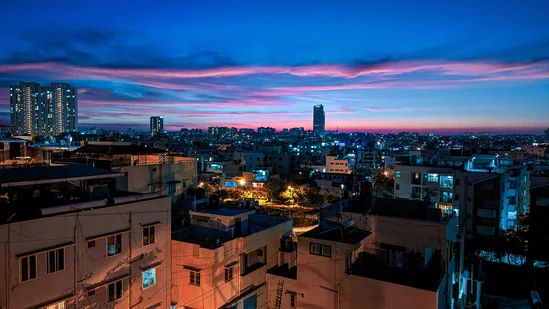
Nordic silence to Bengaluru chaos: Arto Sivonen swapped 'happiest' capital, Helsinki, for India’s tech kaleidoscope. Result? A culture shock that rewired him. In a world increasingly obsessed with linear resumes and structured borders, Arto Sivonen moves like a self-directed piece of kinetic art. The impact strategist and co-founder of Common Ground never went to high school, let alone college. Yet today, he advises global systems on sustainable transformation and lectures at prestigious academic institutions, including Finland’s Aalto University. Also read | Ukrainian woman shares difference between gym culture in India and EuropeArto Sivonen never needed space… until India. Now he’s obsessed with the noise, the warmth, the jugaad. (Pics courtesy: Mikael Niemi and Instagram/ Arto Sivonen)His latest adventure? Swapping Helsinki — consistently crowned the world’s quietest, most structurally predictable, and happiest capital — for the hyper-caffeinated, tech-fueled sensory kaleidoscope of Bengaluru.For Arto, who has lived in countries such as South Korea, Kenya, and South Africa, the move to India wasn't a shock, but an explicit investment in radical growth. "I knew India was one of the places in the world where I would learn the most and the fastest," he reflects in an interview with HT Lifestyle. What resulted is a profound collision of two entirely different worlds, forcing him to re-evaluate his Nordic conditioning against India’s fluid, community-driven landscape.Sensory shift: distant silence to ‘uncles and aunties’To transition from Finland to India is to renegotiate how one occupies time and space. The contrast is not merely geographical; it is philosophical. "Finnish people live at a distance," Arto says. "They don't talk too much, they keep their space, they don't touch each other. I respect that, it's a big thing. In India, there are a lot of uncles and aunties — everything belongs to everyone. It’s extremes," he explains.For a man who has spent his entire adult life bouncing through communal, co-living setups without ever feeling the need to retreat, Bengaluru presented a surprising personal first: the urgent need for a closed door."I think India, I found for the first time in my life, like, actually, I need some space. First time in my life, I started to pay more attention to my home, like, it's a place where I can rest and be quiet, and isolate myself for a while," he admits. "It never happened to me before India. Here it happened, and I feel like I need to do that because of all this noise and people around me," he adds.Yet, it is precisely this lack of boundaries that breeds the social warmth Arto finds glaringly absent in the hyper-independent Nordics. When he returns to Finland, the silence is no longer just peaceful — it can sometimes feel lonely. "Something that I do love in India, which Finland doesn't have, is how people are together, help each other, and how they live. I can always find a way together with others. The social skills are magnificent — in parties, talking to random guys. In Finland, you can avoid people, so you don't need to do that. That’s something I really do miss when I go back to visit Finland," he shares. Also read | ‘Leaving on time is normal’: Indian woman in Australia reveals 6 workplace culture differencesSilicon Valley specs with a tractor on the streetAs a strategist operating at the intersection of human rights, design activism, and climate action, Arto views Bengaluru as a fascinating paradox. It is an online-first metropolis where citizens summon everything via apps with frictionless ease, yet the physical infrastructure operates on a completely different, occasionally fractured timeline."It’s the mix of everything," Arto notes, highlighting the surreal juxtaposition that defines India’s tech capital. "There are tractors (here) almost everywhere in a Finnish city context. Structural things don't work — electricity is down, holes in the street. And then at the same time, it is super high-tech. People order everything online," he adds.This duality extends into the city's corporate boardrooms, where high-stakes digital innovation comfortably coexists with unyielding cultural traditions. Even in the swankiest tech parks, the day does not function without localised anchors: a steel tumbler of frothy filter coffee and a crisp dosa.While he appreciates Mumbai's sprawling, high-end restaurant scene, Arto finds Bengaluru’s culinary soul thrives on the simplicity of its streets: "Southern Indian kitchen is so strong, and there are a lot of tiny little spots around the city, and all of them are really good. The better food is on the streets, actually."However, his eye for authentic design notes a missed opportunity in the local landscape: "Something that Bengaluru is missing in the restaurants is those great traditional spaces. There are a couple of really nice places that look more like modern Indian design —cleaner and nicer. But too often, Bengaluru restaurants start copying ideas from Europe instead of building something new from Bengaluru. Maybe that spot is missing a bit."Ultimate global framework: equity, precision, 'jugaad'When asked to assemble an imaginary, ultimate framework for global problem-solving by extracting a single core cultural trait from the countries he has inhabited or visited, Arto constructs a brilliant cross-continental formula from Finnish values, Japanese execution, and an Indian mindset.He envisions a paradigm in which Finland lays a foundation of structural equity — an approach that fundamentally prioritises human dignity and cuts through rigid social hierarchies. Japan infuses the mix with radical precision, offering an unyielding sense of discipline and mutual accountability for shared public spaces. Finally, India injects the essential spark of 'jugaad' and multi-perspective thinking, a cognitive flexibility and resourcefulness that prevents people from simplifying complex problems too quickly and opens up infinite structural possibilities."Those three sound pretty good," Arto muses, reflecting on how these distinct elements balance each other. "Equity means you are looking at the people — human first — and leaving the structural behind," he adds.Yet, he believes it is India’s inherent capacity to hold multiple truths simultaneously that the rigid west desperately needs to counter its own analytical paralysis. "In India, people see multiple abilities. They are doing things in many ways; they can think about things in many ways. Deep history, spirituality, way of living, diversity — that stuff keeps our minds open for possibilities. That is really India," he says."When I go back to Finland, for example, it's a super simple country. Things are straightforward, clear, and easy to do. But the downside is that people can't see the possibilities. They only have yes-or-no answers — only one right answer. That’s so different," he explains.Shadow side: mirage of 'surface-level' sustainabilityArto’s admiration for India isn't romanticised or blind. Having spent decades confronting unethical models — he walked away from lucrative advertising agency roles in his 30s because 'creative entities do whatever for the money' — he is highly critical of how sustainability is packaged in developing markets compared to Europe.For Arto, the greatest shock in India remains the profound socioeconomic divide. While Finland’s high ranking in the World Happiness Report is powered entirely by its baseline of equality, India operates in deep variance. "The hardest thing from India — and I knew it was going to happen — is a lack of equity," he points out directly."How can you be sustainable if you just need to find your food every day? If you don't find it, this is not what you're thinking. The income gap, the inequality is so huge. You need to find ways for everyone to benefit from a sustainable life," he adds. He also cautions against a growing culture of eco-performative behaviour or 'brainwashing' within corporate and cultural elite circles, where sustainability is treated as an aesthetic badge rather than a systemic rewiring."Sometimes I have seen sustainability used in different events only because it looks cool and nice. Not like people really want to make the change. They use all these recycled plates at our events, and then you have meat on the plates — that doesn't make sense. Or they talk only about some minor climate-related thing because people can't talk about equity, equality, or humans. If the people running those events need to change their own lives, they won't do it. It’s just at the surface level," Arto explains.Disrupting silos from a borderless hubIt is precisely to bridge these gaps that Arto co-founded Common Ground along with his Bengaluru-based partner, Anna Dias. Conceived over a couple of years and officially operationalised over the last five months in Bengaluru, the agency is built as a borderless, lean collective engineered to break down international echoes."Next thing, I'm heading to Helsinki to build the Finland office. Then I'm wishing we could open Nairobi as well," he shares of his expansion blueprint, adding, "It’s basically borderless. For me, it's important to connect people around the world because too often they are just working in their own silos. Europeans are really Eurocentric. Indians too often think only about India because it’s a superpower and they don't need to do anything else. I want to disturb the minds of people; I want to connect them."A massive component of his future vision involves empowering the next generation of creative minds through design activism. Having taught across universities in different countries, he aims to shake design students out of commercial apathy. "I feel I would like to help those young designers take the stage. Once they graduate, the problem is they don't know enough about how they can use their skills for better purposes than only creating logos or another chair we don't need," Arto notes."No one is teaching them about this. I want to change that because I know how much power design holds in this world. We should be using it for better purposes," he concludes.With a keen eye for detail and a heart for storytelling, Sanya is a seasoned lifestyle journalist who has spent over a decade documenting the intersection of aesthetics and substance. Since stepping into the media world in 2012, she has cultivated a career defined by versatility, curiosity, and an unwavering passion for what makes life both beautiful and meaningful.
Finnish founder compares 'opposite' life in Helsinki vs Bengaluru, shares what India has that 'happiest' Finland doesn't
Nordic silence to Bengaluru chaos: Arto Sivonen swapped 'happiest' capital, Helsinki, for India’s tech kaleidoscope. Result? A culture shock that rewired him.
1,861 words~8 min read