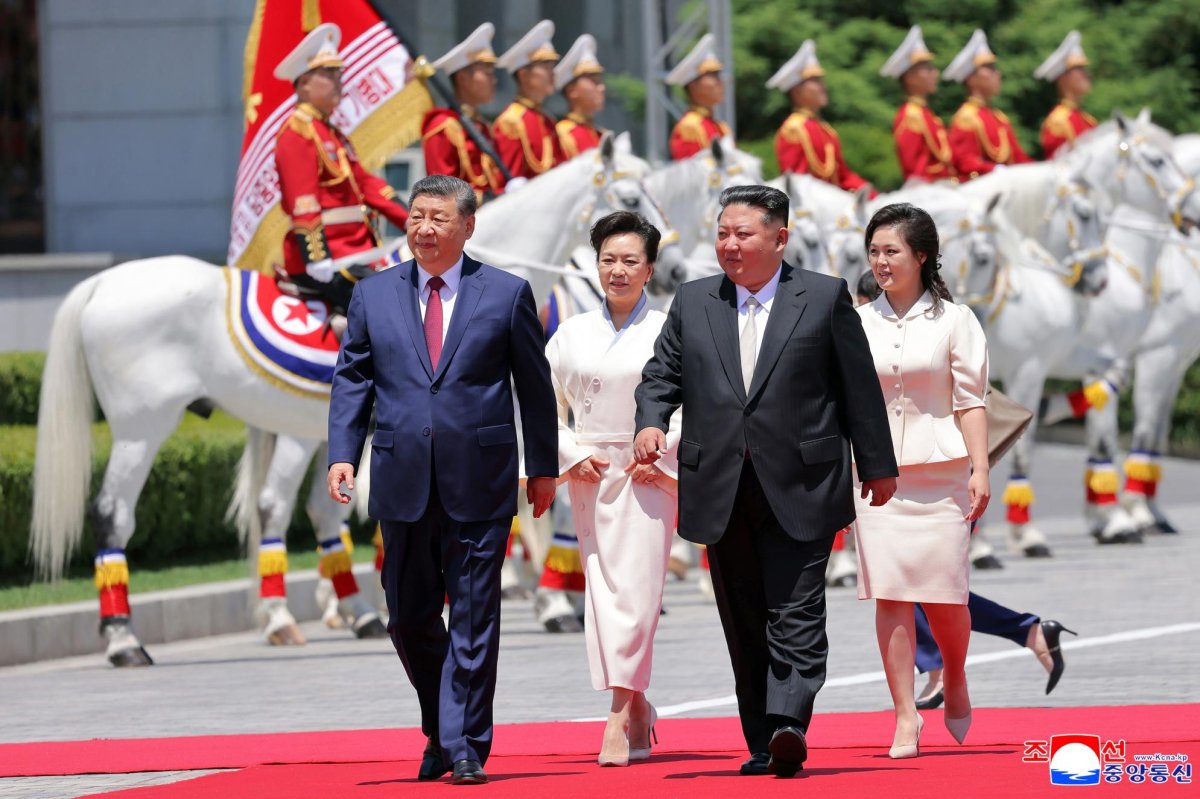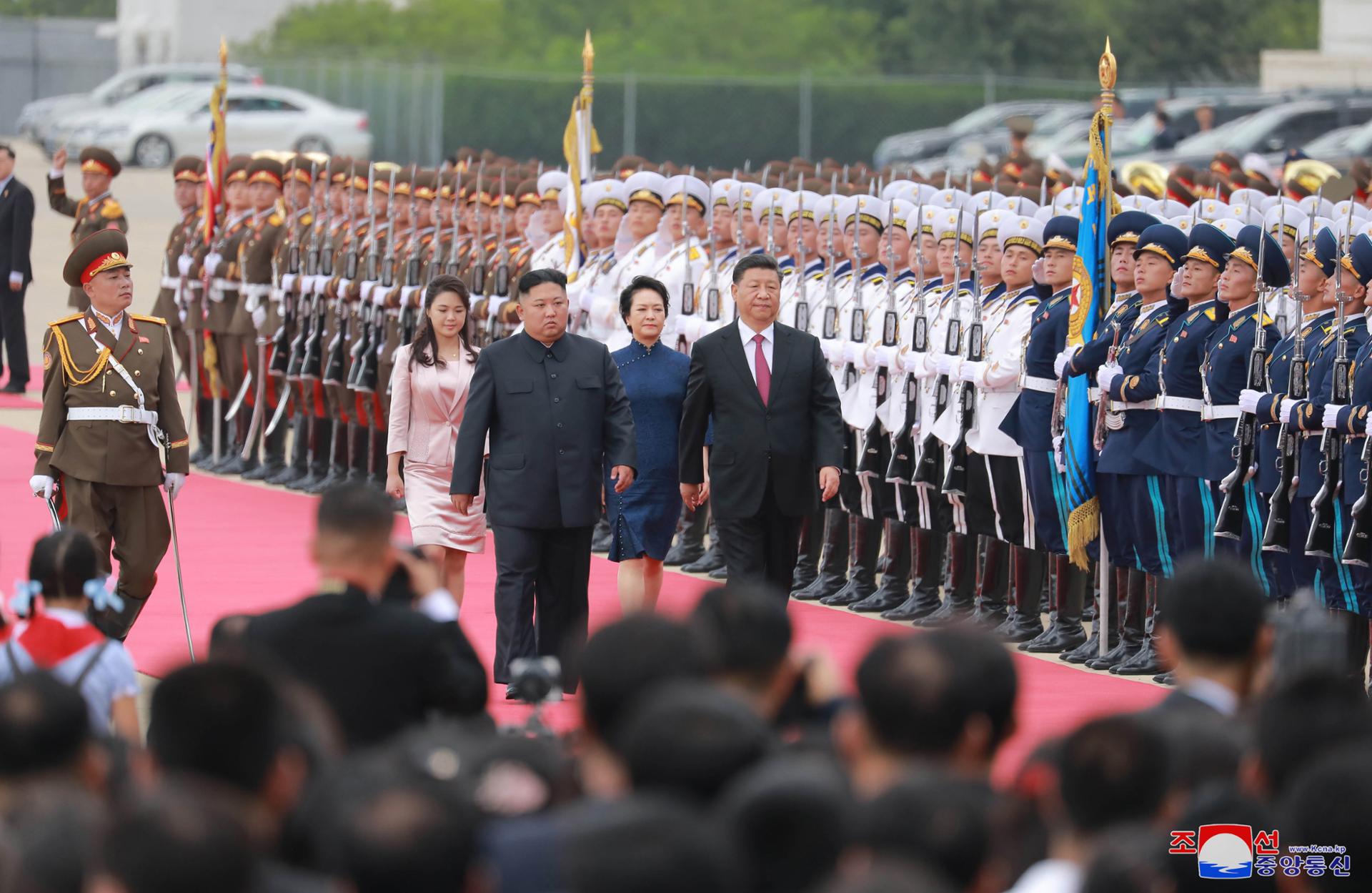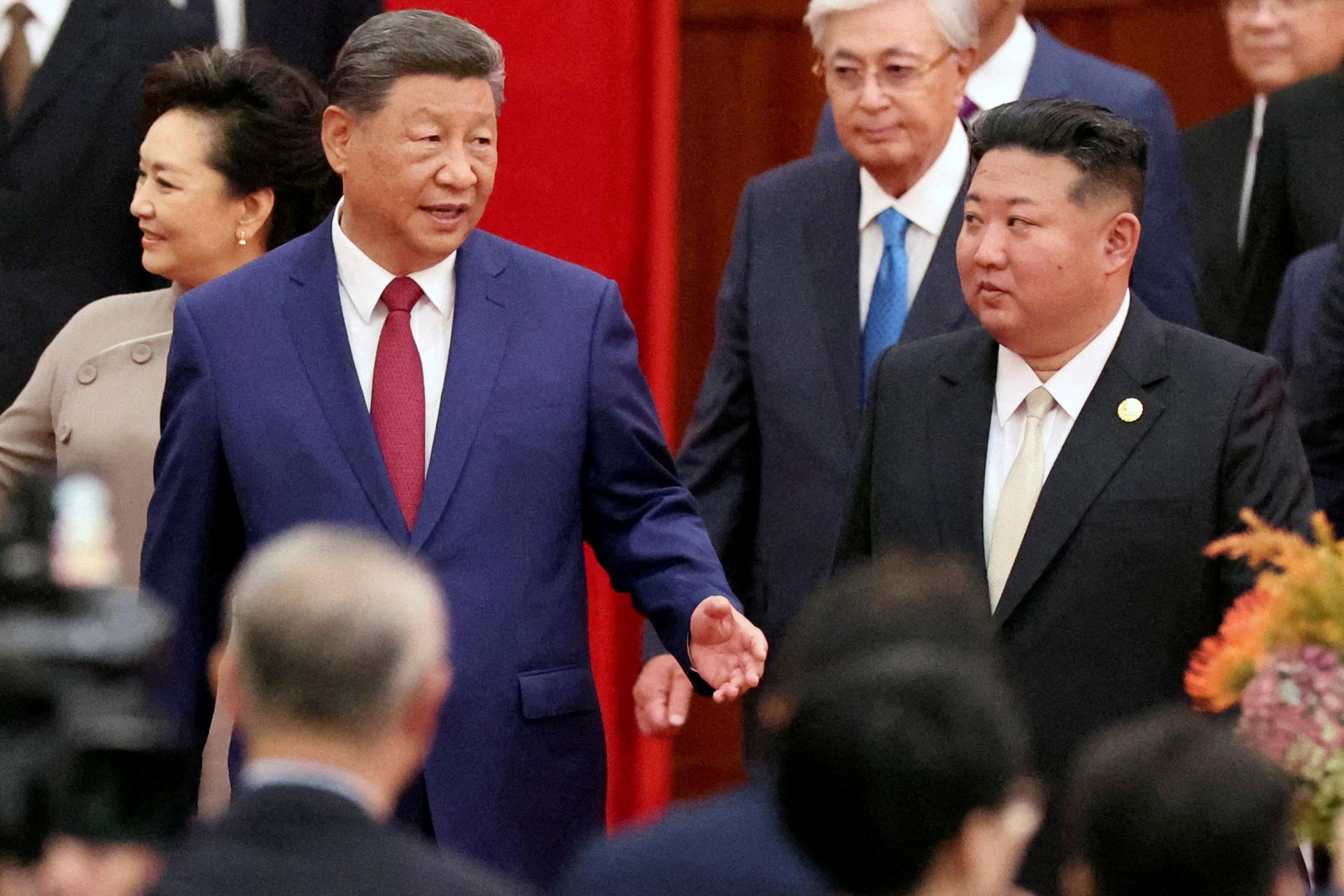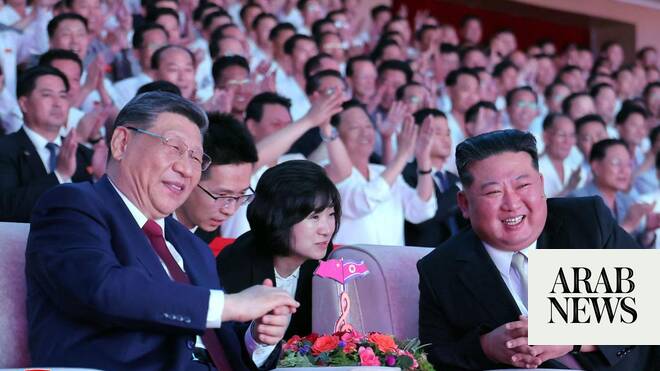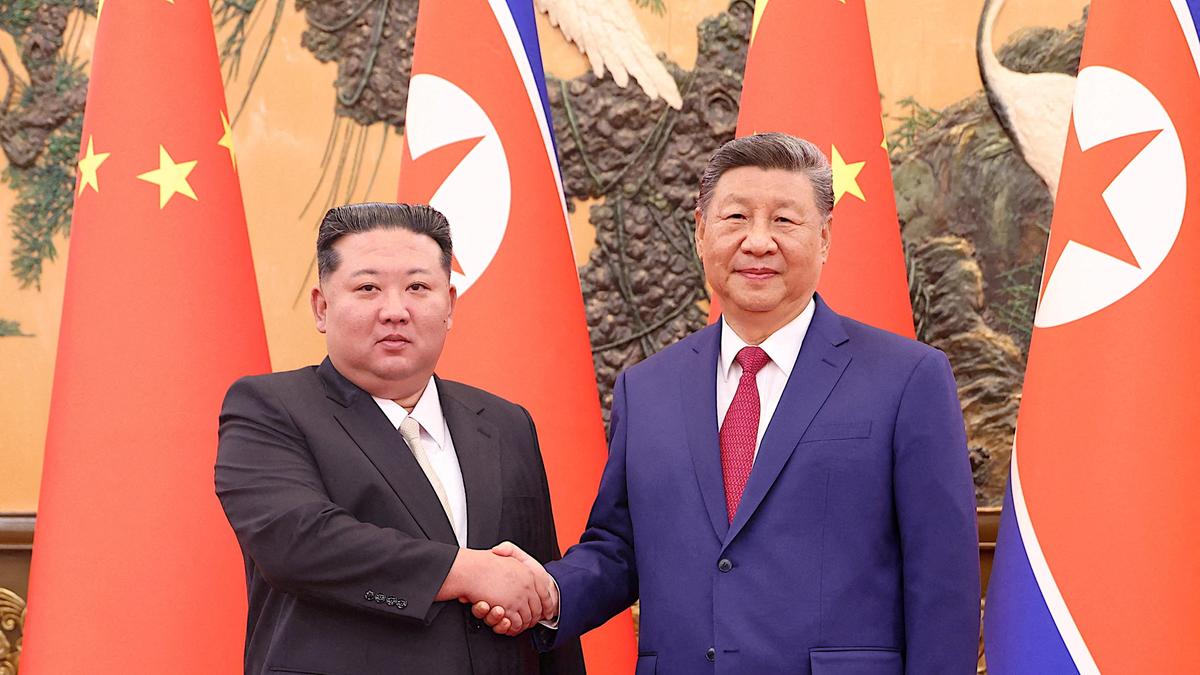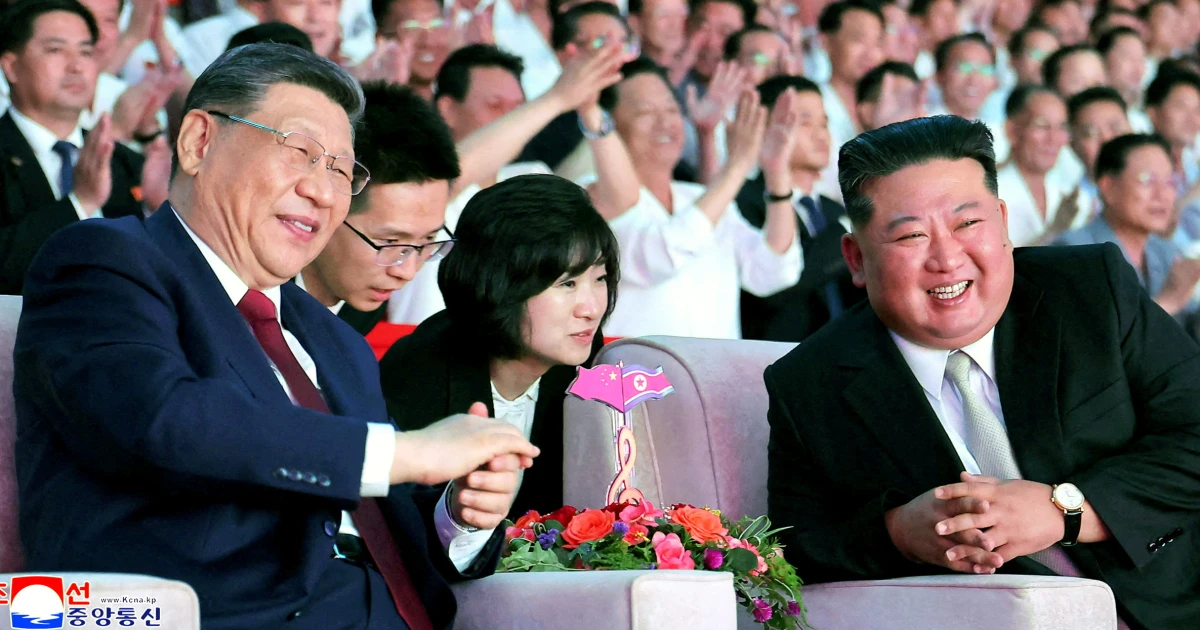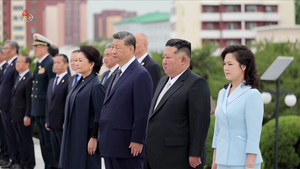
Chinese President Xi Jinping (center left) and his wife, Peng Liyuan, who were on a state visit to North Korea, visit the Friendship Tower in Pyongyang together with North Korean leader Kim Jong-un (center right) and his wife, Ri Sol-ju, on Tuesday, as shown in footage broadcast by Korean Central Television on Wednesday. (Korean Central Television screen capture-Yonhap) Chinese President Xi Jinping's latest state visit to North Korea is fueling speculation among experts over the implications of the Chinese side explicitly calling for greater exchanges in the "military" sphere — a formulation rarely highlighted in public discussions of bilateral ties.According to China's Xinhua News Agency on Tuesday, Xi told North Korean leader Kim Jong-un during their summit that the two countries should strengthen exchanges in "diplomacy, law enforcement, military affairs and others."A Xinhua commentary published Wednesday further emphasized that direction, stating that the two sides should "further expand and invigorate friendly exchanges at various levels and in various fields between the two parties, deepen exchanges of experience and mutual learning on party and state governance, and enhance exchanges in diplomacy, law enforcement, military affairs and others."The reference has drawn attention because Xi has not publicly emphasized military exchanges in China-North Korea relations since Kim Jong-un came to power in 2011. Chinese Defense Minister Dong Jun accompanied Xi during the visit and attended the summit meetings, unlike during Xi's previous trip to Pyongyang in 2019.Eom Hyo-sik, director of defense and security studies at the Korea Defense and Security Forum, said North Korea could assume a supporting role within China's broader regional strategy."North Korea appears likely to operationalize military cooperation with China by assuming a deterrent role aligned with Beijing's strategy, preventing US Forces Korea from exercising 'strategic flexibility,'" he said.Kim reinforced that political alignment during the summit, declaring that, "No matter how the situation may change, our party and government will fully support the policy and stand of the Chinese party and government to defend the core interests on the 'one-China' principle," according to KCNA.The summit concluded Tuesday with both leaders pledging to deepen exchanges in politics, the economy, culture and science, and to expand high-level contacts. Neither side, however, mentioned North Korea's nuclear program or the security situation on the Korean Peninsula.Still, several analysts caution against interpreting Xi's remarks as evidence that Beijing and Pyongyang are preparing direct military coordination.Hong Min, a senior researcher at the Korea Institute for National Unification, offered another interpretation, suggesting Beijing's interest may be driven less by preparations for joint operations than by a desire to better understand North Korea's rapidly evolving military capabilities following its growing cooperation with Russia."Xi's reference to 'military exchanges' is directly related to China's concerns over the rapid acceleration of North Korea's nuclear and conventional weapons modernization resulting from its military cooperation with Russia," Hong said."The purpose is to strengthen personnel exchanges and information sharing in the military sphere so that China can better understand technological changes within North Korea's armed forces and the extent of Russian technology transfers."For some analysts, the summit suggests Beijing increasingly views North Korea as a strategic asset in its long-term competition with the United States.Yang Moo-jin, a distinguished professor at the University of North Korean Studies, said Xi's subsequent thank-you message carried broader geopolitical implications. In a letter released Wednesday, Xi thanked Kim for what he described as "fruitful" summit talks and warm hospitality, saying the two leaders had exchanged views "in-depth" and reached "important common understanding" on issues of shared concern that added "new substance" to bilateral relations, KCNA said.Describing China-North Korea relations as entering "a new historical journey," Xi said he was prepared to work with Kim to consolidate ties and advance the socialist cause of both countries."This suggests that China recognizes strategic competition with the United States will be long-lasting and is prepared to regard North Korea as one of its foremost strategic partners over that extended period," he said.He also contended that Pyongyang may have emerged as the greater beneficiary of the summit."Most importantly, North Korea appears to have secured what amounts to a tacit exchange: continued support for the 'One China' principle in return for China's de facto acceptance of North Korea as a nuclear weapons state," Yang said."Unofficially, however, it is more appropriate to conclude that China is effectively acquiescing to North Korea's nuclear development."
Xi's North Korea visit fuels speculation over deeper China-North Korea military cooperation
Chinese President Xi Jinping's latest state visit to North Korea is fueling speculation among experts over the implications of the Chinese side explicitly calli
718 words~3 min read