Whole books have been written about the role of a birth partner and I had read none of them when I became my daughter’s labour sidekick a couple of years ago. Nothing could have prepared me for the reality anyway. I gave birth to her and her sister in the 1980s, an era when epidural analgesia was still highly restricted and considered a kind of moral cowardice, replete with warnings of physical catastrophe. Like many women in that grim decade, I kept up the health insurance payments specifically for the private en suite and the chance of an epidural through the kind offices of a He-God private obstetrician. In the labour ward I bayed so loudly for that epidural that my prestigious obstetrician ordered me (loudly) to stop shouting because I was disturbing the other mothers. The fact that I was spared the worst of the birth agonies because health insurance had opened access to an epidural – almost alone of the suffering women in that ward – was a further shame. Despite that my husband and I carried on paying for insurance because stories coming from the public system about waiting times worried even the most sanguine. Then in our late 50s and in ghastly succession, we each got cancer. For logistical reasons, I opted for chemotherapy in Tallaght where, I discovered, there was no difference between private and public, no luxury chairs in discreet lounges for the insured. We were all in this together, the vast majority being in the public system, all under Janice Walshe (now professor), the same remarkable oncologist whom I first saw privately. It seemed like the opposite of a two-tier system. My husband was diagnosed with a glioblastoma by a superbly efficient and sensitive team in the Mater public hospital’s Emergency department about two hours after we had been dismissed from a private hospital’s A & E unit with a note saying no neurology team was available and directing us to a small general hospital near home. A few hours later, he suffered a near-fatal seizure in a Mater bed, saved by specialists on standby in that public hospital. Most of his subsequent treatment took place in Beaumont Hospital, where he queued among public and private patients for scheduled appointments with frequent admissions to public wards. When he was officially designated a public patient some months before the end, occupational therapists suddenly appeared with ingenious mobility solutions along with social workers we never thought we needed, home carers to help out, hospice care that saved our sanity. All in the public system. Yet the old preconceptions and influencer energy are strong. I assumed that my daughter would want to book the private (male) obstetrician revered in her friendship and social media circles. Along with his prestige of course, her hard-earned money would cover a private room with space for balloons, several chairs and – the holy grail after childbirth – a private bathroom. She chose the public system. After those cancer journeys, both she and her sister knew that in the event of a night-time emergency, private patients have to present like everyone else to a public hospital emergency department. They had seen privately-treated new mothers shocked to find themselves plunged into the public maternity system when illness struck. None of it made sense for the insured or the taxpayer. In the Coombe hospital, my daughter’s antenatal appointments were reassuringly frequent, thorough and kind. Different faces behind the desk were of no concern since she was low-risk. In the end, my granddaughter’s delivery became urgent and traumatic. A midwife summoned this birth partner back from a walk and warned there would be a lot of people in the room. Yet my enduring memory, as if from an old painting, is of a large team of women quietly and fiercely focused on saving a mother and baby. No amount of money, I am convinced, would have bettered the care that day. It was afterwards, in a clammy, noisy eight-bed ward, separated into tiny cubicles that barely contained a narrow bed, one chair and essential maternity supplies, that the women around us – many with broken, bloodied postnatal bodies – struggled to cope with new life. One tried to soothe her baby while her audibly snoring male partner lay on the single bed. A woman who sounded like a child herself cried incessantly, wailing for a midwife who tried to explain to her that her crying baby was her responsibility now and she had to try to care for it. The nauseating smell of a burger takeaway drifted from the next cubicle where a row was in progress while my daughter – worn out after a forceps delivery, a second transfusion, a fourth day in this oppressive, minuscule space while struggling to feed a bruised little newborn – looked about to throw up in the communal bathroom.She endured, knowing she had the luxury of choice, knowing that if any new mothers were in desperate need of continuity of care, a rest, and the peace and dignity of a private en suite, it was some of the ghostly, beaten-down women in that public ward. We all deserve better. Not just a few of us, all of us. Stay with it, Jennifer Carroll MacNeill.
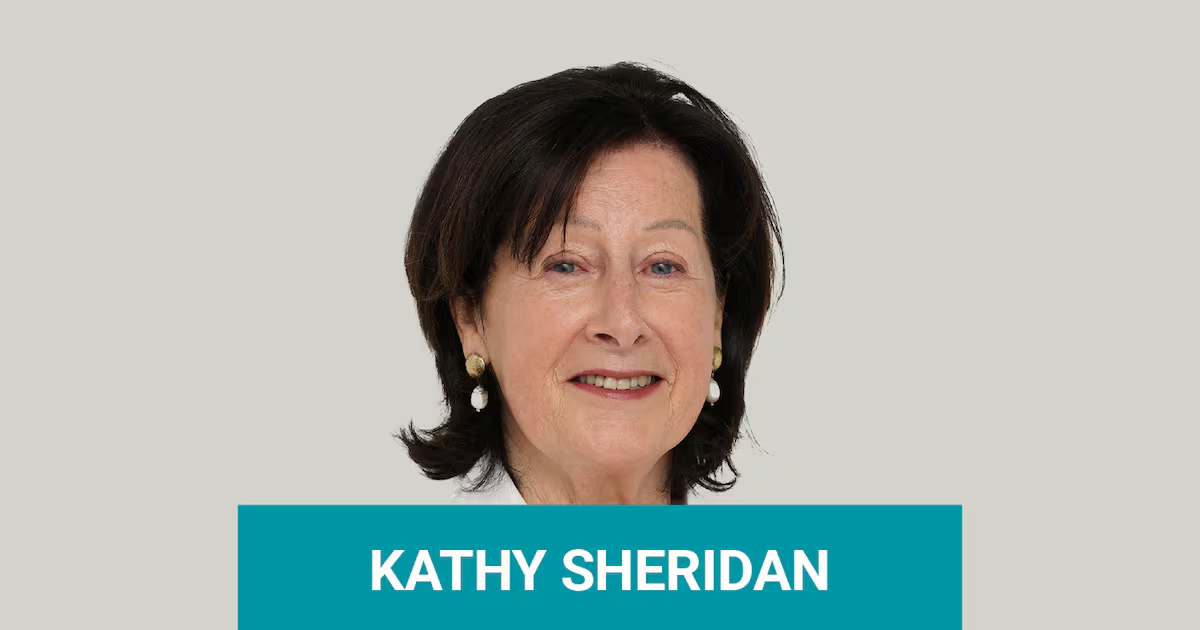
Kathy Sheridan: Private healthcare made little difference to my husband or me. So our daughter went public
No amount of money, I am convinced, would have bettered the care my daughter got giving birth. The recovery in a noisy, clammy ward was a different story
877 words~4 min read