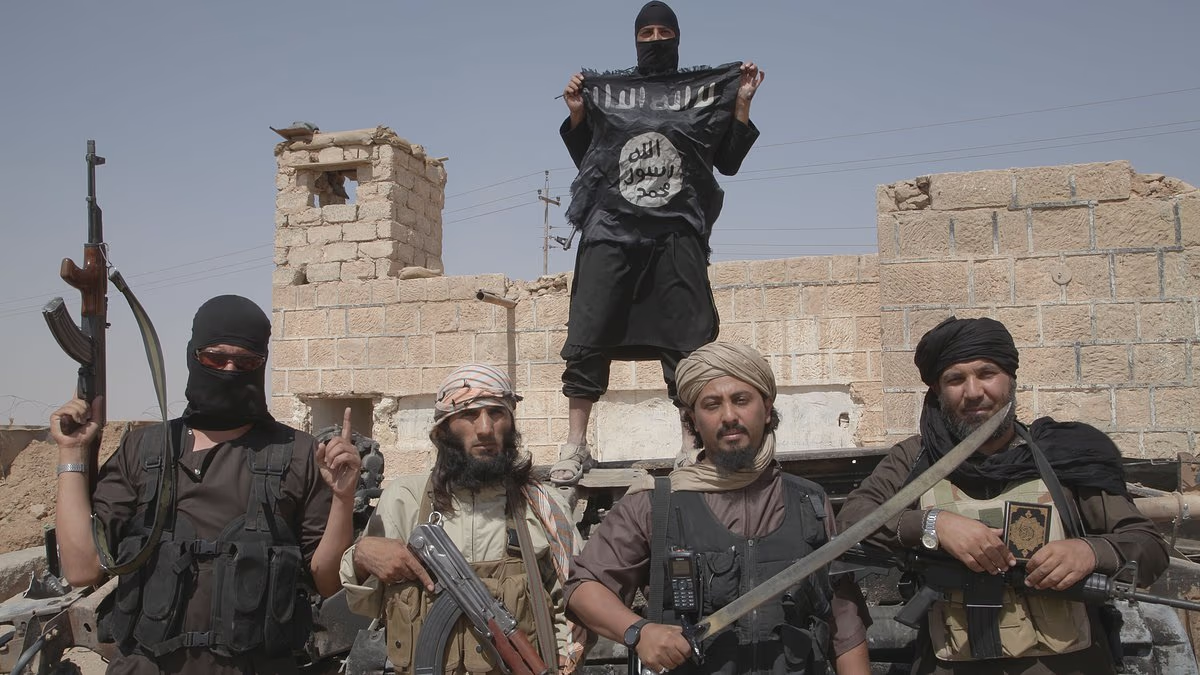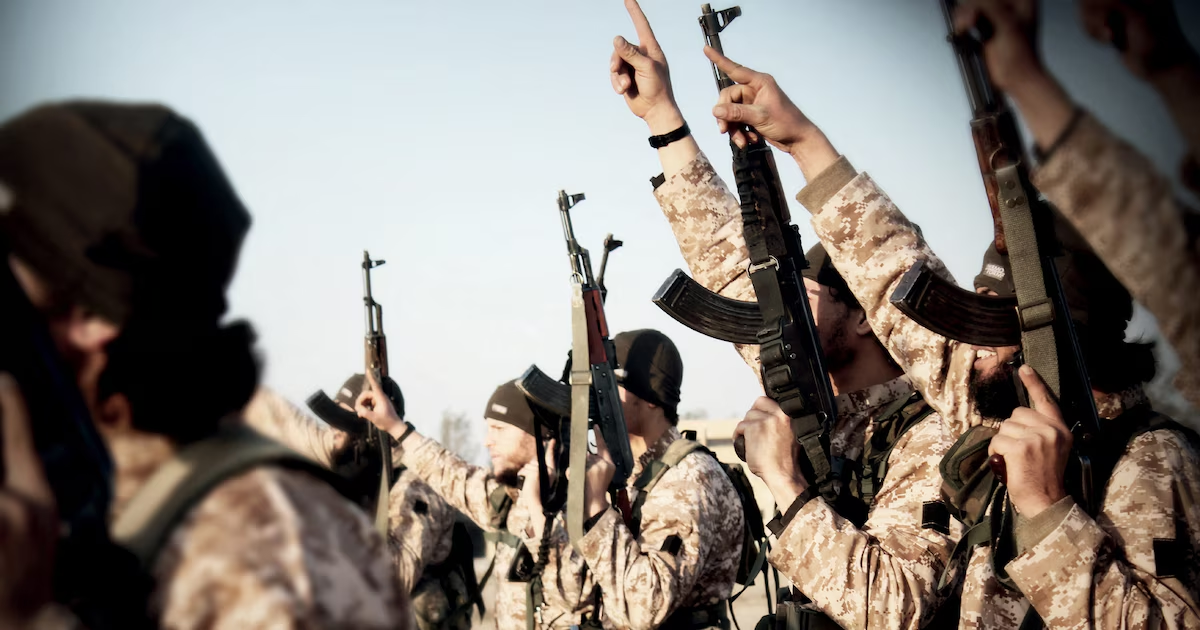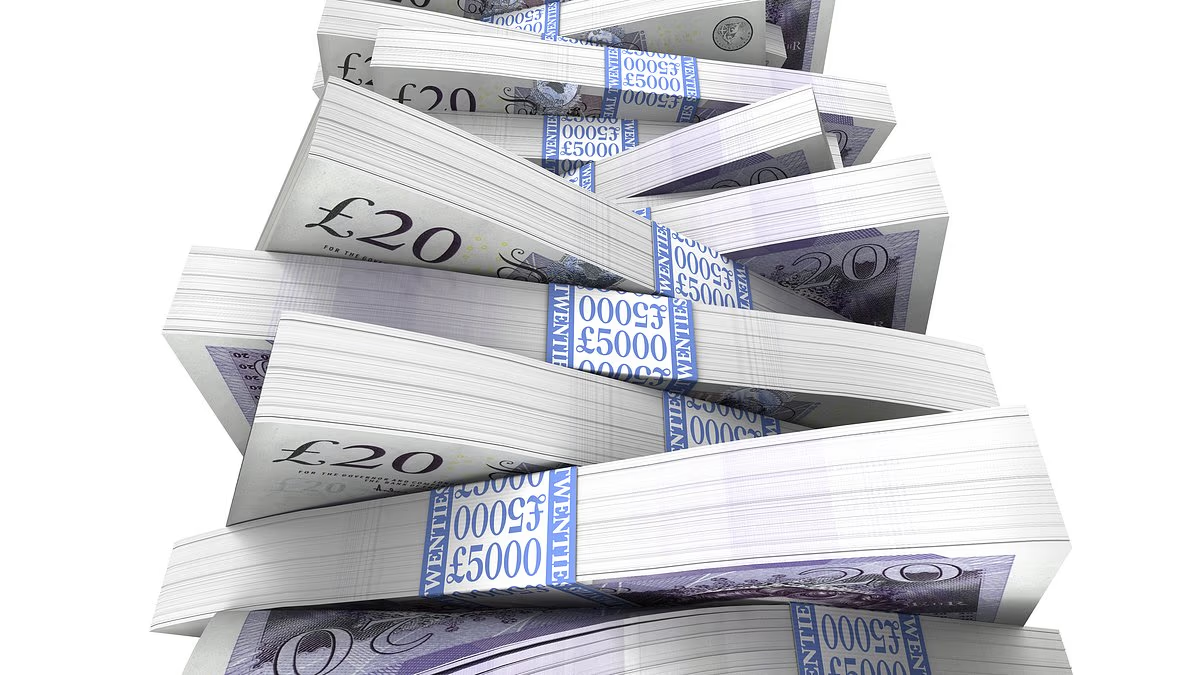
Here we are yet again. The revelation that a classified Cabinet Office dossier found that almost £28billion of British public money ended up in the hands of terrorists, hostile states and criminals between 2015 and 2021 should have triggered an immediate national scandal.But it didn’t, of course. Instead, the report – which was commissioned and produced by the Cabinet Office in 2023 – was sat on.The political fallout was deemed more dangerous than the fact that taxpayers’ money was finding its way to those who most wish Britain harm.The dossier’s findings are, for me, unsurprising – and, as I know full well – the rot begins at home.A couple of years ago, I began investigating several institutions linked to the Iranian regime operating openly in Britain. In Maida Vale, north London, I visited the Islamic Centre of England, effectively the now happily dead Ayatollah Khamenei’s outpost in the capital. Nearby sits the School of the Islamic Republic of Iran, where footage emerged of children singing songs pledging allegiance to Iran’s Supreme Leader.Exactly the sort of places we should be shutting down, right? Not according to the Government, which – I discovered – saw fit to dole out hundreds of thousands of taxpayers’ money to them.During Covid, the Islamic College of London received £205,000 in furlough payments and the Islamic Centre almost £250,000.These sums were doled out to a regime whose Supreme Leader denounced British vaccines and described Covid as a ‘Zionist bioweapon’. During Covid, the Islamic College of London received £205,000 in furlough payments and the Islamic Centre almost £250,000These cash injections pale in comparison to the £28billion identified in the newly released Cabinet Office dossier. But the principle is the same: a state apparatus so consumed by process and staggering incompetence that it failed to ask the most basic question of all; who exactly are we funding?If that could happen here, in London, under the noses of our own authorities, why should anyone be surprised that billions sent overseas disappear into far darker places?In theory, at least, foreign aid remains an important tool of statecraft. It allows Britain to project ‘influence’ on the global stage, alleviate suffering, stabilise fragile regions and build alliances –even if we often act like we are still richer than we are.Meanwhile, the Foreign Office, Ministry of Defence and taxpayer-funded charities not only provide humanitarian relief but also assist those battling the most regressive and imperialist of global actors. Many of their projects do great work and are an asset to the British state.But all too often, instead of a tool of soft power and altruism, foreign aid has become the plaything of an ideologically driven bureaucracy more interested in advancing fashionable causes than British interests. Sometimes the consequences are merely embarrassing. And sometimes they are far more serious.Consider what the dossier uncovered. Money sent to relieve suffering in Syria was hoovered up by Islamic State terrorists. British research was funnelled to institutions linked to China’s military machine. British taxpayers helped to fund a defence technology company that was later bought into by a Kremlin-linked investor. In effect, we helped build an asset from which Moscow could profit.Our public cash is flowing, directly or indirectly, to the world’s most malign trinity.Russia is waging the largest war in Europe since 1945. China is increasingly identified by our military and defence communities as Britain’s foremost long-term strategic challenge, while Iran, when it’s not sending its assassins on to British soil, is now holding the world economy hostage in the Strait of Hormuz. Our public cash is flowing, directly or indirectly, to the world’s most malign trinity, writes David PatrikarakosYet this is only one side of the story. The total spend by the British government on foreign aid between 2015 to 2021 was approximately £96.4billion. So where was the rest of this cash spent? The answer would be comic if it were not being paid for by all of us.If you think you know about foreign aid waste – and the Daily Mail has covered many of its worst excesses in the past – think again. Just consider some of the absurdities we have funded.Readers may remember that, from 2013 to 2016, £15million was spent on a scheme aimed at reducing the flatulence of Colombian cattle to help combat climate change.And £25million was splurged on teaming up meteorologists with Kenyan ‘rainmakers’, to watch patterns of ants and better try to predict the weather.A staggering £285million or so was spent on an airport on the remote South Atlantic island of St Helena. The problem? It was unusable because winds made it too dangerous to land aircraft. But don’t worry, it wasn’t a total loss: the airstrip was able to be used as a go-karting circuit.But in truth, it’s not just Britain: this is a global swizz. In Ghana, a friend who worked with the government there told me about a trip she took to a rural area. Entering a small house, she found it filled with boxes of washing-up liquid. Puzzled, she asked the owner why he needed so much.‘Western project,’ he shrugged. ‘They want men to take part in household chores for “equality”; so now if I tell them I do the washing up, they give us money – and all this,’ he said, gesturing at the bottles before muttering with simple disbelief: ‘Ah…white people.’Would the ordinary taxpayer, struggling with rising bills and stagnant living standards at home, look at many of these projects and conclude they represented a reasonable set of national priorities? Of course not.Particularly now.Because this debate is not taking place in isolation. Ministers are drawing up defence plans in response to the most dangerous international environment Britain has faced in decades. Across multiple regions our security picture is deteriorating.We are told, repeatedly, that there is not enough money for defence, policing, prisons or border security. Yet somehow there is always money available for projects that satisfy the ideological instincts of officials who will never be held personally accountable if those projects fail.We have seen versions of this mentality across the public sector for years. The endless production of strategies, frameworks and initiatives that sound admirable in theory but collapse under first contact with reality.Reality, however, does not care about intentions. A government’s first duty is not to make its staff feel virtuous but to defend its people and aid its allies.Indeed, the great irony is that this behaviour ultimately damages support for foreign aid itself.Britons are not heartless. We understand that famine relief, disaster assistance and supporting our allies at war matter. Many would support generous aid spending if they believed it was reaching the people who genuinely need it.What undermines public confidence is not the principle of aid but the spectacle of money ending up in the hands of extremists while officials congratulate themselves because they’ve hit ‘diversity targets’.And there’s a reason for that. As the Cabinet Office dossier confirms, Britain does not have a foreign aid problem, it has a governing-class problem.Until that is addressed by proper leadership and serious structural reform of the state, we will continue to watch yet more taxpayer cash leave our shores to fund jihadist psychopaths – and flatulent cows.
DAVID PATRIKARAKOS: The madness of Western aid laid bare
The revelation that almost £28billion of British public money ended up in the hands of terrorists, hostile states and criminals between 2015 and 2021 should have triggered a national scandal.
1,193 words~5 min read