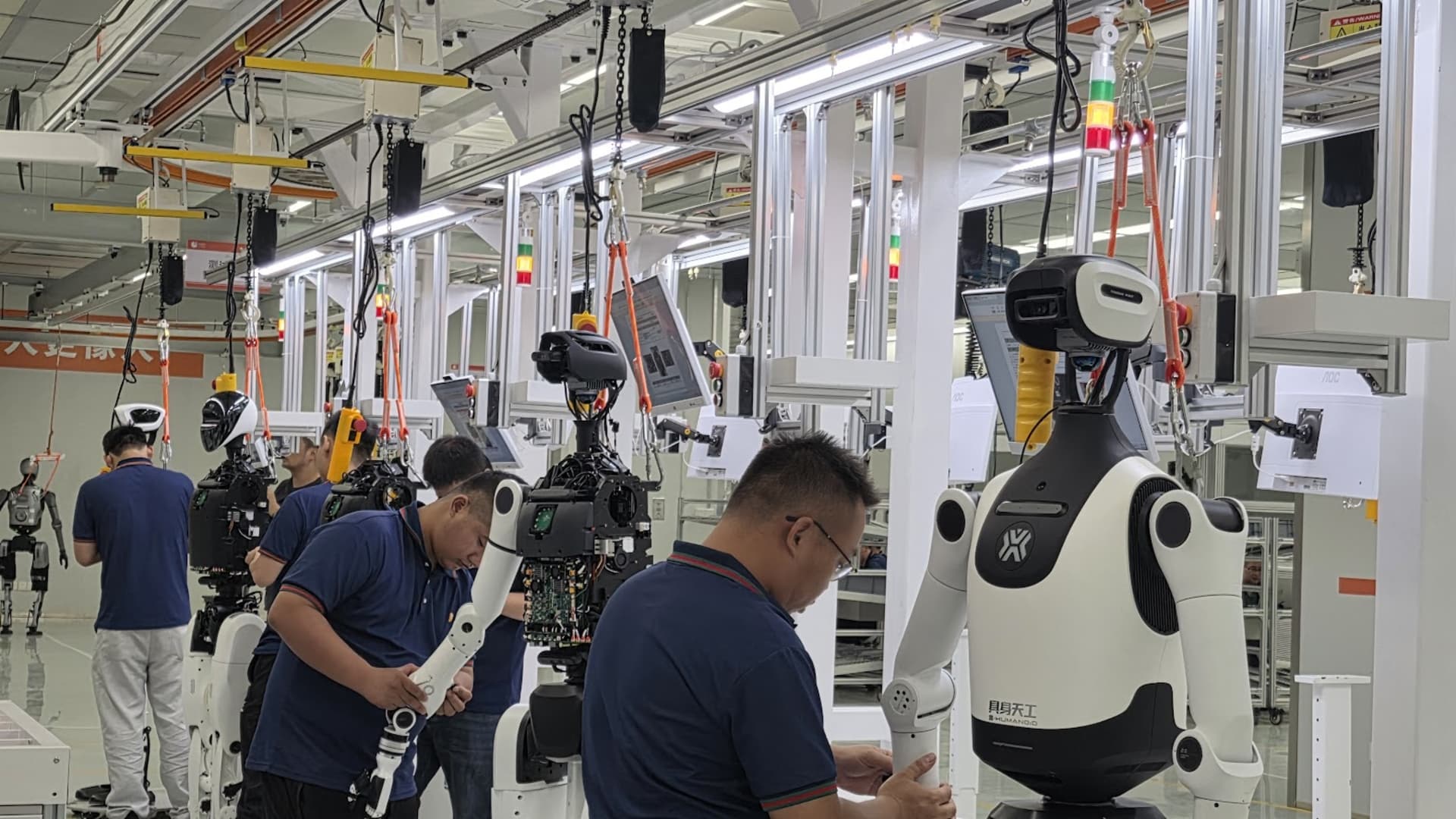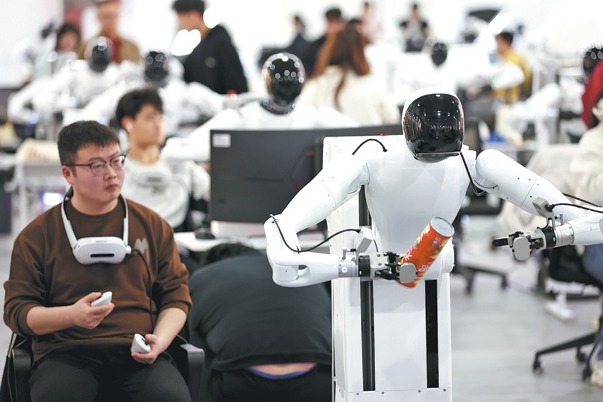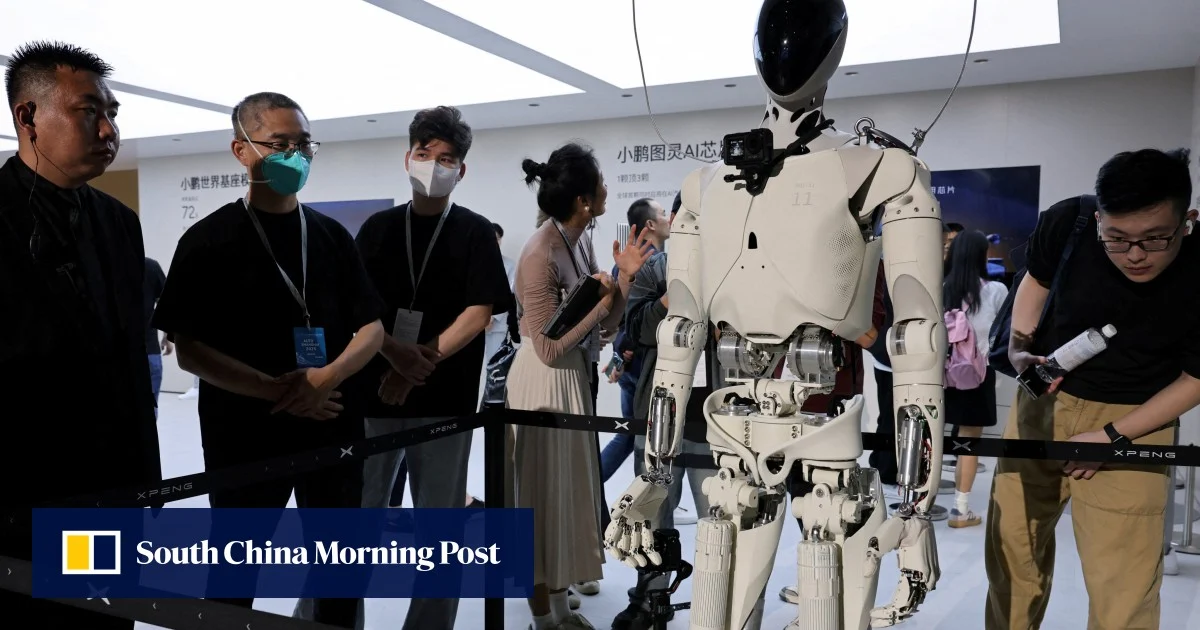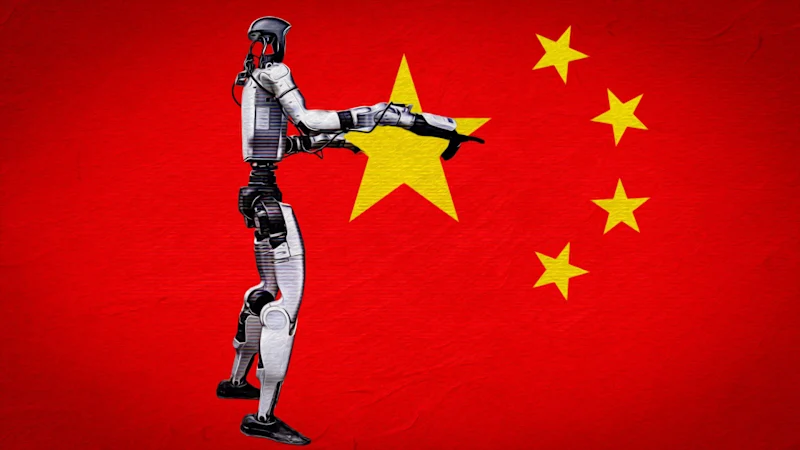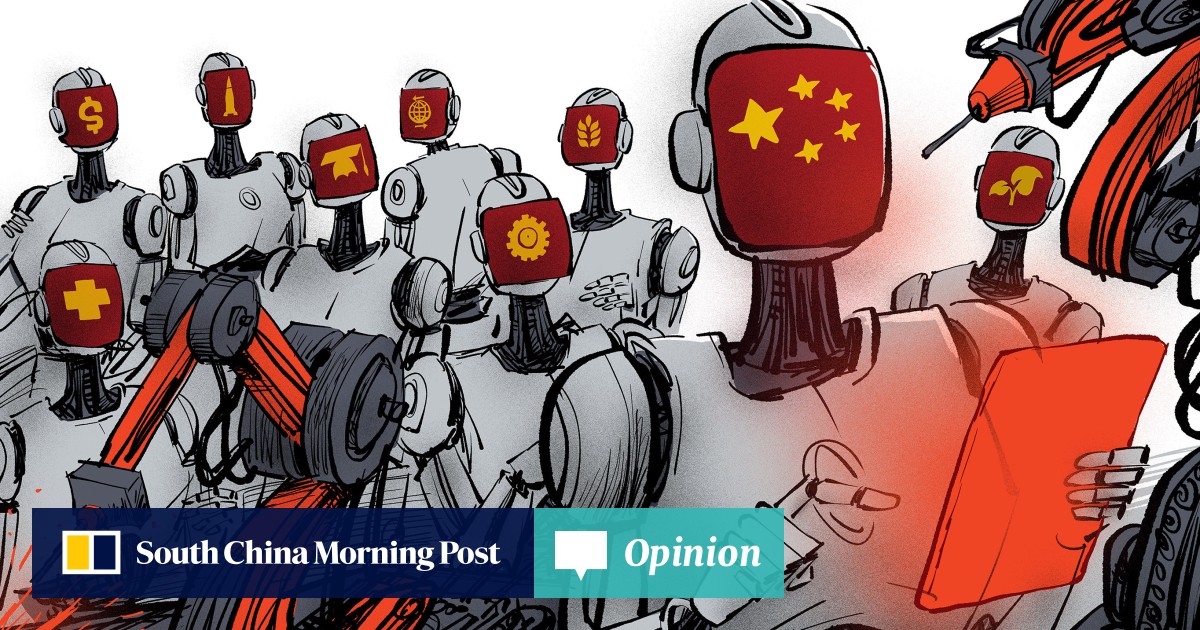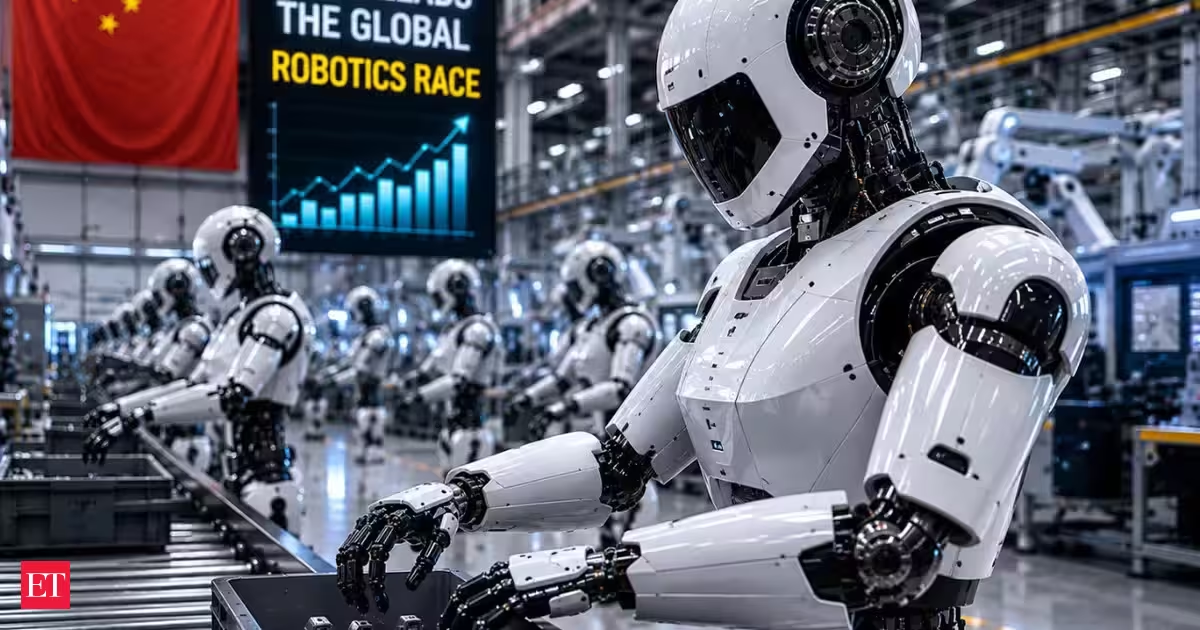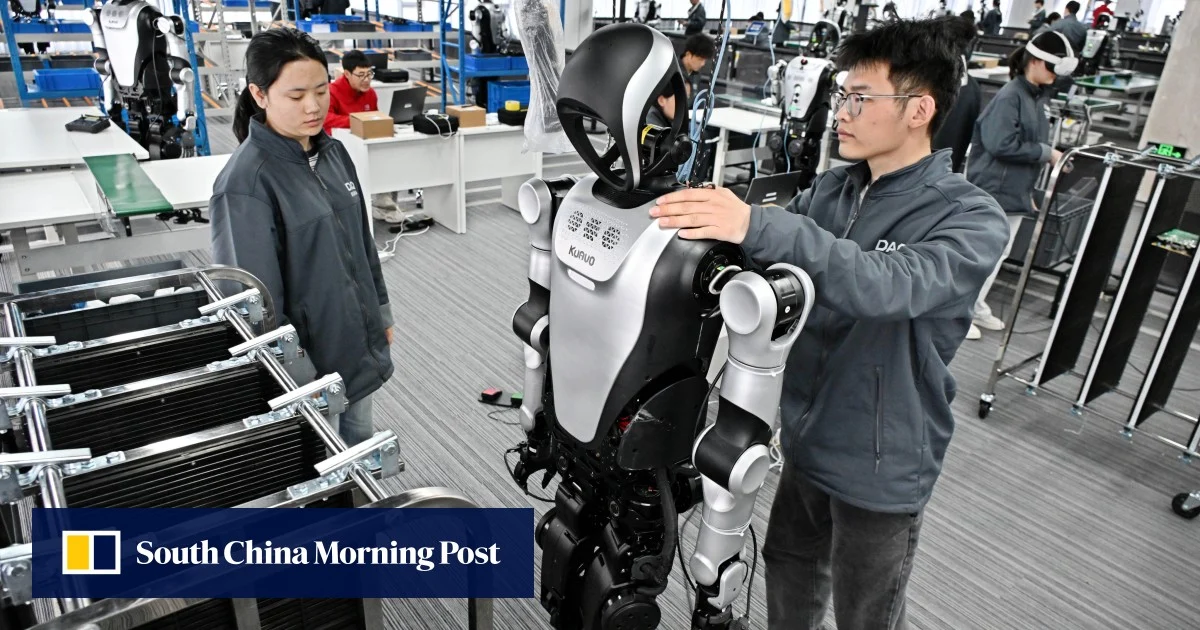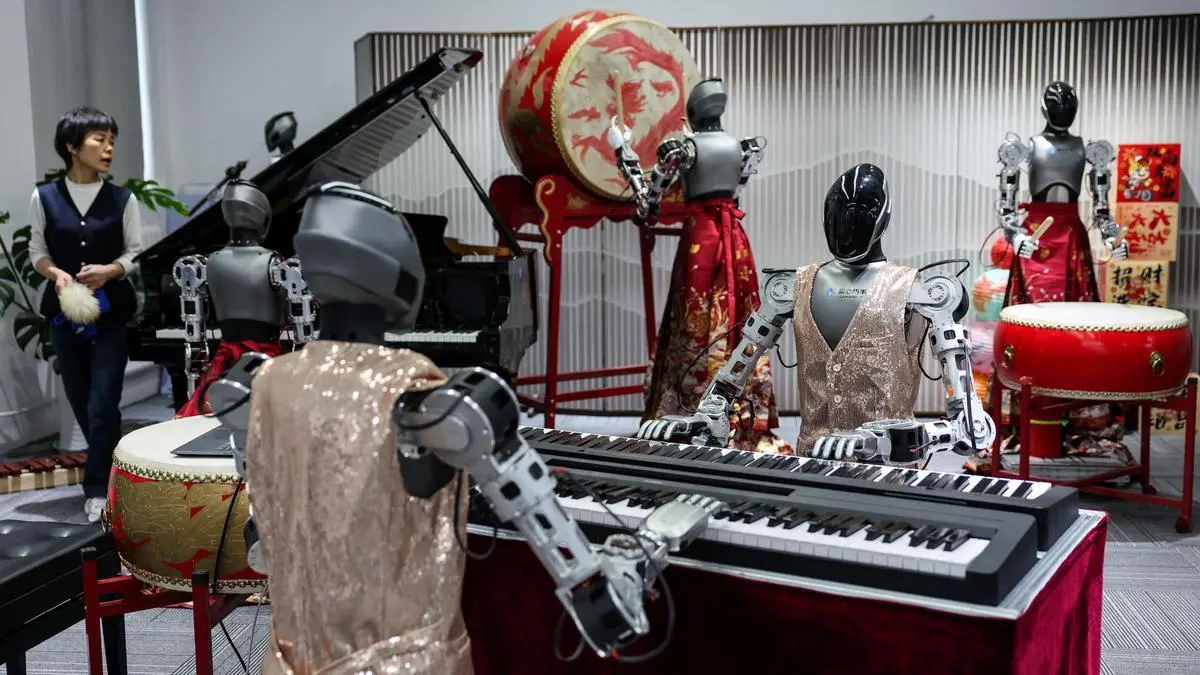
Dozens of humanoid robots stand motionless in a row on the sprawling factory floor of Lingyi iTech. In one corner of this modern facility on the outskirts of Beijing, engineers take notes as robots march single-file and perform other tasks, from screwing bolts onto circuit boards to stretching to demonstrate their agility.Lingyi emerged as a lynchpin in the Chinese supply chain over the past three decades. It is a major precision manufacturer that supplies components made in its factories in China and around the world (including one in Sriperumbudur outside Chennai), to companies like Foxconn that assemble them into iPhones, laptops, and a range of other electronics.In the company’s journey from basic electronics manufacturing to robotics is the story of two China shocks. Starting out making components for cheap Chinese electronics that flooded the globe, it then moved up the value chain, emerging as a key cog in China’s push to dominate more advanced industries. The second China shock, now underway, is seeing Chinese Electric Vehicles (EVs), solar panels, and batteries decimate Western manufacturing, which is unable to compete with cost made possible not only by state support but huge investments in R&D.Lingyi is not done there. As is the case with other Chinese firms in this space, the company is pivoting rapidly from components for EVs and advanced electronics to an industry that many in China believe will be at the heart of the next phase of advanced industrial manufacturing — robotics.The firm’s Vice President Philip Yang tells me the Beijing factory went online this April. By the end of next year, it will be making 20,000 robots annually. It has the capacity to scale up to manufacturing 100,000 units by 2028 and 500,000 a year by 2030.And this is just one of the company’s five such facilities in China.Lingyi sits in the middle of a robotics cluster that Beijing is building in its southern Yizhuang district. It is a hub and spokes model. At the centre is the state-supported Humanoid Robot Innovation Centre. The talent pool comes from Beijing’s research universities such as Peking University and Tsinghua, that are, by many metrics, fast closing the gap on the world’s best research institutions when it comes to robotics and AI.Yang believes much of the demand for humanoid robots will come from within China itself, with state policy already paving the way for use of humanoid robots in manufacturing, hazardous industrial environments, and in healthcare. With China facing a shortage of personnel for elderly care in a rapidly ageing society, policymakers see humanoid robots filling the void.This robotics push will certainly be felt beyond China’s borders, and it may well be the next China shock. Lingyi alone will be making more than two million robots a year by 2030, if the demand meets its forecasts.It remains to be seen how, as with EVs and solar panels, others can compete with an already established supply chain, and an industrial policy that is aimed at making the world more dependent on China, and China less dependent on the world.The global response is not going to be straightforward. Indeed, there is already rising concern, especially in Europe, on the impact of China’s advanced manufacturing on European firms that have long dominated this space. Whether EVs or solar panels, Europe is looking at a 30-40 per cent cost disadvantage. Closing the door, however, may constrain Europe’s ability to adopt industries of the future. Therein lies the dilemma.Where India standsIndia is wrestling with similar questions, especially with the continuing surge in imports from China over the past decade. If in the public imagination, cellphones, toys and cheap goods are what India is buying, these account for a very small share of the basket. It is advanced machinery, electronics, solar components and lithium batteries that India is buying in huge quantities. In 2025, India’s imports grew to a record $130 billion, out of two-way trade of $155 billion. India accounts for only 3 per cent of China’s foreign trade, but as much as 10 per cent of China’s total trade surplus.In 2014, Delhi’s idea was to rope in Chinese firms under “Make in India” to manufacture in India, rather than sell to India. India laid out the red carpet for Chinese companies, including through proposals to set up dedicated manufacturing clusters in Gujarat and Maharashtra.If Delhi’s instincts were correct, neither cluster eventually took off, and as relations soured, so did India’s appetite for investment.Investment policy turned 180-degrees in early 2020, when at the start of the pandemic (and before the Ladakh tensions), India issued Press Note 3, requiring approval for all investments from countries sharing a land border with India. Investment dried up overnight.On March 10, the Cabinet amended PN3, allowing investors with non-controlling beneficial ownership from land border countries up to 10 per cent under the automatic route. Clearance would be expedited for investments in manufacturing in capital goods, electronic capital goods, electronic components, polysilicon and ingot-wafers.The broader context to the easing, however, is hard to miss — the harsh dual reality of decreasing FDI and increasing reliance on Chinese manufacturing.The hope now appears to be to engage China just as, decades ago, China engaged Japan to bring in technology though JVs, integrate into global supply chains, move up the manufacturing ladder, and ultimately reduce reliance on imports.Chinese firms still retain the appetite to go to India, which is seen as the biggest remaining untapped large overseas market. However, this is an appetite that has been significantly diminished after what Chinese firms see as five years of scrutiny and restrictions.Cooperation agreementsAn even bigger problem is Beijing’s increasing wariness at allowing firms in strategic sectors to get into cooperation agreements abroad, with an eye on ensuring technology in critical sectors such as batteries and robotics stays in China. The reach of export controls is widening beyond critical minerals. Last year, restrictions were imposed on exporting some types of EV batteries. That followed battery maker Gotion coming under fire in China for announcing a deal in India that involved some transfer of technology.More recently, automaker Chery, on June 8, issued a statement to deny it would transfer any EV technology to Tata Motors under a cooperation agreement, following a social media uproar in China over the deal. Indeed, China understands more than most what is to be gained from absorbing technology through investment, and what it stands to lose if India succeeds in doing the same.Published on June 10, 2026
The next China shock
The country’s robotics push is backed by an already established supply chain and an industrial policy aimed at making the world more dependent on China
1,073 words~5 min read