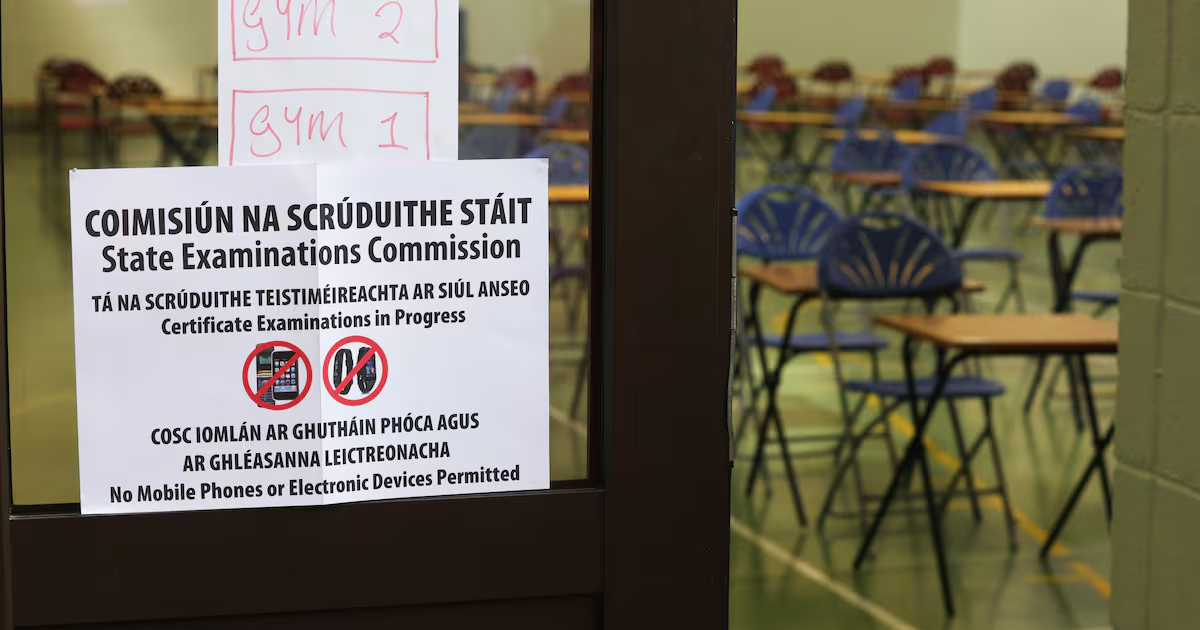
State Examinations Commission apologises for error, which will be taken into account in markingThe exam hall at Lucan Community College, Dublin. Photograph: Alan Betson
Peter McGuireTue Jun 09 2026 - 20:11 • 3 MIN READThe State Examinations Commission (SEC) has apologised for an error in Tuesday’s Leaving Certificate higher level biology paper and says it will be taken into account in the marking scheme.Question 16 (a), a genetics question, contained a labelling error in diagram B. The four daughter cells in diagram B were each labelled ’2n’, when this should have been ‘n’.“The State Examinations Commission (SEC) acknowledges that this error may have been a cause of confusion for some candidates,” the body said in a statement. “The SEC operates within the core principle that candidates cannot be disadvantaged due to an error on an examination paper.“The SEC apologises to candidates impacted by this issue, noting that the impact on candidates’ answering will be fully taken into account by the Chief Examiner when finalising the marking scheme for this examination.“The marking scheme will, as usual, be published along with those in all other subjects after the issue of results in mid-August. Candidates will have the option of appealing their results,” a spokeswoman for the SEC said.Emma Ronan, a biology and chemistry teacher at St Mary’s Secondary School, New Ross, Co Wexford, said this mistake was not flagged to students in her exam centre.“Having spoken to my own, it definitely impacted their performance in that question,” she said.Otherwise, Ronan said the paper rewarded students who had engaged consistently with the course and who had developed a broad understanding of the subject.“Overall, I felt this year’s higher-level biology paper was fair and accessible,” Ronan said.“There was substantial choice throughout the paper. Students who wished to avoid particular areas such as plant biology or genetics could largely do so without being disadvantaged, allowing them to play to their strengths while still demonstrating a broad understanding of the course.”Declan Cathcart, a biology teacher at TheTuitionCentre.ie, said students with strong knowledge of definitions, labelled diagrams, and core biological processes were well rewarded.“Questions were generally clear and direct, although success still depended on genuine understanding rather than simple recall of isolated facts,” he said.The significant coverage of units one and two stood out for Ronan. “By my analysis, approximately 84.5 per cent of the paper could be answered using material from these two units alone,” she said.“Students who had focused on developing a strong understanding of the foundational concepts in these units were therefore very well placed before even attempting questions from unit three.”Compared with several recent papers, Cathcart said there appeared to be less emphasis on unfamiliar stimulus material and data interpretation. “The predator-prey graph questions in section C, while not especially unfamiliar, still required higher-order understanding and have historically proven challenging for many candidates,” he said.“The practical content was also pretty predictable. The mix of mandatory practicals in question 8, together with the standard enzyme investigation in question nine, will likely have been welcomed by many candidates.”He said there were no surprises in the photosynthesis and respiration questions, and there was nothing tricky about the sex-linked genetic cross. In section C, Ronan said the genetics question was wordy but accessible when broken down, and the ecology question was particularly well balanced.On the ordinary level paper, Liam Hennelly, a biology teacher at Belvedere College and Studyclix.ie subject expert, said it offered a broad and accessible range of questions across many core topics.“The short questions covered food, the scientific method, cell structure, natural selection, ecology, bacteria and the human breathing system – a familiar and manageable mix for students,” he said.“The experiment‑based questions focused on cells and microscopy, immobilised enzymes, and transport in both humans and plants, all of which are standard practical areas that students would have encountered repeatedly in class.“The long questions provided extensive choice, with options spanning ecology, genetics, respiration and photosynthesis, the human digestive system, human reproduction and microbiology, among other topics.” IN THIS SECTION