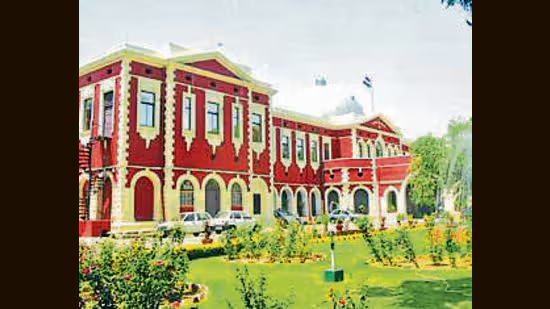
The Jharkhand High Court has issued a comprehensive set of directives aimed at safeguarding the dignity, privacy, and long-term rehabilitation of sexual assault survivors in the state, people aware of the development said on Tuesday.J’khand HC issues directives for rape survivors’ rehab, speedy justicePronouncing its verdict in a suo motu Public Interest Litigation (PIL) on Monday, a division bench comprising Chief Justice MS Sonak and Justice Rajesh Shankar ordered strict penal and departmental actions against officials failing to enforce these mandatory victim-centric frameworks.An HC advocate close to the matter said the court’s ruling addressed deep systemic gaps in institutional support, legal enforcement, and administrative accountability.“The HC made it absolute that police authorities must register a ‘Zero FIR’ immediately upon receiving information about a sexual offence, completely disregarding territorial or geographical jurisdictions,” the advocate said sharing the order on Tuesday.Highlighting that delays jeopardised prosecution by risking the loss of medical evidence, the HC directed the preliminary investigation of rape cases be completed within 15 days. The entire police investigation must wrap up within two months. Furthermore, trial courts were directed to strictly adhere to statutory timelines, mandating the conclusion of trials within two months from the filing of the charge sheet, without granting unnecessary adjournments.Reiterating multiple Supreme Court precedents, the bench declared that the invasive and unscientific “two-finger test” or “per vaginum examination” was strictly prohibited in all healthcare institutions. The state has been directed to issue binding circulars to all government and private hospitals. Any medical practitioner found violating this directive will face immediate disciplinary action for professional misconduct.In a significant expansion of the Right to Education (RTE) framework, the court directed the state to appoint district-level nodal officers to ensure automatic, uninterrupted free education up to Class XII for minor children born out of rape incidents. The order also mandates state-funded scholarships for meritorious students from this vulnerable background who secure admission into premier central institutes like the IITs, NITs, AIIMS, or IIMs.Taking note of an extensive assessment report submitted by the Amicus Curiae, the court expressed serious concern over the “poor” and “unsatisfactory” infrastructure in several district One-Stop Centres (OSCs). The state was directed to fill all vacant administrative positions, secure premises with functional CCTV networks, establish proper hygienic kitchens, and ensure safe drinking water facilities.On financial relief, the court ordered that interim or final compensation awarded by courts under the NALSA framework must be disbursed by the designated authorities within 30 days of the order, independent of the trial’s ultimate outcome.The court issued a strict warning to media houses, digital platforms, and law enforcement personnel against disclosing the name or any identifying particulars of sexual assault survivors. All police and court records containing victim identities must be kept in strictly sealed covers, permitting only redacted versions for public domain scrutiny.To ensure continuous ground-level monitoring, the DGP has been mandated to constitute a Special Task Force to monitor case progression and undertake quarterly reviews to enforce absolute institutional accountability.The HC took suo motu cognisance on September 24, 2025, by initiating a PIL on its own motion. The court acted on internal judicial observations and critical field reports regarding systemic infrastructure gaps, subsequently allowing an intervenor and JHALSA representatives to assist the bench.
J’khand HC issues directives for rape survivors’ rehab, speedy justice
The Jharkhand High Court mandates protections for sexual assault survivors, including immediate FIRs, swift investigations, and education rights, while prohibiting invasive medical tests.
534 words~2 min read