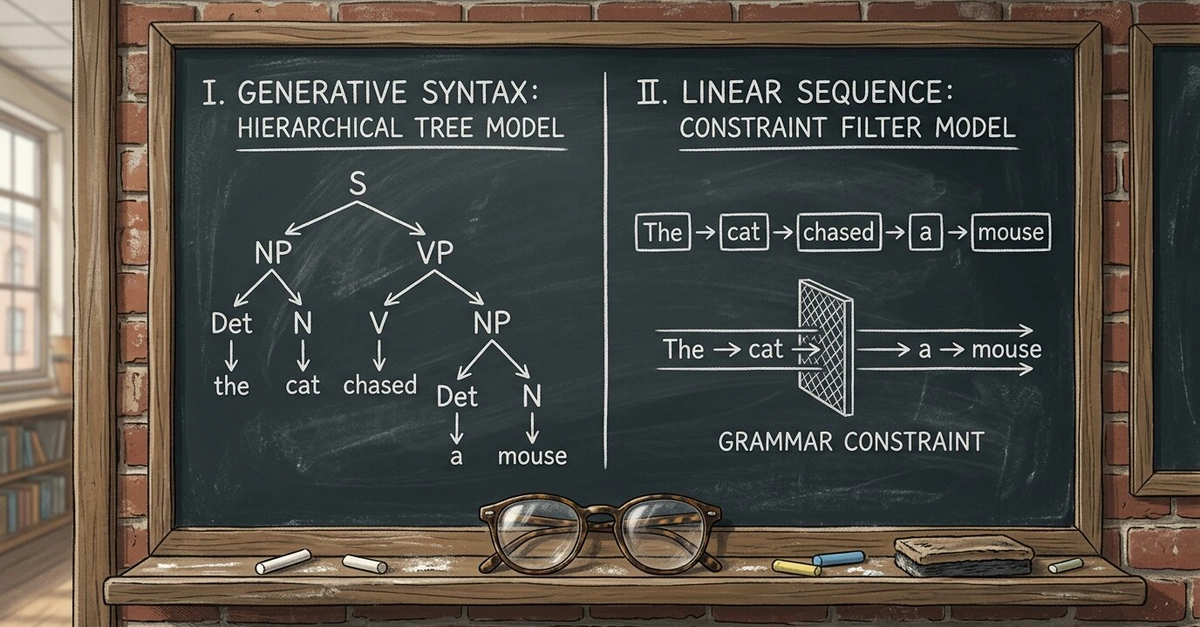
A useful technical idea, repeated often enough, eventually generates an unuseful philosophical claim. The current example is grammar-constrained decoding. The technique is straightforward — at each generation step, the language model's next-token logits are masked so that only tokens whose continuation can satisfy a formal grammar remain selectable; the output is, by construction, structurally valid. JSON parses. SQL is well-formed. Function-call signatures match. There is a real engineering payoff and a healthy ecosystem of libraries that deliver it.
The drift is not in the engineering. It is in the rhetorical move that follows the engineering. A growing corner of 2025-2026 AI writing argues, more or less explicitly, that constraining a model's output is making the model approach meaning — that filtering linear sequences is somehow building structure, and that structure is somehow building understanding. I want to take that drift seriously, because it is the same conflation Chomsky and collaborators flagged in their March 2023 essay in the New York Times, and the engineering literature on constrained decoding agrees with Chomsky on the substantive question, even when the marketing copy doesn't.