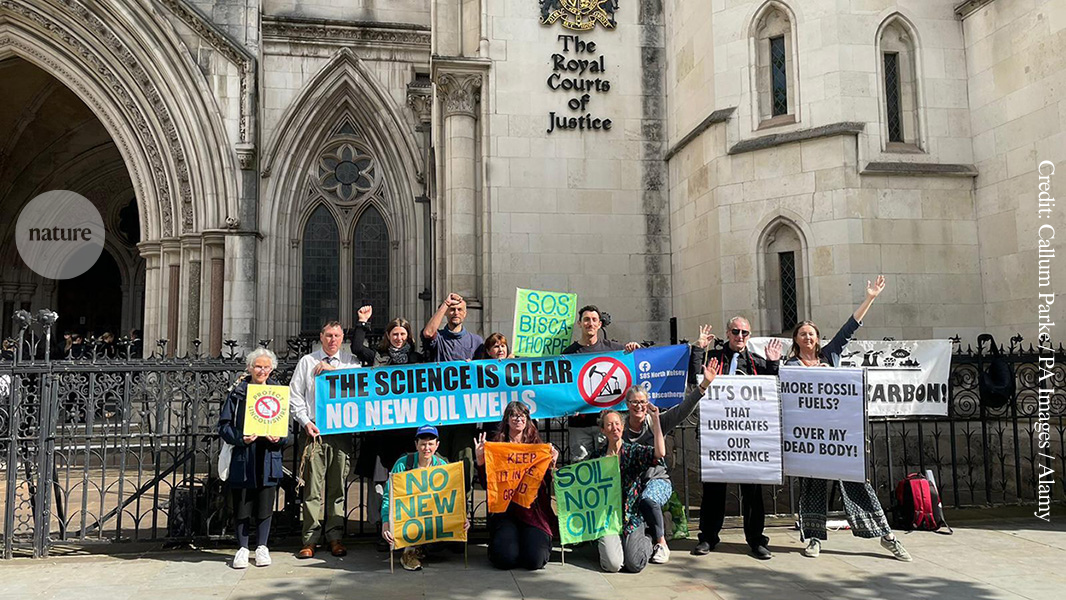
This group of activists from Lincoln, UK, took their anti-oil campaign to London in 2024 with the help of Andrew Kythreotis, who used his research skills to support them.Credit: Callum Parke/PA Images/Alamy Last year, I applied for what looked like an attractive position at a private university in Hanoi. The role covered both research and strategy with minimal teaching, paid about £28,000 (US$ 37,000) more than my tenured position at the University of Lincoln, UK, and included perks such as an accommodation allowance and private education for my two children.I was 20 years into my academic career as a human geographer, doing research on the geographies of power in place-based climate governance, policy and politics, but feeling burnt out and unmotivated. I wondered whether a change of scenery might help me to get away from UK academia’s metrics-driven culture and the bureaucracy that fuels it. Also, my spouse (who is also an academic) and I were excited by the opportunity to experience living in a country in southeast Asia.After two interview rounds, I received a tentative offer with an attractive package, so in May 2025, I took a mutually agreed retirement package from the University of Lincoln and left my position. The next month, we flew to Hanoi to check everything out. The plan was to start my new job in early 2026. This gap of a few months, I figured, would enable me to mentally recharge, to think about future research and complete those unfinished articles in my computer’s ‘procrastination files’.Before making a career move, try an experimentHowever, in August 2025, the provost changed at the Vietnamese institution, just when my spouse was going through her two-stage interview process for a different role there. In mid-September, the original offer for my job was rescinded and replaced by a one-year visiting position. My wife’s job-application process was also stopped. Despite this setback, I still felt that a visiting position abroad would reinvigorate and maybe transform my appetite for exploring fresh avenues of research. This included a potential collaboration with the Vietnamese government — in which I had already made a key contact — focusing on governing air pollution, a key environmental issue in Hanoi.Unfortunately, we couldn’t agree on terms with the university’s human-resources team, despite stoic support from the faculty dean who had given me the original offer.I had gone from having a very attractive offer to nothing, leaving me in limbo without a paid academic position. I began applying for various research and faculty-member roles, overcome with a mix of emotions about my situation.I was determined to bounce back, and refused to be reduced to simply another metric of an unemployed academic in an already weakened global higher-education sector.Andrew Kythreotis, pictured far right, celebrates with campaigners after winning a legal case to block drilling for oil in Lincolnshire, UK.Credit: Theresa MercerSince my opportunity to move abroad disappeared, I landed guest-lecturing roles at Cranfield University, UK, (where my wife works) and King’s College London and am organizing conference sessions and reviewing national grant programmes. These activities have kept me in touch with the latest developments in climate research. I also reached out to people in my professional networks and applied for substantial funding, in the hope that it would lead to a senior research position. And I have started writing several books and journal articles in collaboration with existing and new colleagues from countries in the Southern Hemisphere and elsewhere.
My overseas job offer was rescinded. Here’s how I bounced back
Andrew Kythreotis re-evaluated his personal and professional priorities after a mid-career opportunity to move abroad fell through.
570 words~3 min read