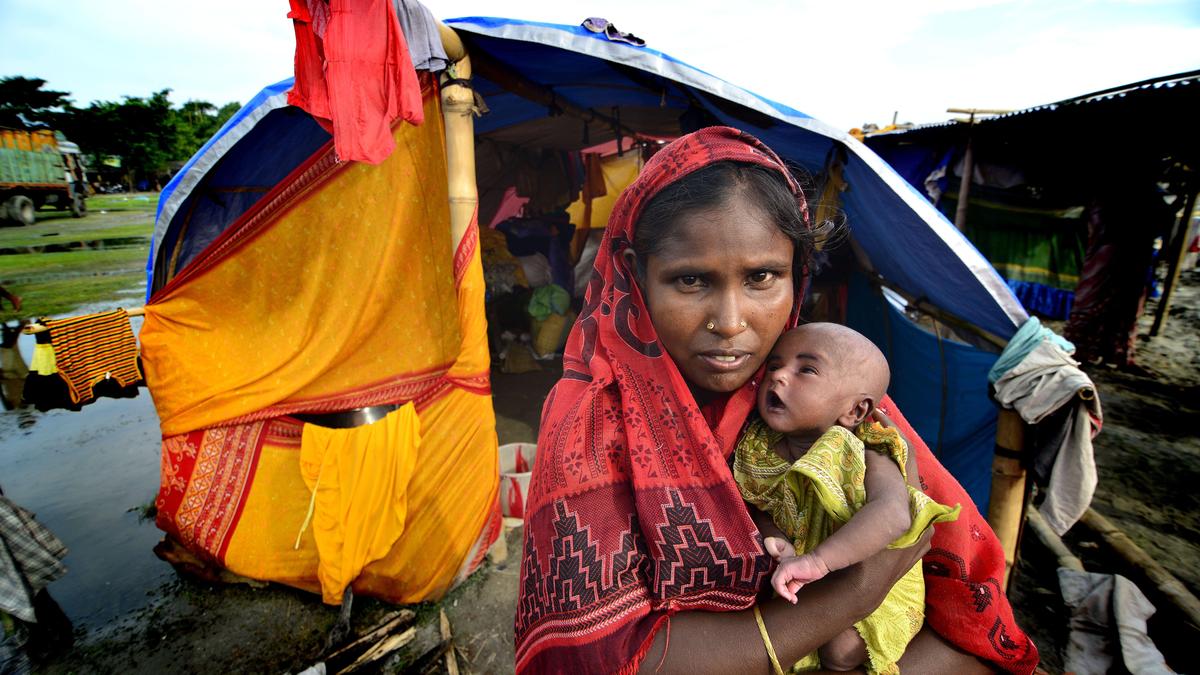
Assam’s maternal health journey demonstrates how sustained policy attention, targeted welfare interventions and improvements in healthcare delivery can produce transformative outcomes even in challenging conditions
| Photo Credit:
Assam’s Maternal Mortality Ratio (MMR) has dropped significantly to 84 deaths per 100,000 live births according to the latest Sample Registration System (SRS) estimates for 2021-2023. The State’s MMR has fallen below the national average of 88 for the first time. This marks a historic turnaround for Assam, which recorded an MMR of 480 during the 2004-2006 period (one of the worst in the country).Assam started from a place of disadvantage in 1992 with almost 44.4 per cent of women married before the legal age of 18 years, almost 50 per cent women did not receive antenatal care during pregnancy and institutional delivery stood at a meagre 11 per cent. In terms of household welfare only 20 per cent of the households had access to electricity. The challenge for Assam was never merely improving from a moderate baseline. It had to reduce maternal mortality while dealing with recurrent floods, difficult riverine and char areas, dispersed rural settlements, large tea-garden population and historically weaker health infrastructure than many western and southern States. The State has come a long way now.To understand the story of Assam’s drastic improvement in maternal health post 2006, one needs to have a comprehensive look at the underlying indicators related to women’s health over the past two decades. Assam’s transformation did not happen in isolation. Behind this decline in MMR lies a quieter story of expanding healthcare access and improving living conditions.The National Family Health Survey provides several proxy indicators that are strongly associated with maternal survival and health outcomes which need to be understood. One can trace major improvements from NFHS-3 to NFHS-6, where institutional deliveries have increased by nearly 286 per cent, meaning that far more women are now giving birth in health facilities rather than at home. Skilled birth attendance has risen to 90.4 per cent, ensuring that childbirth is increasingly supported by trained health personnel capable of responding to complications. These changes are particularly significant because the risks associated with pregnancy and childbirth are often determined in the critical hours surrounding delivery.The gains extend beyond the health system itself. Female literacy has increased by nearly 39 per cent since NFHS-3, equipping more women with the knowledge and confidence to access healthcare services. Access to drinking water has improved by over 28 per cent, while electricity coverage has expanded by an impressive 153 per cent, bringing households closer to information, services and better living conditions. Viewed together, these indicators suggest that Assam’s improvements are not due to any single policy or intervention but due to sustained effort from government and healthcare providers.Understanding the improvement in indicatorsIf one has to understand the improvements in demographic indicators of Assam, one needs to put them in perspective with the policy changes observed especially, from the year 2009 onwards when the government introduced schemes such as the Majoni scheme. It combined maternal health and girl-child welfare objectives. It encouraged institutional deliveries and provided a fixed deposit for girl children, redeemable at age 18 if the girl remained unmarried.Another similar scheme which promoted institutional deliveries is the Mamata Scheme of 2010. The impact is most profoundly observed in institutional deliveries which increased from a mere 22.7 per cent in NFHS-3 to 70.6 per cent in NFHS-4. One also observes an 8 per cent reduction in women getting married before the age of 18 years in this time period. The MMR had reduced to 229 around 2017, indicating that these schemes did have an impact on women’s health.Under the current government, we see an increased focus on grassroots outreach through schemes such as the Orunodoi, and wage compensation for pregnant women in tea gardens which provides direct cash transfer to women beneficiaries. It intends to improve household consumption security and strengthen women’s control over resources. Coverage expanded substantially during 2021-2026 with four million women being the direct beneficiaries of the scheme. It has also been instrumental in improving maternal welfare indicators and female literacy indicators. This improvement is clearly illustrated in the change observed between NFHS-5 and NFHS-6 with female literacy rising to 87.5 per cent, institutional delivery rising to 87.6 per cent. MMR during this period fell from 110 in 2021-23 to 84 in 2022-24, finally placing Assam below the national average.Way forwardAssam’s maternal health journey demonstrates how sustained policy attention, targeted welfare interventions and improvements in healthcare delivery can produce transformative outcomes even in challenging conditions. The State’s achievement in reducing maternal mortality from one of the highest levels in the country to below the national average is not merely a statistical success story but a reflection of broader social change. Rising institutional deliveries, greater access to skilled care, improved female literacy and better household living conditions have collectively created a safer environment for mothers. While challenges remain, Assam’s experience offers an important lesson: long-term investments in women’s health and welfare can yield substantial and measurable gains.Deb is former Chief Economist, Chief Minister’s Secretariat, Government of Assam, and Dubey is Mukherjee Fellow, Policy Politic & Governance FoundationPublished on June 9, 2026