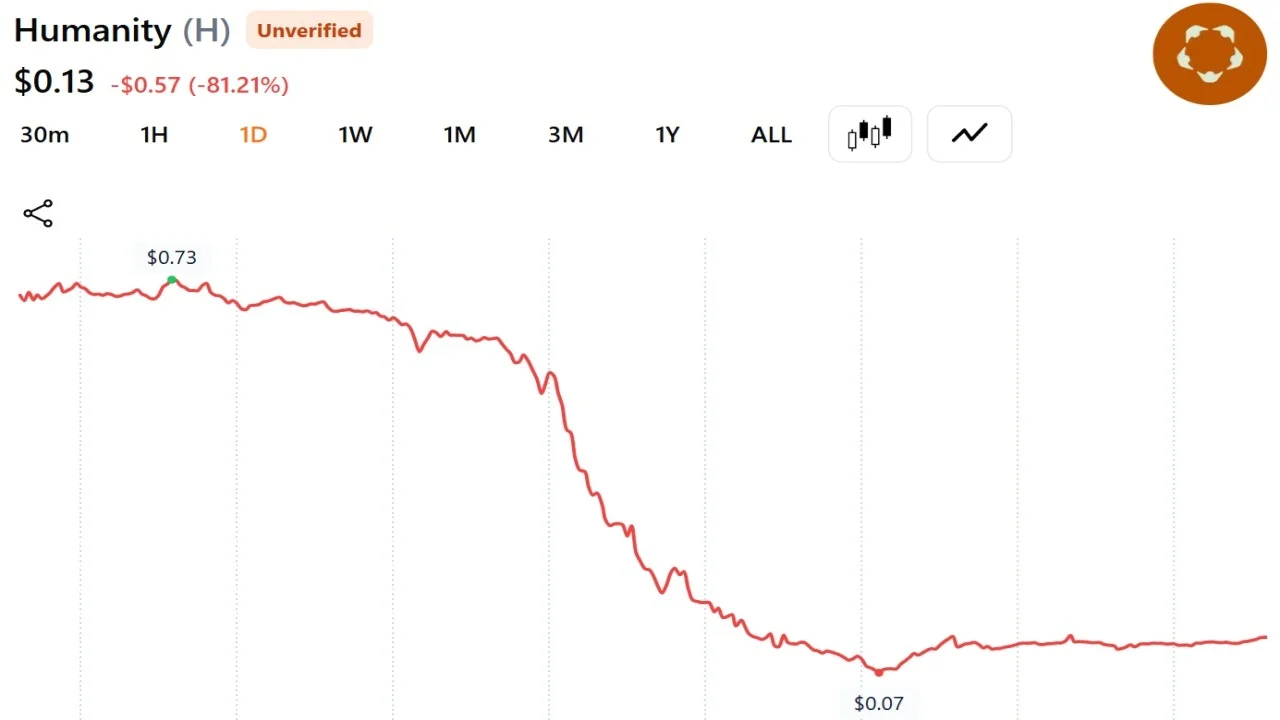
The decentralized identity project said attackers compromised the keys of a foundation member and are dumping the stolen H tokens for ether.Updated Jun 9, 2026, 5:06 a.m. Published Jun 9, 2026, 4:54 a.m. 2 min readMake preferred on Humanity Protocol's H token crashed more than 80% on Tuesday after attackers stole the private keys behind the project and drained more than $30 million, the latest in a year of crypto thefts that go after keys rather than code.About 17 wallets tied to the project were emptied, with losses topping $32 million and still climbing, per on-chain data assessed by CoinDesk.The thief has been selling the stolen H for ether and minted another 100 million H, worth roughly $11 million, on the BNB Chain, blockchain data shows, pointing to more selling pressure ahead. H fell from about $0.67 to near $0.13 and briefly touched $0.05, an intraday drop of about 90%.Humanity confirmed the breach, with founder Terence Kwok saying attackers had compromised the private keys, the secret codes that control crypto wallets, of a member of the Humanity Foundation. The project urged users to stop touching its bridge, the tool that moves tokens between blockchains, and its liquidity pools until the issue is contained, and said it was working with security firms and exchange partners. Humanity Protocol is a decentralized identity project that uses palm-scan biometrics and zero-knowledge cryptography to let people prove they are human without revealing personal data, positioning itself as a rival to Sam Altman's Worldcoin.The hack fits the dominant pattern of 2026, in which the biggest losses have come from stolen keys rather than flawed code. Solana exchange Drift lost about $285 million in April after attackers seized an administrative key, and Kelp DAO lost roughly $292 million the same month through a single-validator bridge.H last traded around $0.13, down about 82% on the day, with the theft still in progress.More For YouThe launch comes as AI agents increasingly emerge as participants in crypto markets, executing trades and managing capital on behalf of users. What to know: MetaMask launched a self-custodial AI agent wallet that allows autonomous software to trade across DeFi while keeping users in control through spending limits, protocol allowlists and two-factor authentication for risky transactions.The wallet's main selling point is security: every transaction undergoes simulation, threat scanning and MEV protection, while transactions deemed...Read full story
Humanity Protocol token crashes more than 80% after a $32 million private-key hack
The decentralized identity project said attackers compromised the keys of a foundation member and are dumping the stolen H tokens for ether.
391 words~2 min read