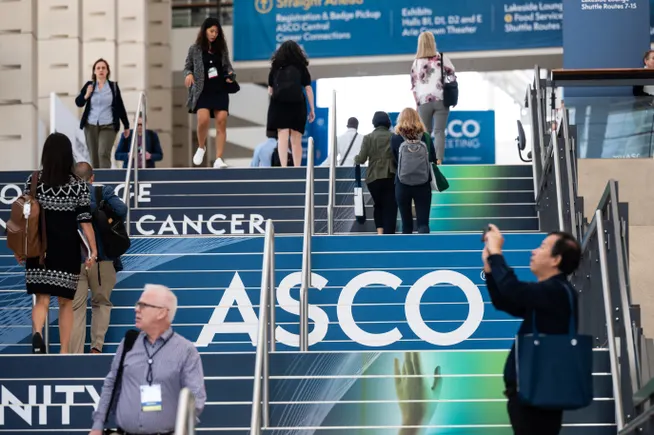
CHICAGO — The American Society of Clinical Oncology’s annual meeting always features data with the potential to change clinical practice. This year’s meeting, though, was headlined by the kind of medical breakthrough cancer researchers have waited years for — and progress for another class of medicine many believe to hold similarly standout potential.
These two headlining presentations from Revolution Medicines in pancreatic cancer and Akeso and Summit Therapeutics’ in lung cancer dominated the discussion at McCormick Place on Sunday. But they were also just two of hundreds of studies that sparked debate that carried on outside presentation rooms and across convention center hallways, as well as at sales meetings, dinner tables and cocktail parties.
Below are three storylines that emerged from ASCO.
A bispecific vs. ADC clash
Bispecific antibodies and antibody-drug conjugates have exploded in popularity in recent years, in part, for their potential to upend more traditional methods of cancer treatment. Bispecifics, as their name suggests, can get after two troublesome targets instead of one. And antibody-drug conjugates, or ADCs, are a form of precision chemotherapy designed to squarely aim tumor-killing toxins at cancer cells while sparing healthy tissue.