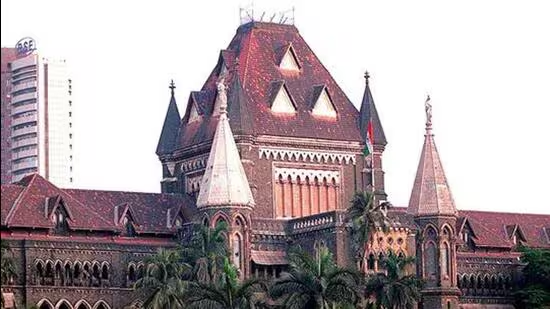
MUMBAI: Granting relief to telecom companies Bharti Airtel Limited and Vodafone Idea Limited, the Bombay High Court on Monday quashed the central government’s decision to levy a one-time spectrum charge retrospectively on telcos for spectrum held above 6.2 MHz 2008 onwards.HC strikes down retrospective one-time spectrum charge on telcos“The Union of India has not been able to justify its unilateral action of issuing the impugned decisions within the four corners of the terms and conditions of the contract/ license agreements or the relevant statutory provision and therefore, the retrospective effect of the same further demonstrates its illegitimacy, rendering the same unsustainable and liable to be set aside,” the division bench of justices Manish Pitale and Shriram V Shirsat said in the order.The dispute arose after the central government, in November 2012, directed that a one-time charge would be levied for spectrum held beyond 6.2 MHz July 2008 onwards. In December 2012, the department of telecommunications specified the rates at which the charge would be levied. The central government subsequently issued demand notices to telcos, specifying the amounts payable towards one-time spectrum charges.Aggrieved by these orders, Bharti Airtel Ltd and Vodafone India Ltd moved the high court in January 2013, claiming that the central government had no power to impose such charges, that too retrospectively.Counsels appearing for the petitioners referred to the 1994 telecom policy, the 1999 new telecom policy, and the license agreements, which were executed and amended subsequently, to contend that there was no source of power available to the central government to have issued the impugned decisions and demand notices.Neither the licence agreements nor provisions of the Indian Telegraph Act empowered the government to retrospectively impose the levy. “The centre, as a licensor, could not have unilaterally sought to change the terms of the contract by imposing one-time spectrum charges without there being any provision in the contract itself,” they said.Opposing the petition, additional solicitor general Anil Singh, advocate Adarsh Vyas and others submitted that spectrum was a material resource of the public, of which the centre was a trustee, and the amounts to be recovered as one-time charges were to be utilised for common good.They rejected the contention that retrospective charges were not sustainable, saying the petitioners were clearly put to notice from 2007-08 about the central government determining spectrum allocation prices. Yet, the petitioners neither surrendered the spectrum, nor challenged the approach adopted by the centre while continuing to exploit the spectrum commercially. “Therefore, the decisions manifested only computation of charge payable, exercise of which was undertaken in the year 2012-13 for additional spectrum allocated for the earlier years,” Singh and others said.The court, however, held that the centre “has not been able to justify its decisions and its action of levying one-time spectrum charge retrospectively upon the petitioners”; the decisions have now become “nothing but executive orders without any source of power, seeking to impose liability retrospectively”, it said.The court examined the 1999 new telecom policy (NTP-99), licence agreements, and Telecom Regulatory Authority of India (TRAI) recommendations, and found out that additional spectrum beyond 6.2 MHz was not allotted “virtually free of charge”, as claimed by the centre.“The documents and the manner in which the objectives and targets of NTP-99 were sought to be achieved, shows that there was no place for imposition of one-time spectrum charge by the decisions in the year 2012, retrospectively for the period beginning in the year 2008.” the court said.Criticising the central government for its “unilateral” action, the court said that it cannot resile from the terms and conditions of the contract and then justify the same by taking shelter in concepts such as “common good, public good, public interest”. “Revenue maximisation was clearly not an objective or target of NTP-99,” and the centre “cannot be permitted to change the contract midway…and then claim that it took the decision in public interest”, the court said.The bench also noted that the petitioners had paid the entire consideration as per the terms and conditions of the contract and yet, the centre had suddenly chosen to impose one-time charges retrospectively.“Such decisions taken on whims by the respondent (centre), which are not justifiable either under the statute or under the terms of contract/ licenses, cannot be sustained and if held otherwise, it would be impossible to conduct business. Thus, we find that the respondent has not been able to identify any source of power to issue the decisions and the consequent demand notices,” the court concluded.
HC strikes down retrospective one-time spectrum charge on telcos
Criticising the central government for its “unilateral” action, the court said the government cannot resile from the terms and conditions of the contract and then justify the same by taking shelter in concepts such as “common good, public good, public interest” | Mumbai news
743 words~3 min read