2 hour(s) ago
Tariq Alam
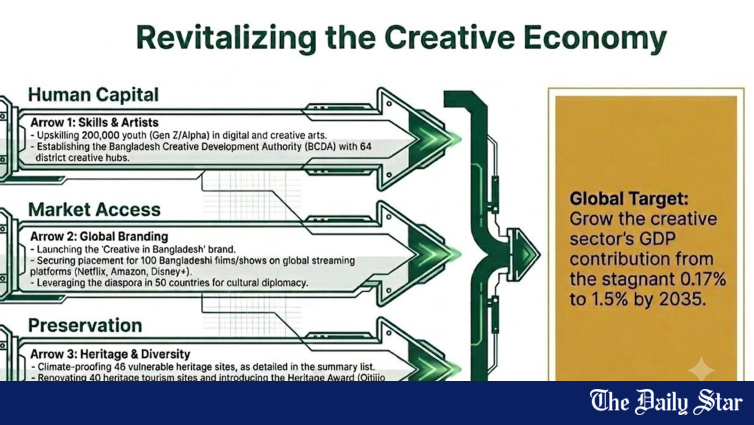
Bangladesh has set itself an ambitious objective: developing a creative economy that can generate jobs, exports and investment through media, entertainment and digital content.Policymakers increasingly recognise that film, television, streaming platforms and digital creators can become important drivers of economic growth, employment and global reach of Bangladeshi content.For this ambition to succeed, Bangladesh must also address a growing challenge that threatens the long-term sustainability of the media and entertainment ecosystem.A creative economy can only thrive when creative assets have value.When intellectual property is routinely copied, redistributed and consumed without authorisation, the incentives that drive investment, innovation and content creation begin to erode.Piracy is therefore no longer merely a copyright issue -- it is a direct challenge to Bangladesh's creative economy ambitions.In Bangladesh today, illegal access to broadcast and entertainment content is no longer confined to obscure websites. It is becoming increasingly normalised.What is often described as “piracy” reflects a broader shift in content distribution.Content is increasingly accessed through a mix of illicit streaming services, social media streams and unlicensed platforms that carry broadcast signals over IP-based networks outside established licensing frameworks.It is the emergence of an unregulated digital distribution layer operating alongside, and increasingly replacing the formal system.As internet penetration rises and streaming becomes mainstream, piracy is expanding rapidly.Bangladesh, with its growing appetite for sports, entertainment and digital content, is entering a critical phase where piracy risks becoming deeply entrenched across the content ecosystem.While the immediate impact falls on broadcasters, rights holders and content distributors, the broader implications extend across the creative economy.For a country seeking to expand the global reach of its content and attract investment into media and entertainment, ensuring that those who create, distribute and invest in content can capture its value becomes increasingly important.Every successful creative economy is ultimately built on intellectual property.Whether through long-form, short-form or creator-led content, the underlying asset is content that can be licensed, monetised and exported.That value chain also depends on broadcasters, Pay TV operators, streaming platforms and licensed distribution networks that invest in acquiring, distributing and monetising local and international content.Piracy directly undermines this model.When it becomes widespread, legitimate revenues decline, weakening incentives to invest in new content and reducing the broader economic contribution of the formal media ecosystem.Investors become more cautious, content budgets shrink, and creators struggle to capture the value of their work.The consequence is not merely lost revenue today but less content, less innovation and fewer opportunities tomorrow.Over time, this can also limit job creation across the broader media and entertainment value chain, from production and distribution to creative and technical professions.Ambitions to increase the global reach of Bangladeshi films, television programmes and digital content will be strengthened by a regulatory environment that gives creators, investors and distributors confidence that intellectual property rights are effectively protected. Bangladesh already has a legal framework.The Copyright Act 2023 prohibits unauthorised distribution and retransmission of broadcast content, including digital distribution over IP networks.The law provides both civil and criminal remedies against infringement. Yet piracy continues to thrive because the challenge is not legal absence but enforcement.As broadcast and internet-based distribution increasingly converge, regulatory responsibilities are spread across multiple authorities, including the Ministry of Information and Broadcasting (MoIB), the Bangladesh Telecommunication Regulatory Commission (BTRC) and relevant authorities responsible for digital governance and cybersecurity.Addressing piracy in its current form therefore requires coordinated enforcement rather than isolated action.Piracy itself is evolving as content distribution becomes increasingly digital and interconnected.It increasingly occurs through digital and IP-based platforms operating outside established licensing and regulatory frameworks, creating new challenges for enforcement. The implications extend beyond lost revenue.These networks often operate outside regulatory visibility, relying on foreign-hosted infrastructure and opaque payment channels, while exposing consumers to cybersecurity risks and weak protections.Piracy is therefore not only a content issue but also a broader question of digital governance and ecosystem integrity.Digitalisation is often presented as an important solution to piracy, but not all digital systems are equal. To be effective, digitalisation must be supported by technologies and systems that enable traceability, content protection, compliance and accurate subscriber reporting.Without these safeguards, digital platforms can simply make unauthorised redistribution more efficient. Effective digitalisation should strengthen visibility, accountability and enforcement.The challenge facing Bangladesh is therefore not one of legislation but of execution.Two priorities stand out. First, more effective enforcement of existing laws, supported by stronger coordination between broadcasting, telecommunications and digital governance authorities to address increasingly complex digital distribution models.Second, a structured approach to digitalisation that prioritises transparency, traceability and system-wide accountability.As Bangladesh seeks to strengthen its position in media and entertainment, the protection and commercialisation of creative assets will become increasingly important to attracting investment, supporting innovation and fostering sustainable growth.In this context, piracy should be viewed through a broader lens of economic competitiveness and digital governance.Bangladesh's creative economy will increasingly depend on its ability to create, monetise and export intellectual property.As media, entertainment and digital content become more important drivers of growth, ensuring that creators and investors can realise the value of their work will be essential.Ultimately, the success of the creative economy will depend not only on producing more content, but also on creating the conditions that allow that content to generate lasting economic value.While an established legal framework exists, the opportunity now lies in strengthening enforcement, improving coordination across institutions and building a digital ecosystem that supports innovation, investment and accountability.Doing so can help create the conditions for a more vibrant media and entertainment sector and support the continued growth of Bangladesh's creative economy.The author is a strategic consultant across technology, media and infrastructure industries