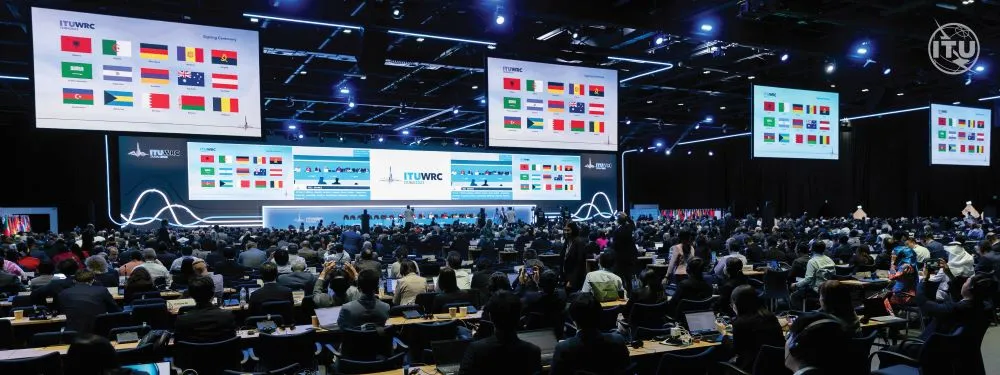
Nearly 4,000 people attended WRC-23 to debate worldwide regulations that affect how companies provide communications service. Credit: ITU
For anyone who wasn’t sure whether China was in it to win the space race and dominate the rapidly growing space economy, its filings in December for 200,000 more satellites should dispel all doubts. Beijing is seeking to position itself as a leader in low Earth orbit satellite constellations, electronic warfare and the space race more broadly. But the next battleground in this race is a regulatory conference, not the launchpad.
In late 2027, global regulators will gather in Shanghai for the International Telecommunication Union’s 2027 World Radiocommunication Conference (WRC-27), where about 80% of the agenda addresses space and satellite issues. The results will have profound effects that extend beyond the space economy and space exploration to national security, political influence and the future balance of power.
The competition to establish low Earth, also known as non-geostationary orbit (NGSO) satellite constellations is particularly fierce and growing more intense. In sheer numbers, the United States currently has an advantage based on Starlink’s constellation of more than 10,000 satellites. Other companies, notably Amazon and AST Space Mobile, are well underway in launching constellations of their own. And more are coming. However, China is not that far behind, rapidly scaling its national champions, Guowang and Qianfan. If America wants to maintain its leadership, government and industry players must act now to make success at WRC-27 a strategic priority for advancing the United States’ broader space and technology strategy.