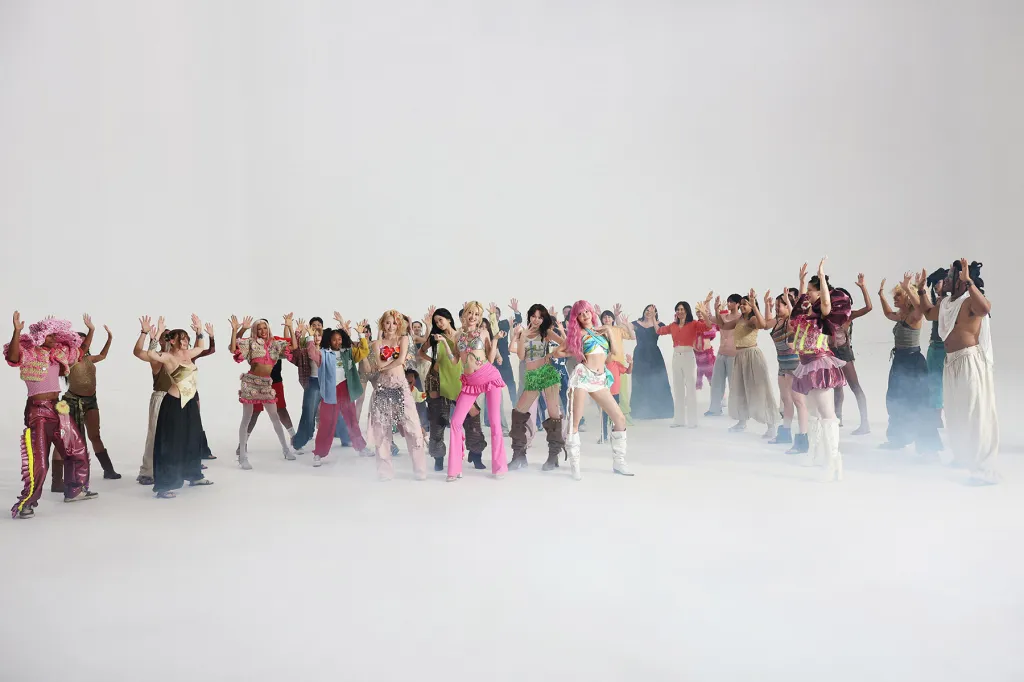
K-pop artists increasingly revisit familiar melodies as agencies seek broader mainstream appeal Le Sserafim (Source Music) Listen to Le Sserafim’s latest song, “Boompala,” and it might sound familiar.The lead single from the group’s second album, “Pureflow Pt. 1,” samples elements of Los del Rio’s 1993 global hit “Macarena,” with the song incorporating parts of its iconic melody and the video reinterpreting aspects of its signature choreography.The group's use of sampling as a strategy to appeal to global audiences seems to be paying off, as the album recently debuted at No. 10 on the Billboard 200 chart, while “Boompala” peaked at No. 10 on Billboard’s Bubbling Under Hot 100 chart.Sampling differs from plagiarism in that it requires permission from copyright holders. For “Boompala,” both writers of "Macarena" — Rafael Ruiz Perdigones and Antonio Romero — were credited as songwriters, reflecting the standard industry practice for authorized samples.Le Sserafim is not alone in the sampling trend.Across K-pop, more artists are turning to well-known pop songs and classical compositions as source material for new releases, creating a growing trend that industry observers say is helping broaden the genre’s appeal beyond its traditional fan base.During an interview held ahead of the album's release, Le Sserafim told the press that hearing “Macarena” immediately brought back memories.“Because ‘Macarena’ is such a globally recognized song, we felt that people of all ages and backgrounds would be able to enjoy and dance along to it, and that we’d be able to share the joy behind our music with everyone from around the world,” member Yunjin said. NCT Wish (SM Entertainment) Other recent examples of the music sampling trend include NCT Wish’s “Ode to Love,” which draws from Irish rock band The Cranberries’ “Ode to My Family” — a tune widely recognized in Korea via the comedy program “Gag Concert” — as well as Ive’s “Attitude,” which incorporates the recognizable melody from Suzanne Vega’s “Tom’s Diner.”Classical music has also become a popular source of inspiration.Blackpink demonstrated this trend by reinterpreting Niccolo Paganini’s “La Campanella” for its 2022 hip-hop-based track “Shut Down,” while Red Velvet’s “Feel My Rhythm” blended K-pop with melodies from Johann Sebastian Bach’s “Air on the G String.”More recently, girl group Meovv sampled Bach’s “Toccata and Fugue in D Minor” for the main track of its second EP, “Ddi Ro Ri.” During a media showcase on June 1, the group members acknowledged the pressure of reworking a widely recognized classical composition but said they saw the song as “an opportunity to showcase (their) evolving musical identity and willingness to experiment across genres.” Meovv (The Black Label) Industry observers view the rise of sampling as part of K-pop’s effort to reach broader audiences by connecting contemporary releases with melodies that listeners may already recognize.Music critic Lim Hee-yun added that sampling famous tracks in new releases can help extend K-pop’s reach by drawing from songs that have already stood the test of time.“K-pop trends tend to move quickly, and the popularity of many songs is relatively short as new releases become more frequent,” Lim said. “By incorporating fragments of songs that have remained relevant for decades or even centuries, artists can expand K-pop’s musical scope to reach even those who don’t regularly tune into the genre.”Even so, culture critic Kim Heon-sik warned that excessive reliance on sampling could carry risks.“If it becomes too common, listeners may feel that artists are relying on proven hits rather than presenting truly original creations,” Kim said. “There’s also the possibility of diminishing the artistic value of the original work if it is not reinterpreted thoughtfully.”
Classic hits, pop anthems find new life as K-pop embraces sampling trend
Listen to Le Sserafim’s latest song, “Boompala,” and it might sound familiar. The lead single from the group’s second album, “Pureflow Pt. 1,” samples elements
593 words~3 min read