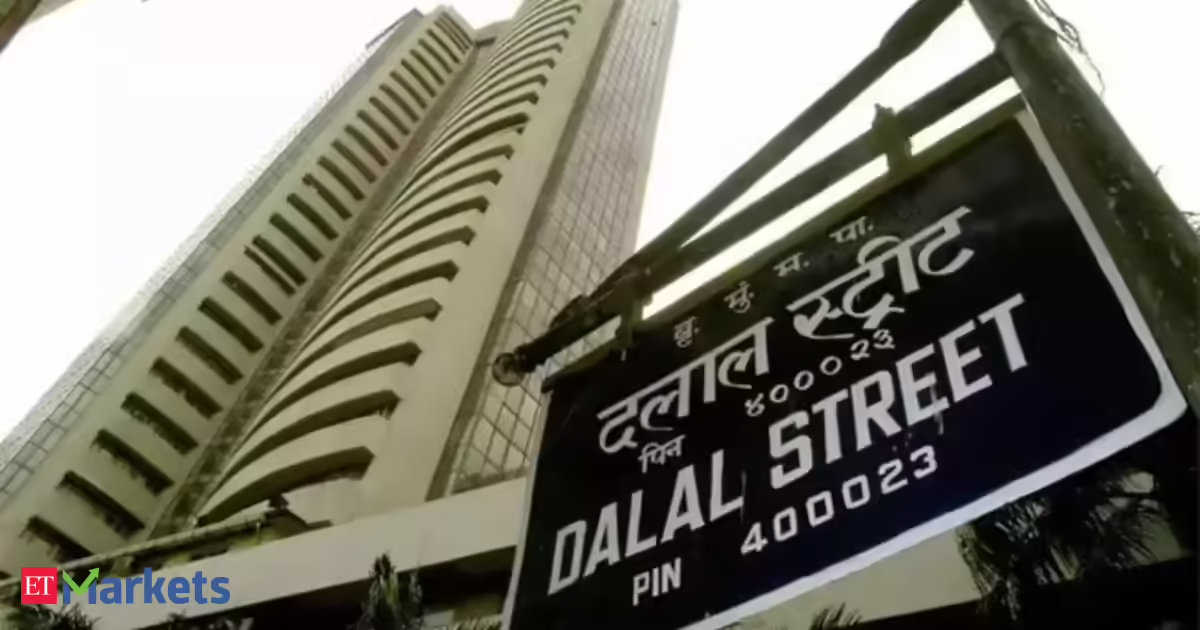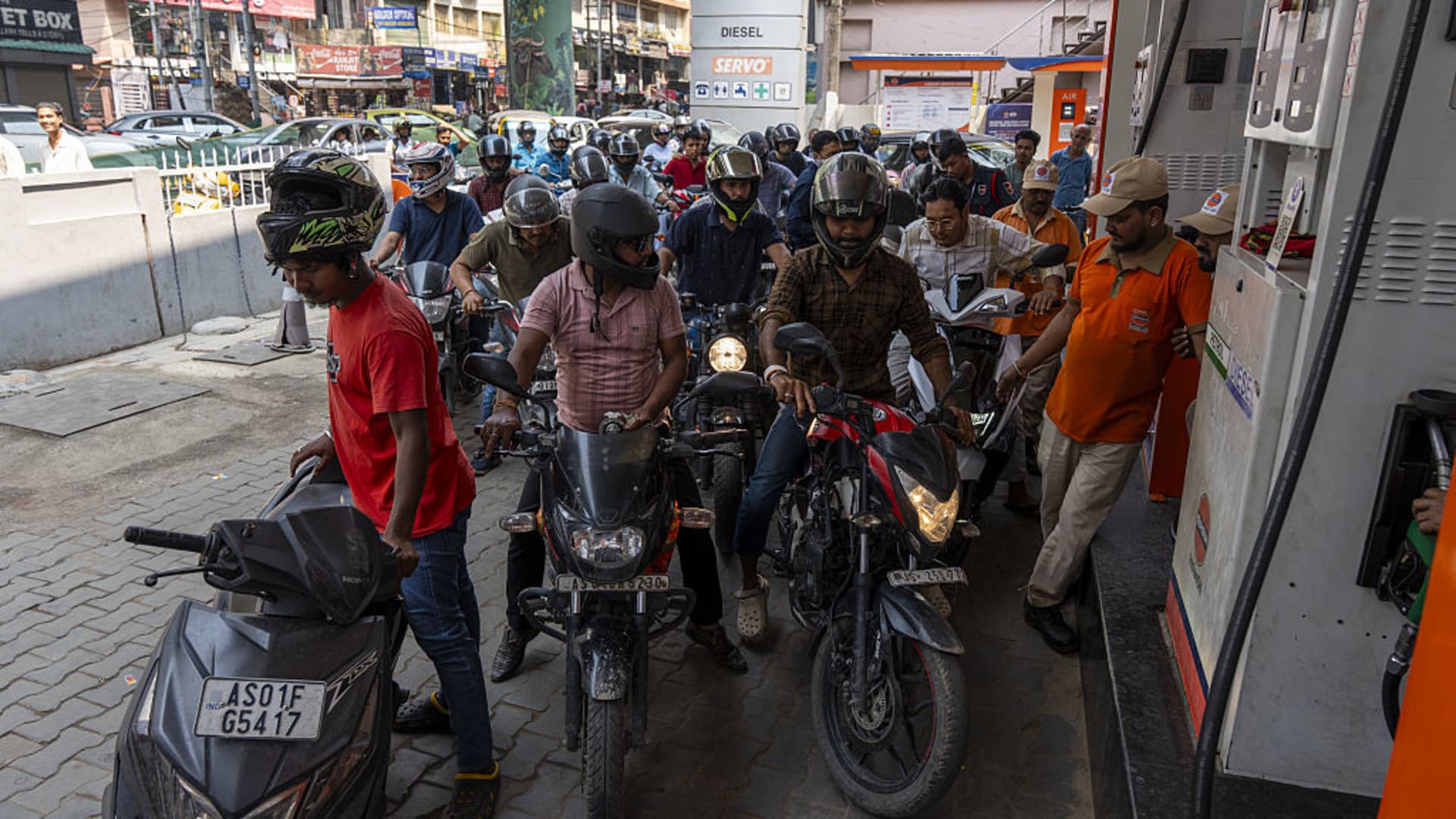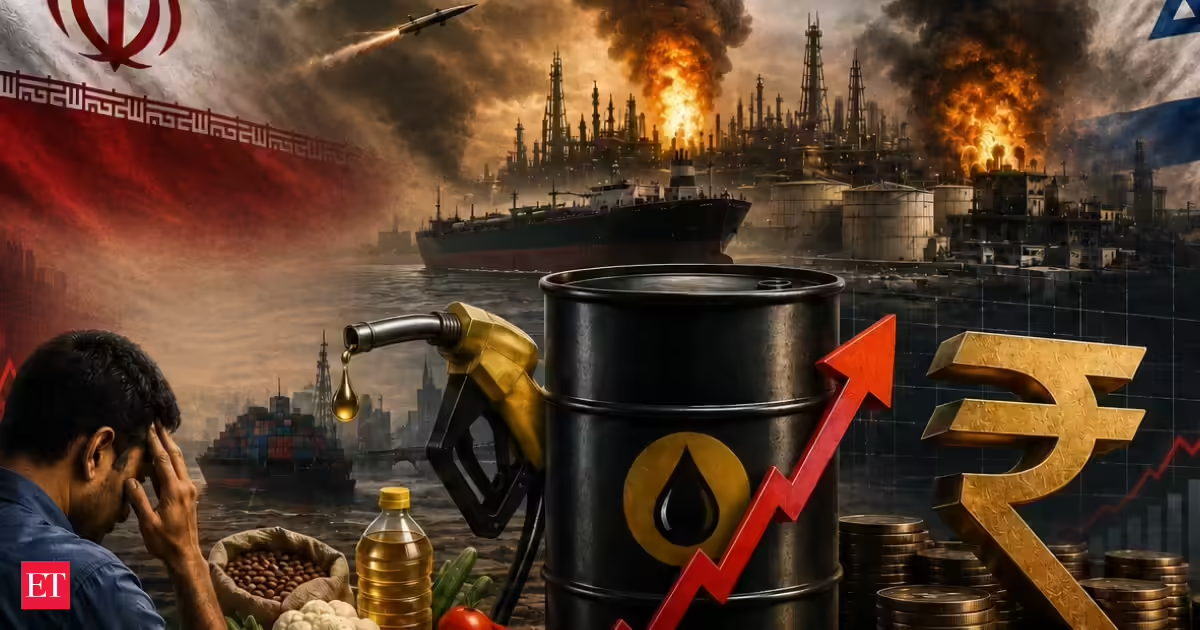
The escalation of the West Asia war into a 100-day conflict has combined with a violent structural unwinding of the global artificial intelligence trade to hit Indian equities. The combined market capitalisation of BSE-listed stocks collapsed by Rs 4.5 lakh crore as the Nifty index slid roughly 7%, exposing the domestic market to severe global crosswinds.India’s equity ecosystem faces a dual threat: geopolitical stress that has pushed Brent crude above $96 a barrel, and a sharpening exit by foreign institutional investors (FIIs), who have dumped a record $28 billion year-to-date (YTD). This foreign flight intensified dramatically over the past two weeks, with nearly $4 billion in outflows driven by passive regional liquidations. The sell-off coincides with systematic downgrades to India's corporate earnings cycle, with analysts trimming CY26 MSCI India profit forecasts to 13% from 16% since the West Asia war began.The local correction, tracking a sharp 4.18% cut in the Nasdaq, has rattled global ecosystems, sending shockwaves through technology-dominated hubs like South Korea and Taiwan."There are strong headwinds for the market this week," said Dr VK Vijayakumar, Chief Investment Strategist at Geojit Investments Limited. "The escalation of conflict in West Asia, with Iran firing missiles at Israel in retaliation for Israel’s aggression in Lebanon, has hardened crude prices. Brent has moved above $96. The jobs data from the US is good, and therefore the Fed will not cut rates as President Trump wants. Rates are likely to be on hold for some time."However, the tech-led rout in global benchmarks may offer an unexpected structural silver lining for Indian equities via capital reallocation."It is important to note that the sell-off in the US on Friday was a tech-led sell-off. This can trigger a rotation from AI trade to non-AI trade, which can be beneficial for India. If the AI trade cools down and reverses, that can trigger a reversal of FPI outflows. Therefore, watch this trend," Dr Vijayakumar said.Also Read | The AI play no one is talking about: Why BofA is snapping up power & metals instead of ITWhich stocks fell the most?Market data shows that the escalation has heavily penalised specific pockets of the domestic market, with banking and financial services bearing the brunt of the liquidations. While Nifty has lost over 7% of its value in the last 100 days, PSU banks have been hit the hardest. The Nifty PSU Bank index is down nearly 16% since the war began, wiping out over Rs 3.6 lakh crore in market capitalisation. State Bank of India has shed 18.6% of its value. Bank of Baroda is down 18.1%. Punjab National Bank has lost 17.5%. Union Bank of India has slipped 17.4%. Bank of India has declined 19.6%.Oil and gas stocks have been hammered, down roughly 9.4% as a sector. Bharat Petroleum Corporation is off 23.5%. Indian Oil Corporation has fallen 26.2%.Nifty Bank is down 9.97% since the conflict began. Private banks have fared slightly better but are still down over 8%. ICICI Bank has slipped 8.5%. Axis Bank is off 8.1%. Nifty IT is down 5.2%, squeezed by the Nasdaq rout. TCS has dropped 16.6%. HCL Technologies has fallen 16.9%. Infosys is off 7.9%.Auto has not been spared, with Nifty Auto down 7.1%. Tata Motors has lost 26.9%. Ashok Leyland is off 31.2%.Nifty Financial Services has lost over 10% of its value. Insurance companies, NBFCs and financial services firms have taken a uniform beating. HDFC Life Insurance is down nearly 20%, ICICI Prudential Life down 26.2%, and SBI Cards down 23.9%.Among individual blue chips, Reliance Industries has shed 7.4%. HDFC Bank is off 15.8%. ITC has lost 10.5%. Maruti Suzuki is down 12.2%. Bajaj Finance has declined 10.7%. Godrej Consumer Products is off 18%.On the other hand, pharma and healthcare have outperformed sharply. Nifty Pharma is up 5.6% over the period. The Nifty Healthcare index has gained 3.6%. Capital markets, defence, metals and energy have also gained.Small and mid-cap indices like Nifty Smallcap 100, Nifty Smallcap 250 and Nifty Midcap 100 have held firm or gained, reflecting a domestic growth narrative that has partially decoupled from global tech.The outlook for a rapid recovery remains clouded by regional corporate earnings revisions. Goldman Sachs analysts indicated that India’s earnings metrics could weaken further over the next two months."We expect foreign flows in equity to remain subdued on expectations of a worsening earnings cycle ahead," Goldman Sachs said in a research note, adding that its indicators suggest "India will see another 3% EPS cut in the coming two months, greater than most markets in the region."To counter capital flight, the Reserve Bank of India (RBI) and the government have rolled out structural measures to build a forex buffer. These include exempting interest and capital gains from FPI investments in government securities from taxation, absorbing hedging costs on FCNR deposits, increasing the forex swap window, and boosting access to government bonds via the FAR route.These adjustments have provided immediate stability to the local currency. The Indian rupee, which had depreciated to a historic low of 96.96, has strengthened to around 94.94. This appreciation is expected to act as an anchor, deterring FIIs from sustained panic selling.What should investors do?As the domestic market re-baselines, valuation divergences have emerged between capitalisation tiers, reshaping fund manager strategies. Domestic institutional investors (DIIs) continue to provide counter-cyclical support, absorbing liquidations with a $44 billion YTD commitment.Fund managers say parts of the broader market have corrected enough to offer selective valuation comfort:"Broad concerns regarding valuation levels in the market have cooled off in recent months," said CA Anupam Tiwari, Equity Chief at Groww Mutual Fund. "At the current juncture, close to one-third of the mid-cap space is priced below its five-year average valuation levels, whereas nearly half of the small-cap space is trading below its own five-year average valuation levels. A multi-cap strategy, together with bottom-up investing, can work well."Conversely, some institutional allocators see the primary margin of safety in large caps."At an index level, large caps are trading below their long-term average valuations, while mid- and small-cap stocks are trading above them," said Hiten Jain of Invesco Mutual Fund. "This divergence suggests greater valuation comfort and a stronger margin of safety in large caps."Near-term corporate earnings are expected to remain uneven, with initial growth concentrated in commodities, metals, mining and select energy companies benefiting from higher oil prices. However, asset managers expect earnings expansion to broaden to financials, consumer, industrial and healthcare sectors once tensions ease and supply chains normalise.(Data: Ritesh Presswala) (Disclaimer: Recommendations, suggestions, views and opinions given by the experts are their own. These do not represent the views of The Economic Times)
100 days of Iran war, Rs 4,50,000 crore wiped out: Is your stock portfolio safe from missiles?
Indian equities have lost Rs 4.5 lakh crore in 100 days as the Iran-led West Asia conflict and a global AI trade unwind trigger sharp FII outflows. Banking, oil and IT stocks led declines, while pharma outperformed. Analysts warn of earnings downgrades, though valuations are turning attractive in select segments.
1,096 words~5 min read