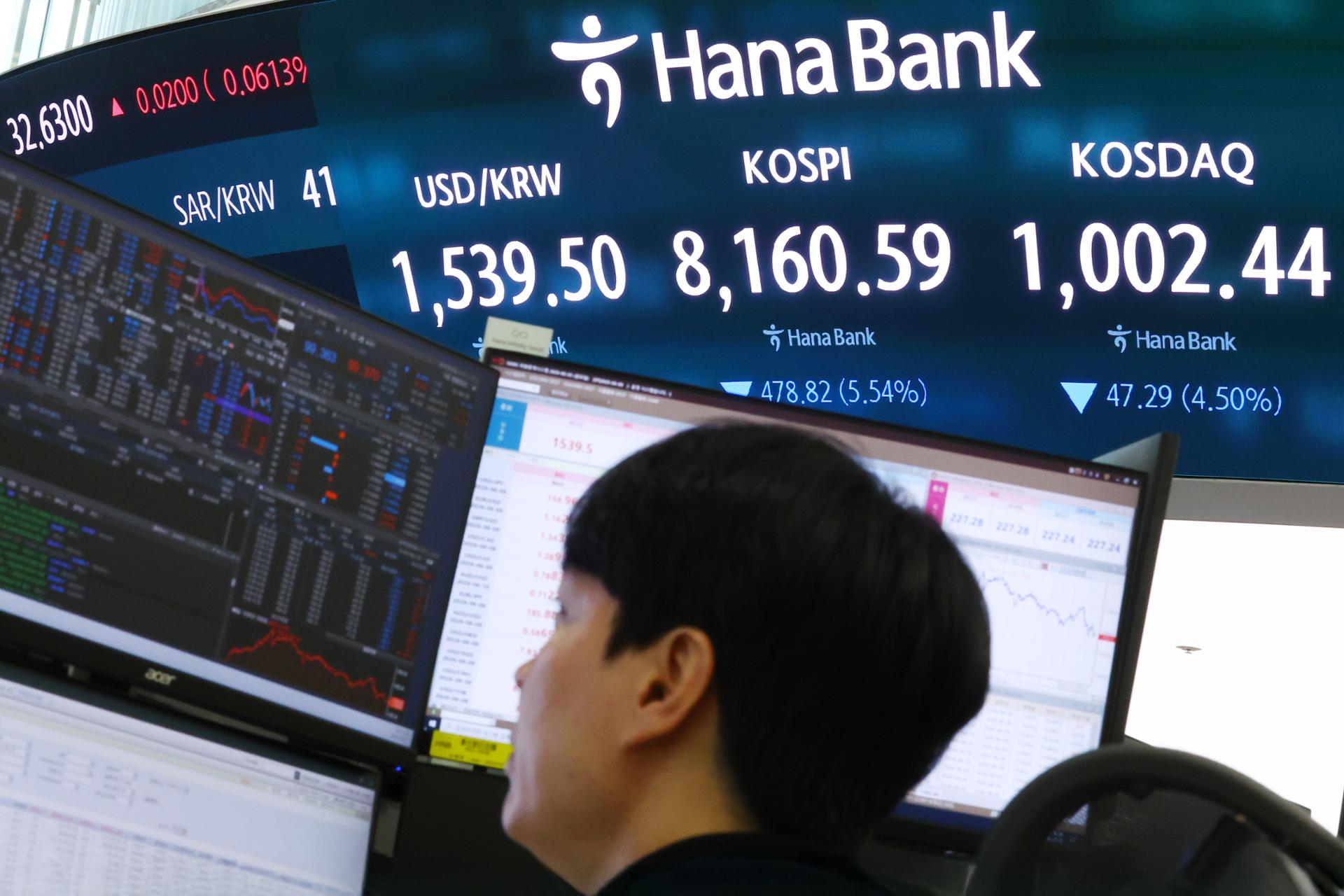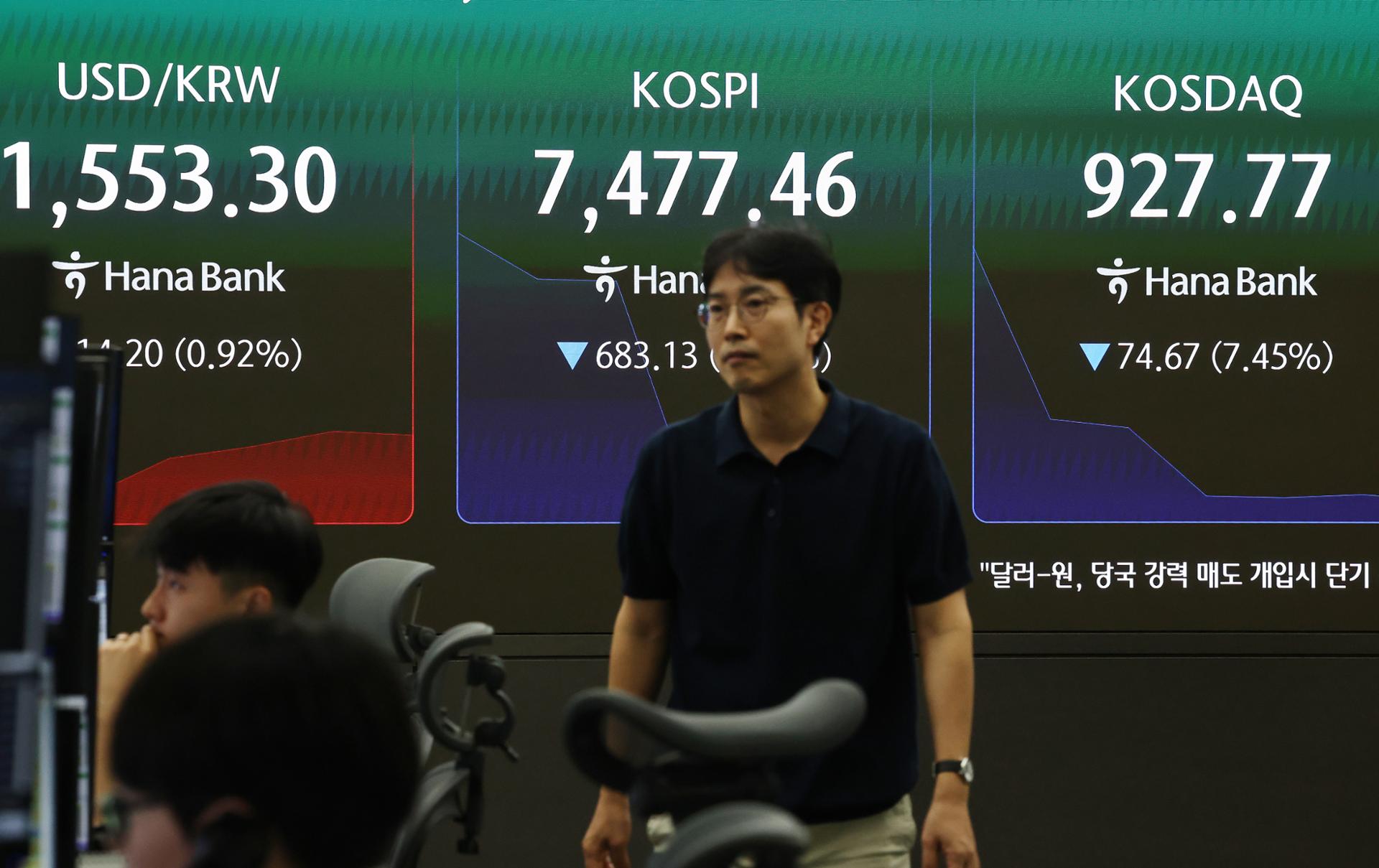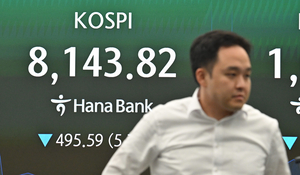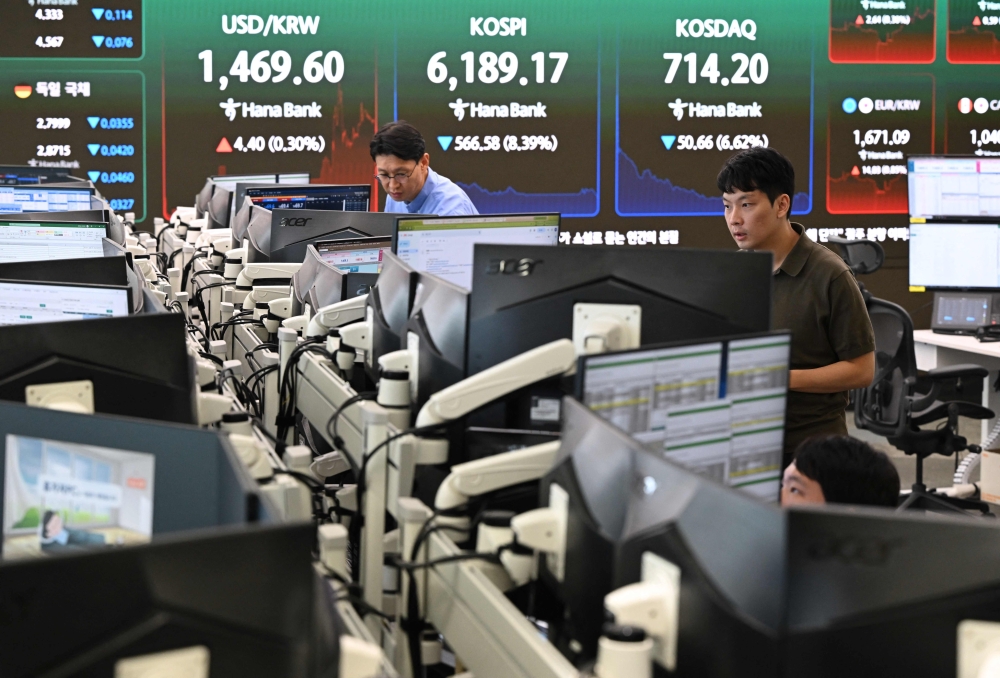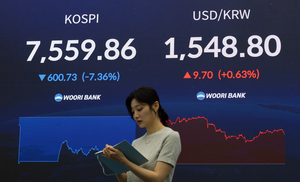
Authorities step up warnings as won slides to 16-year low A financial data screen at Woori Bank's dealing room in central Seoul shows the Kospi standing at 7,559.86, and the won quoted at 1,548.8 per dollar during trading, Monday. (Yoon Chang-bin/The Korea Herald) The South Korean benchmark Kospi suffered the worst day of the year as chip stocks tumbled, mirroring a rout in US semiconductor stocks on Wall Street.Soon after opening 1.38 percent lower at 8,048.09, selling accelerated, pushing the index below the 8,000 mark. The index later recouped some of its losses in afternoon trading but was still down 5.18 percent at 7,737.63 as of 1:30 p.m.A circuit breaker was triggered at 9:03 a.m., halting program trading for 20 minutes. The measure was activated on the Kospi market for the third time this year, marking its first activation in three months since March 9.Trading resumed at 9:23 a.m., but persistent foreign selling pressure triggered a sell-side sidecar at 9:34 a.m., prompting a second intervention within minutes.The junior bourse Kosdaq also opened down 4.27 percent at 959.61, falling below the 1,000-point mark. At 9:06 a.m., the index plunged 7.58 percent to 926.42, triggering a sell-side sidecar. It stood at 936.98, down 6.53 percent as of 1:30 p.m.Foreign investors pushed the benchmark down, net selling shares amounting to 1.24 trillion won ($805 million), while retail and institutional investors purchased a net 936.9 billion won and 151.1 billion won, respectively.Chip stocks led the plunge with Samsung Electronics shedding 6.08 percent to 309,000 won. SK hynix dipped 3.09 percent to 2.006 million won as of 1:30 p.m.Earlier in trading, Samsung Electronics inched down to as low as 292,500 won, while SK hynix hit 1.85 million won.SK Square tumbled 8.03 percent to 1.157 million won, while Hyundai Motor dropped 6.64 percent to 653,500 won.The market rout followed steep losses on Wall Street on Friday, with a plunge in semiconductor stocks dragging the tech-heavy Nasdaq Composite down 4.18 percent.“The US sell-off on Friday was not driven by a single shock factor such as war or oil prices, as seen in past market downturns. Instead, it reflected a confluence of macroeconomic pressures — including the Federal Reserve outlook and labor market data — and company-specific fundamentals tied to Broadcom, Nvidia and Xai,” Yang Hyeong-mo, analyst at DS Securities, said.“Concerns are growing that valuations have already priced in much of the rosy outlook, leaving the market vulnerable as it enters a phase where lofty expectations could become a burden.”Meanwhile, Bloomberg reported Sunday that investors are becoming more cautious on South Korean equities, with some moving to hedge exposure and pare back crowded positions.While the Korean market “captured global attention as a combination of the AI boom and the government’s successful corporate reform,” the extended rally has left the market “vulnerable to abrupt reversals,” the report said.The won also struggled amid the heavy foreign selling pressure. It was quoted at 1,555.2 per dollar at the start of the onshore trading, marking its weakest level against the dollar since March 6, 2009, in the wake of the global financial crisis.During overnight trading on Saturday, the won had also weakened past the 1,560-per-dollar mark.With the won’s sharp depreciation, the foreign exchange authorities signaled their readiness to step in if volatility persists."Recent volatility in the forex market appears to have been amplified not only by supply and demand factors but also by speculative foreign exchange transactions, including those in the non-deliverable forward market," said Yoon Kyoung-soo, director general of the International Department at the Bank of Korea, and Lee Hyung-ryul, director general of International Finance at the Finance Ministry, through a joint statement."We will not tolerate excessive volatility or one-sided market movements that are inconsistent with economic fundamentals and will strongly respond to such developments."Following the verbal intervention, the won partly recovered its strength and was quoted at 1,546.82 per dollar as of 1:30 p.m.
Kospi suffers worst day of year as global chip rout spreads
The South Korean benchmark Kospi suffered the worst day of the year as chip stocks tumbled, mirroring a rout in US semiconductor stocks on Wall Street. Soon aft
645 words~3 min read