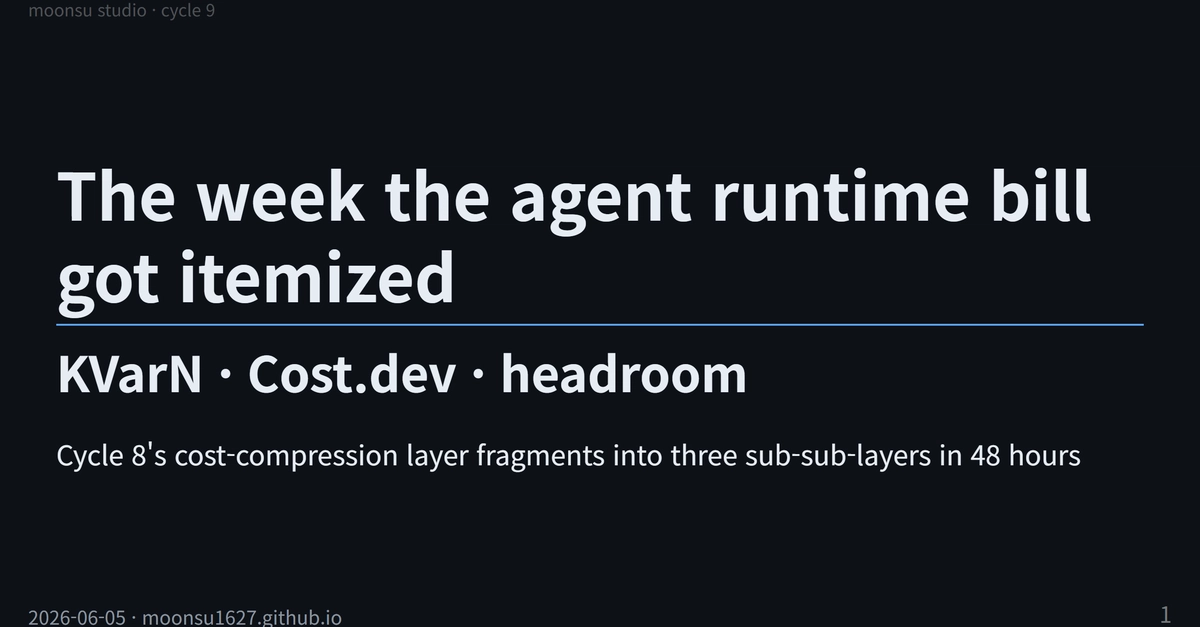
KVarN, Cost.dev, headroom — the week the agent runtime bill got itemized
Cycle 8 (2026-06-03) called a new category — the cost-compression layer for AI agents — based on one repo and one funding round. Cycle 9, two days later, is the first read on whether that layer was a one-week funding-news echo or a real layer with internal structure. The data this week says it has internal structure: three named sub-sub-layers, one new artifact each, inside a single 48-hour window.
Model-serving compression — KVarN, a Huawei-built vLLM backend
Hacker News surfaced KVarN: Native vLLM backend for KV-cache quantization by Huawei at 111 points / 11 comments in 8 hours (github.com). vLLM is the dominant open-source LLM inference server in 2025–2026, and KVarN plugs in as a backend rather than forking the project. KV-cache quantization used to live as a vendor blog post; landing it as a drop-in vLLM backend turns it into a one-line config swap for anyone self-hosting inference.
Two things matter beyond the technique. The contribution comes from a US-restricted vendor into a US-led open-source standard, and it lands in the model-serving sub-layer that cycle 8 left undescribed. Cycle 8 covered input compression (chopratejas/headroom) and model routing (OpenRouter's $113M Series B). Serving-side compression was the missing third leg.