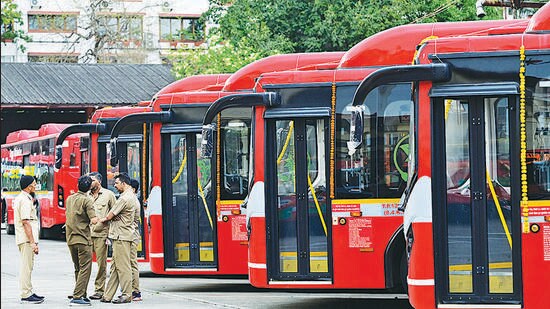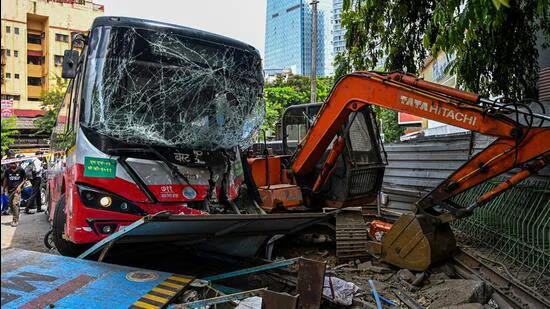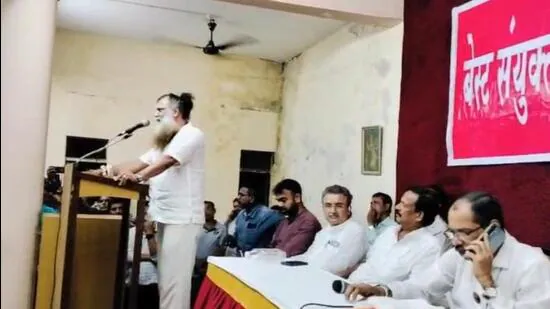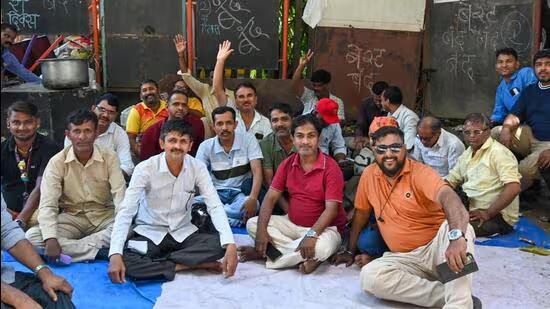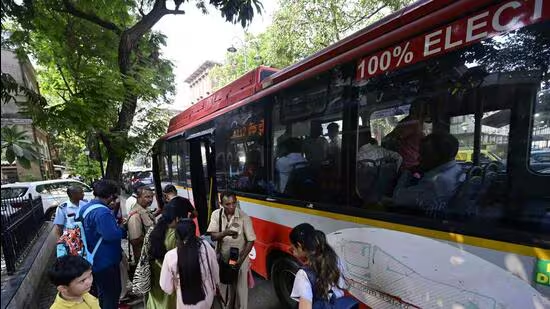
MUMBAI: Nearly five years after the BEST undertaking launched its premium bus service through a private operator called Chalo, BEST Committee members are seeking a careful examination of its contract.BEST committee members lock horns with its premium bus service ChaloThe committee has alleged that the private entity is minting money from its ticket collection and advertising revenue. However, Chalo denied this, stating that the business was being run at a steep cost, with monthly losses of around ₹1.5 crore and a cumulative loss nearing ₹90 crore over its years of operation in Mumbai.BJP leader and BEST Committee member Sunil Ganacharya raised questions on the ₹50 lakh invested by BEST in the first 100 electric buses as per a clause in the agreement with Chalo. “Has such a big investment been made?” he asked. “How was such a big amount raised? The administration needs to come clean on whether it sought a loan, and at what interest rate, or whether it paid from its own kitty. How has the money been shown in the BEST budget?”Ganacharya, who has sought details of the bank guarantee given by BEST to Chalo, stated that the company was also “using the BEST brand, which has tremendous value, for free”. When HT questioned Chalo about this, the company stated that the branding of BEST was as per the tender contract without any deviation. About the ₹50 lakh, it said that this was the only subsidy it had received from BEST, and that it was paying 4% to BEST and 3.5% as passenger tax to the government.“The ₹50 lakh was handed over to the OEM bus manufacturers who get this subsidy and not us, the bus operator,” explained a senior Chalo spokesperson. “We won the contract fair and square. We have spent money from our own investment and loans.” The spokesperson added that the subsidies were government subsidies available to all electric buses at the time under various central and state schemes. The capital cost of the fleet was borne by Chalo.The committee has also sought information from the BEST administration on the Chalo bus fleet. “Are all these buses on EV? How much money was spent on setting up charging points for them, and in which depots have they been placed? Who is paying the bills for the charging? There are a lot of unanswered questions on which the administration should come clean,” said Ganacharya.The committee members alleged that BEST was providing Chalo with free parking and charging facilities for its buses. However, the company refuted these allegations. “We are allowed to park our buses only at the Marol and Anik depots; we have bought space to park at bus depots outside Mumbai,” said a company spokesperson. “As for charging, we have spent on EV infrastructure and have our own charging stations. Seventy-seven percent of our fleet is electric.”The committee members also contested the fares charged by Chalo, which are much higher than regular BEST fares: Chalo’s starting fare is ₹20 as opposed to ₹12 for a regular BEST AC bus. To this, the company said that the average fare per kilometre worked out to ₹4.5 to ₹5, which was far less than the money spent on an auto rickshaw, taxi and two-wheelers. Chalo buses also do not allow standees, making for more comfortable journeys.The company had in the recent past sought a fare hike of ₹7 to ₹8 per kilometre from the Regional Transport Authority (RTA) under the government’s transport department. BEST Committee chairperson Trushna Vishwasrao has directed the administration to provide details of their contract with Chalo.Chalo admitted that it had not fulfilled its mandate of bringing in 3,000 premium AC buses. “We have managed only 135 so far due to overall losses,” said the spokesperson.
BEST committee members lock horns with its premium bus service Chalo
The committee has alleged that the private entity is minting money from its ticket collection and advertising revenue | Mumbai news
622 words~3 min read