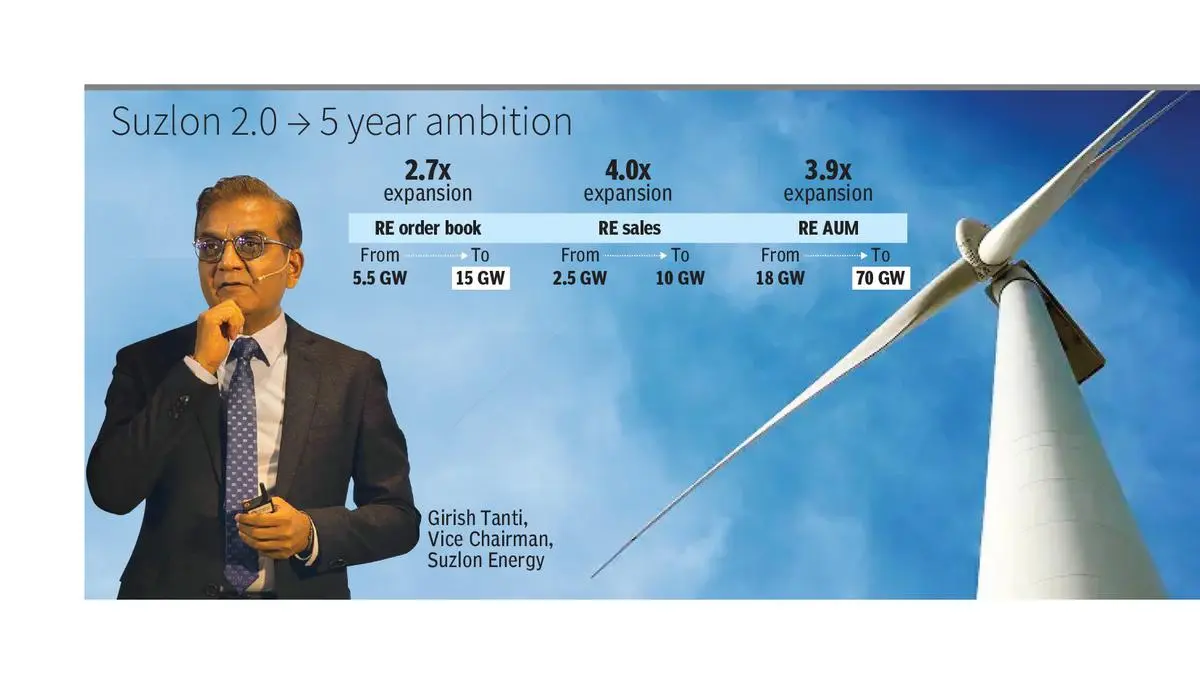
Wind turbine manufacturer Suzlon Energy recently held a press conference to announce its new avatar, Suzlon 2.0. But what the company revealed was nothing new really.Suzlon 2.0, said Vice Chairman Girish Tanti and newly appointed CEO Ajay Kapur, is the transformation of the company from a solely wind turbine manufacturer into an end-to-end solutions provider, bringing in solar (with partners) and battery storage.The company had earlier spelt out to journalists and investors its intention to ginger up project development activities such as land acquisition and connectivity ahead of order wins, under its ‘DevCo division’.In fact, this approach — truly a redux of the early days of wind industry in India — had helped Suzlon bag, for instance, a 250 MW order from steel major ArcelorMittal in January. So, what is new in Suzlon 2.0?When businessline put this question to Tanti, he replied that while the company had directionally revealed its intentions earlier, Suzlon 2.0 was a clear five-year roadmap with carefully fixed targets. He further said that the company had disclosed the targets because it was willing to be judged against them in future.The targets are indeed the sit-up-and-take-notice kind. Three sets of numbers illustrate this: the order book would increase from 5.5 GW to 15 GW by 2030-31, annual sales from 2.5 GW to 10 GW, and ‘assets under management’ (namely operations and maintenance, or O&M) from 18 GW to 70 GW.Limited competitionAs for the order book and sales, Suzlon’s fortunes seem to have hitched a ride on luck — a payback of sorts for holding its ground during a decade of difficulties after its abortive takeover of RE Power of Germany in 2007, a leveraged move that messed up Suzlon’s finances.Today, the company enjoys a strong position in a market where meaningful competition remains limited. The Chinese company Envision is one significant rival. Inox and Adani derive a substantial portion of demand from their own renewable energy ecosystems. During a recent investor call, Inox declined to disclose its turbine volumes, saying revenue was a better indicator of business performance. Other global players such as Vestas, GE and Senvion have only a limited presence in India, while Siemens Gamesa has sold its Indian wind turbine business to an investor group led by a member of the Chennai-based Murugappa family.In 2025-26, India saw 6.05 GW of sales; Suzlon had 40 per cent of it. Tanti vehemently disagrees that Suzlon has it easy in the market, but the company’s targets seem to indicate smug confidence.The recently released ‘Long-term national resource adequacy plan’ of the Central Electricity Authority assumes 10 GW of wind installations annually between 2026-27 and 2035-36; Suzlon expects 7 GW of domestic sales in 2030-31.Secondly, Suzlon expects some propulsion from its re-entry into the international market. Kapur says it aims for 3 GW of overseas sales by 2030-31. It recently launched 6 MW and 5.3 MW turbines for global markets.It proposes to — as Kapur puts it — remove customers’ pain points. This essentially means pre-project development. On top of this is another layer — a bouquet of offerings including standalone wind, wind-plus-solar and wind-plus-solar-plus-storage.Tanti believes the wind-solar-storage bouquet will help Suzlon retain its leadership in the growing ‘FDRE’ market, where developers are expected to deliver ‘firm, despatchable renewable energy’ — either all day or during peak demand periods or following the load, as required by the customer.The Indian renewable energy market is shifting to wind-led FDRE, Tanti said, noting that most forecasts put this market at 100-160 GW of wind by 2030.The third pillarIt is the O&M business target that raises the eyebrow further. Despite being a crowded area, O&M remains a high-margin game. Tanti said the margins go as high as 40 per cent. Suzlon hopes to raise its AUM from 18 GW to 70 GW.Too ambitious?Tanti admits the target is “bold” — but possible.There was a time when developers wanted to handle the maintenance. But with the market growing, Tanti says, they now want Suzlon to take care of the entire thing, as they want to focus on asset build-up.He believes Suzlon’s data from tens of thousands of wind measurement masts and operating turbines will provide a significant advantage in predictive analytics and preventive maintenance — capabilities that could underpin the company’s next phase of growth.Published on June 8, 2026
The fresh wind turning Suzlon 2.0 turbines
Suzlon 2.0 unveils a five-year plan to transform into a comprehensive renewable solutions provider, targeting significant growth in wind and solar markets.
714 words~3 min read