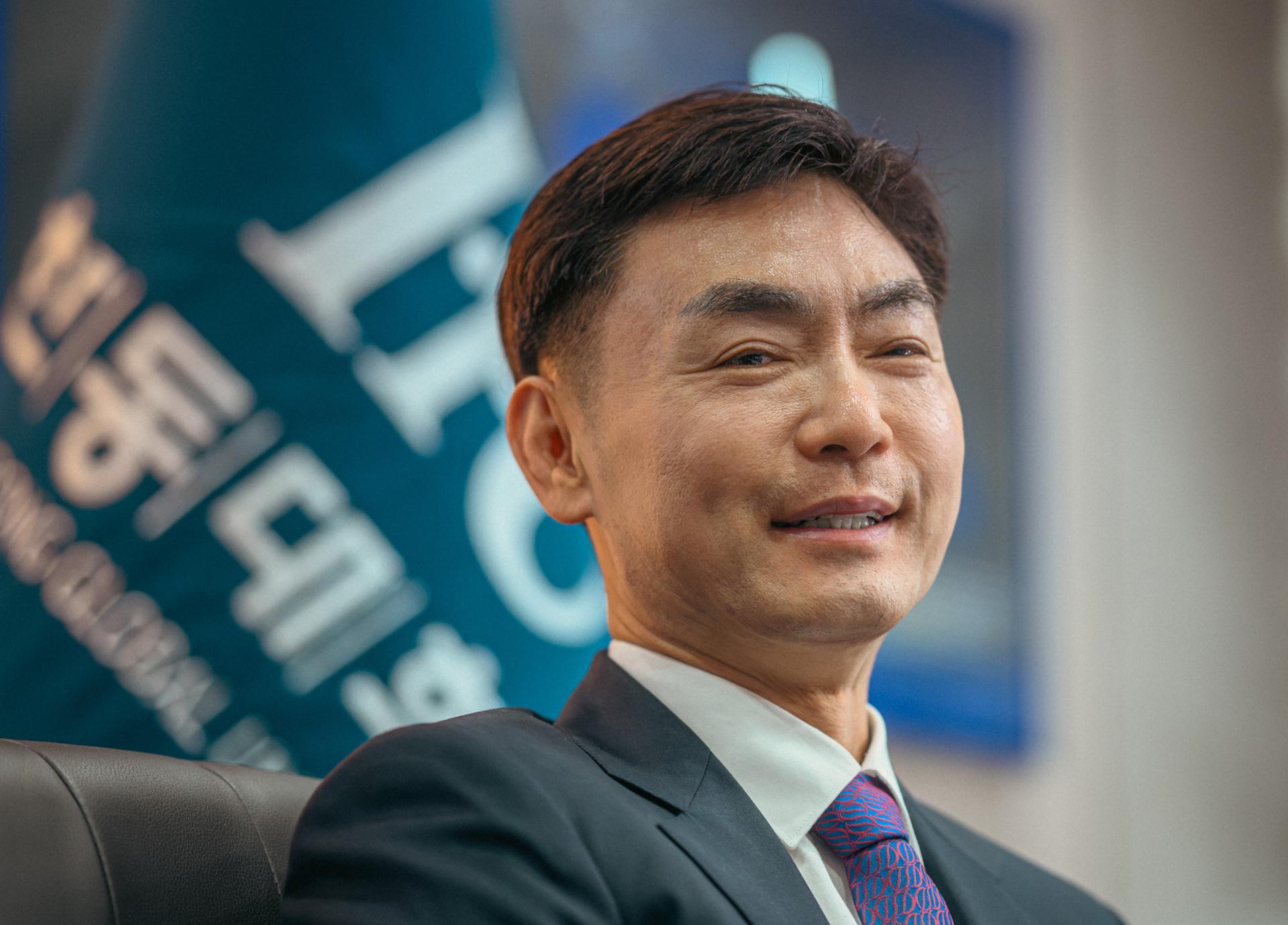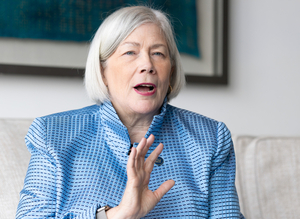
GW President Ellen Granberg says Korea is central to the university's global strategy, touts country’s fast-moving higher education sector George Washington University President Ellen Granberg speaks during an interview with The Korea Herald on Tuesday on the sidelines of a GW alumni event at the JW Marriott Hotel Seoul in Seocho-gu, Seoul. (Yoon Chang-bin/The Korea Herald) George Washington University plans to deepen ties with South Korean universities as part of efforts to expand its research and degree programs in artificial intelligence, public health and international affairs, the university's president said.Ellen Granberg, who visited Seoul last week with a university delegation, said Korean universities have become increasingly important partners for GW as the Washington, DC-based institution seeks to expand international cooperation in fast-moving academic fields."The level of technology and innovation here is like nowhere else in the world,” Granberg said in an exclusive interview with The Korea Herald in Seoul on June 2. “We really want to be a part of the community.”AI, health care and shared challengesGranberg said she met with officials from major Korean universities to discuss ways to jointly address the challenges shared by many industrialized societies, including security, technology, demographic change and health care.Artificial intelligence is one area “ripe for expansion,” Granberg said, adding that the topic came up in her meetings.“GW is a national and international leader in trustworthy AI,” Granberg said. “That was a big topic of our conversation with universities here.”Granberg also said GW hopes to work with Korean universities in areas such as food systems, global development and biomedical innovation. She pointed to the university’s Global Food Institute, launched two years ago, as one possible platform for deeper cooperation.She also cited the current political climate in the US, saying discussions on democracy and civil society could become another area of collaboration.Granberg described Korean institutions as attractive partners for GW, calling the country’s higher education environment “impressive.”“The quality is strong, but what is really inspiring to me is the innovation and the way in which universities are responding to the moment, and moving, in some cases, much faster than universities in the US,” Granberg said.She specifically pointed to the establishment of AI colleges at some Korean universities, saying it was “a good idea” but one that many US universities have not yet adopted.“I commented to one of our alumni that we should come here and study the way Korean universities handle change, because as we evolve as a university, I want us to get better at constantly changing, constantly getting better,” she said.New degree pathwaysBeyond research cooperation, GW is also in talks with Korean institutions over collaborative degree programs that would allow students to earn degrees from both universities after studying at each institution for a set period.“We (would) offer a dual degree track where students can get a degree from both us and a Korean university,” Granberg said.She also pointed to GW’s Four Plus One program, under which students would be able to complete an undergraduate degree at a Korean university and have courses taken during their fourth year count toward the first year of a master’s degree at GW.“So the student only has to come to GW for one year and can graduate with a master’s,” she said.The program is already being offered internally at GW, but Granberg said the university is in talks with some Korean universities to expand the model in areas such as business and international affairs.She said she also hopes to see the program work in the other direction, allowing GW undergraduate students to study at specialized Korean colleges, including AI colleges.“There are regulatory questions that would have to be answered, so I am not sure it can be done, but I would love to see the exchange going in both directions,” she said. George Washington University President Ellen Granberg speaks during an interview with The Korea Herald on Tuesday on the sidelines of a GW alumni event at the JW Marriott Hotel Seoul in Seocho-gu, Seoul. (Yoon Chang-bin/The Korea Herald) A longstanding Korea connectionGranberg said Korea is “central to how the university thinks of itself today,” citing GW’s large Korean alumni base, its current Korean student population and longstanding academic ties to the country.She pointed to the GW Institute for Korean Studies, which brings together faculty, students and visiting scholars studying Korea’s role in the world.“The institute brings together communities of faculty, students and visiting scholars to study Korea as a country, but more importantly as a global actor and a force influencing what’s happening in the world,” Granberg said.She added that the institute holds monthly policy group meetings on regional issues with leading Korean universities, including Seoul National University, to share both domestic and international perspectives.Granberg also noted that GW’s ties to Korea go back more than a century.“The name of the very first Korean student who graduated from GW in 1892 is Suh Jae-pil. He earned a medical degree and was involved in the Korean independence movement,” Granberg said.She also mentioned other Korean alumni who helped shape modern Korean history, including South Korea’s first president, Syngman Rhee, as well as former executives of major Korean conglomerates, including Samsung, Hyundai and Daewoo.Granberg said the university’s Korea alumni chapter, which has about 1,000 members, is GW’s oldest and largest overseas alumni chapter.Making the case for US studyFor Korean students considering studying in the US, Granberg acknowledged that students and parents may have concerns about visa procedures, safety and job opportunities. But she said she believes studying in the US remains a worthwhile investment.“We already have one of the most robust programs, and we’re growing it to make sure our students get those opportunities,” she said, referring to internships and projects the university offers in coordination with organizations such as the International Monetary Fund and the World Bank.Granberg also noted that GW was recently admitted to the Association of American Universities, a group of leading research institutions in North America.She said these programs and the university’s research status can help students diversify their job opportunities, including outside the US.Granberg said GW has one of the highest levels of patents per faculty member among US universities and plans to increase support for student, faculty and alumni entrepreneurship to expand the impact of their research.
George Washington University seeks deeper Korea ties in AI, student exchange
George Washington University plans to deepen ties with South Korean universities as part of efforts to expand its research and degree programs in artificial int
1,036 words~5 min read