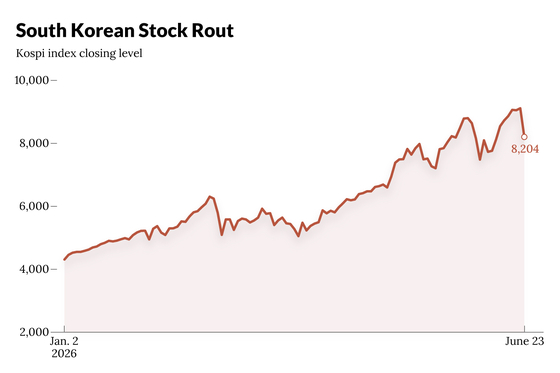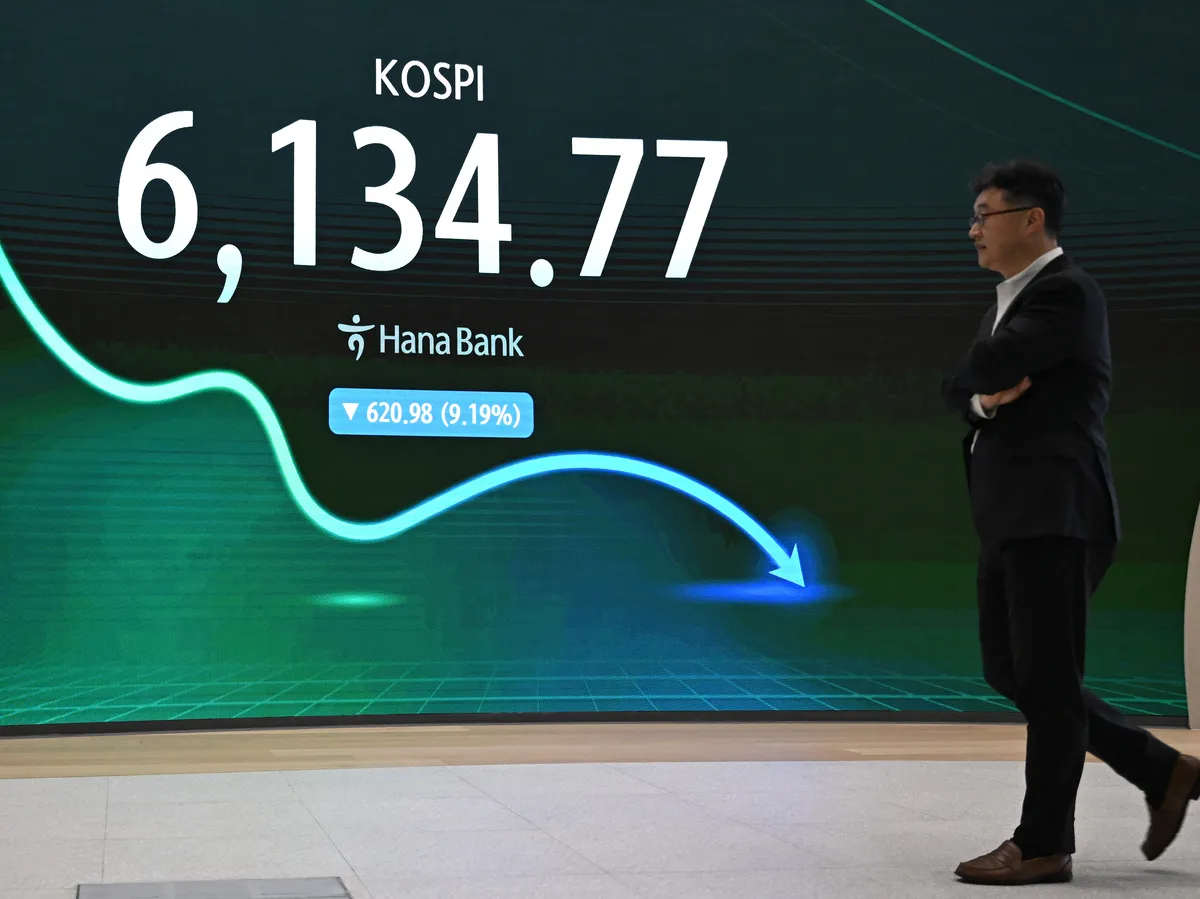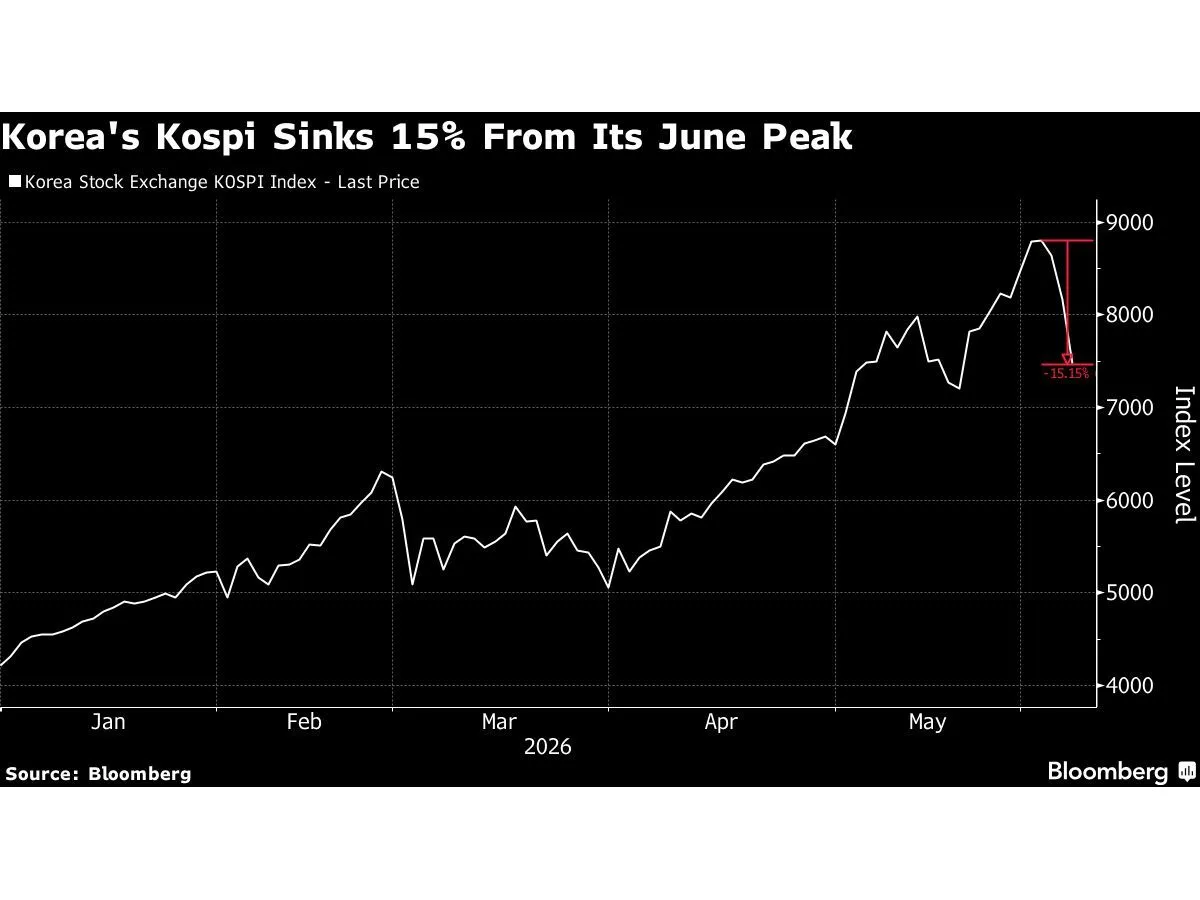
Skip to Content News Archives Economy Energy Oil & Gas Renewables Electric Vehicles Mining Commodities Agriculture Real Estate Mortgages Mortgage Rates Finance Banking Insurance Fintech Cryptocurrency Work Wealth Smart Money Wealth Management Investor Personal Finance Family Finance Retirement Taxes High Net Worth FP Comment Executive Women Puzzmo Newsletters Financial Times Business Essentials More Innovation Information Technology FP500 Podcasts Small Business Lives Told Tails Told Shopping Financial Post Store Obituaries Place a Notice Advertising Advertising With Us Advertising Solutions Postmedia Ad Manager Sponsorship Requests Classifieds Place a Classifieds ad Working Profile Settings My Subscriptions Saved Articles My Offers Newsletters Customer Service FAQ News Economy Energy Mining Real Estate Finance Work Wealth Investor FP Comment Executive Women Puzzmo Newsletters Financial Times Business Essentials HomePMN BusinessKorean Stocks Tumble as Investors Rush to Offload Tech SharesSouth Korean stocks dropped, led by steep losses in chipmaker shares on an intensifying rotation out of artificial intelligence beneficiaries.Author of the article:Last updated 19 minutes ago You can save this article by registering for free here. Or sign-in if you have an account.rlex6}1)fhf9lj9e]9187yg8_media_dl_1.png Bloomberg(Bloomberg) — South Korean stocks dropped, led by steep losses in chipmaker shares on an intensifying rotation out of artificial intelligence beneficiaries. Subscribe now to read the latest news in your city and across Canada.Exclusive articles from Barbara Shecter, Joe O'Connor, Gabriel Friedman, and others.Daily content from Financial Times, the world's leading global business publication.Unlimited online access to read articles from Financial Post, National Post and 15 news sites across Canada with one account.National Post ePaper, an electronic replica of the print edition to view on any device, share and comment on.Daily puzzles, including the New York Times Crossword.Subscribe now to read the latest news in your city and across Canada.Exclusive articles from Barbara Shecter, Joe O'Connor, Gabriel Friedman and others.Daily content from Financial Times, the world's leading global business publication.Unlimited online access to read articles from Financial Post, National Post and 15 news sites across Canada with one account.National Post ePaper, an electronic replica of the print edition to view on any device, share and comment on.Daily puzzles, including the New York Times Crossword.Create an account or sign in to continue with your reading experience.Access articles from across Canada with one account.Share your thoughts and join the conversation in the comments.Enjoy additional articles per month.Get email updates from your favourite authors.Create an account or sign in to continue with your reading experience.Access articles from across Canada with one accountShare your thoughts and join the conversation in the commentsEnjoy additional articles per monthGet email updates from your favourite authorsSign In or Create an AccountorThe Kospi sank as much as 8.8% early Monday, taking the key gauge’s decline from its recent peak to about 15%, poised to enter a technical correction. Memory maker Samsung Electronics Co. fell as much as 11% while peer SK Hynix Inc. slid 10%. Concerns of overheating in the AI rally have taken some steam out of global tech stocks, with US peers tumbling Friday on concerns over a possible Federal Reserve rate hike. Korea is seeing outsized losses after a world-beating stock rally that has made it the posterchild of AI concentration risk.Get the latest headlines, breaking news and columns.By signing up you consent to receive the above newsletter from Postmedia Network Inc.A welcome email is on its way. If you don't see it, please check your junk folder.The next issue of Top Stories will soon be in your inbox.We encountered an issue signing you up. Please try again“Given the crowded positioning in semiconductors and the current volatile environment, some degree of panic selling is not surprising,” said Albert Yong, managing partner at hedge fund Petra Capital Management in Seoul.The sudden plunge Monday triggered a circuit breaker, halting trading for 20 minutes. Stocks pared losses after trading resumed, with the Kospi trading about 5% lower. The Korea Exchange held an emergency meeting Monday to assess the rising volatility and discuss measures to ensure stable market operations.Foreign investors have driven the selloff, selling more than $10 billion worth of Kospi shares on a net basis last week alone. That’s also put pressure on the won, with the currency touching its weakest level against the dollar since March 2009. The South Korean market faces risk of a “Black Monday” event with “currency instability, interest-rate repricing and profit taking in semiconductors all happening at the same time,” said Kim Doo-un, an analyst at Hana Securities.The government on Sunday laid out a series of targeted measures to try and bolster the won, pledging firm action against speculative trading and other activities. The moves come as policymakers across Asia step up efforts to support their currencies amid rising energy costs and a stronger dollar stemming from the Iran war. The won advanced as much as 0.5% Monday.The Korean stock market’s rapid AI-fueled ascent has generated wild swings. The Kospi 200 Volatility Index has mostly held about 70 over the past several weeks.The surge has been largely driven by Samsung and SK Hynix, seen as key beneficiaries of the flood of spending by global tech majors as they build out their AI infrastructure. The pair account for a combined 52% weighting in the Kospi, with leveraged products tied to the names aggravating volatility.Many investors say the longer term outlook for tech hardware is still intact given the hyperscalers’ capital expenditure plans. “I believe it is still too early to conclude that today’s selloff marks the beginning of a prolonged bear market,” said Jung In Yun, chief executive officer at Fibonacci Asset Management Global. “Following a strong rally over recent months, particularly in AI and semiconductor-related names, some degree of correction is both healthy and expected.” Join the Conversation This website uses cookies to personalize your content (including ads), and allows us to analyze our traffic. Read more about cookies here. By continuing to use our site, you agree to our Terms of Use and Privacy Policy.
Korean Stocks Tumble as Investors Rush to Offload Tech Shares
South Korean stocks dropped, led by steep losses in chipmaker shares on an intensifying rotation out of artificial intelligence beneficiaries.
979 words~4 min read