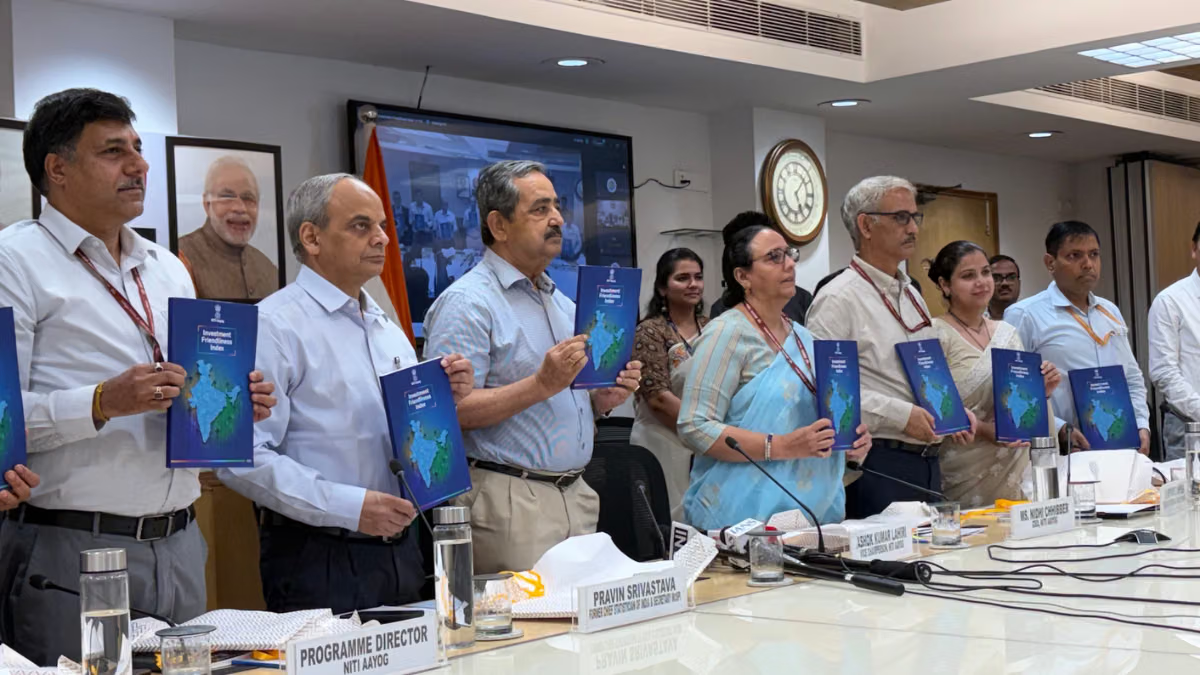
The NITI Aayog has published two editions of its Fiscal Health Index (FHI) using audited Comptroller and Auditor General (CAG) data for the financial year 2022-23 in January 2025 and the financial year 2023-24 in March 2026, to examine and benchmark the fiscal performance of States in India, especially that of 18 major general category states.A comparative analysis of the FHI for 2022-23 and 2023-24 shows vivid discrepancies in subnational fiscal performance. Odisha successfully maintained its achiever position by increasing its score from 67.8 to 73.1 across two years. Goa also moderately improved from 53.6 to 54.7, and Haryana has made a noticeable rise from 29.3 to 32.9, moving from the aspirational to performer tier.On the other hand, Bihar has made a slight improvement from 36.1 to 36.2. Meanwhile, Jharkhand improved its position despite a moderate decrease, with its score dropping from 55.2 to 44.3, causing a downgrade from achiever to front runner.Similarly, Karnataka’s score dropped from 46.2 to 20.2, and Telangana’s from 47.9 to 44.3, both got downgraded to the performer tier. Among those States that have experienced a drop in their score, Tamil Nadu has faced a major drop from 39.5 to 32.1, moving from performer to aspirational tier, while Kerala’s score also declined from 28.9 to 27.3, remaining in the bottom aspirational category.The comparison shows a broadening ‘Southern Fiscal Paradox’, where States with traditionally high social spending seem to be disadvantaged, whereas fiscally restrained states get comparatively higher rankings in the index. The fundamental question that arises is whether the FHI, in its current form, is a true measure of fiscal health or an index of fiscal restraint that rewards states for cutting expenditure and borrowing less, irrespective of whether that restraint comes at the cost of developmental outcomes.What the Index measures?To have a better view of the state-wise fiscal performance, the FHI is built on five key pillars or composite sub-indices, namely Quality of Expenditure, Revenue Mobilization, Fiscal Prudence, Debt Index, and Debt Sustainability. These indices are examined through nine sub-indicators for 18 major general category states, using CAG audited data, normalized through a min-max approach and aggregated with equal weights. The methodology has remained the same in both editions of the report, making a firm ground for a broadly reliable year-on-year comparison.The expansion to the North-East and Himalayan states in FHI 2026, with tailored indicators, is a commendable methodological development when compared to its previous edition. However, beneath this consistency, there lie structural distortions that widely affect the state rankings and more significantly distort the policy signals the index seeks to deliver.The GSDP denominator trapOne of the core issues in the index is the use of Gross State Domestic Product (GSDP) as a denominator across various sub-indicators like Capital Outlay/GSDP, Gross Fiscal Deficit/GSDP, and Outstanding Liabilities/ GSDP. When states’ GSDP increases rapidly, as seen in the case of mineral-rich states like Odisha, the GSDP-normalized ratios would automatically improve even when absolute fiscal performance remains the same.Contrarily, a state that increases its capital expenditure (capex) but experiences slow GSDP growth is simultaneously penalized. This procyclicality structurally benefits resource-rich states and punishes the states whose development has been built on human capital and services rather than natural resources.The revenue mobilization illusionA similar discrepancy is evident in the measurement of revenue mobilization. Both sub-indicators, namely State Own Revenue/GSDP and State Own Revenue/Total Expenditure, merge institutionally earned tax revenue with geographically endowed non-tax revenues like mining royalties in Odisha, and mineral or resource-linked PSU dividends in Chhattisgarh.No State can manufacture these mineral deposits, nor can these geographical advantages enjoyed by these states cannot be replicated through policy. Thus, mineral-rich states consistently top the revenue mobilization rankings not due to their superior tax administration or fiscal effort, but rather due to geological advantages. To obtain a much more credible picture of true fiscal self-reliance, it is preferable to differentiate own-tax revenue from own non-tax revenue and to introduce an indicator of tax buoyancy.The southern fiscal paradox deepensThe comparative analysis of all 18 major general category States in the FHI based on composite score change, rank movement, and tier transition across both editions has revealed that five states, namely, Haryana, Bihar, Goa, Jharkhand, and Maharashtra improved, seven states Odisha, Uttar Pradesh, Madhya Pradesh, Rajasthan, West Bengal, Andhra Pradesh, and Kerala remained stable, and six States Chhattisgarh, Karnataka, Telangana, Tamil Nadu, Gujarat, and Punjab deteriorated.As Tamil Nadu got degraded from the performer tier to the aspirational tier in FHI 2026, both Kerala and Tamil Nadu, which were regarded as India’s undisputed leaders in literacy, life expectancy, and composite human development outcomes, now occupy the bottom-most position in the index.On the other hand, Odisha, Goa, and Jharkhand, which ranked poorly on the human development outcomes, have occupied the top positions in fiscal health. This is not a mere coincidence; it’s structurally produced. High-developed states bear high committed expenditure as the fiscal legacy of their social investment over decades. They often receive proportionately lower central devolution despite contributing more to the national GDP. The FHI penalizes all of this, and it rewards states that maintain fiscal surpluses while their citizens lack access to the quality public services they deserve.Thus, States that are fiscally healthy but poor in human development outcomes must be encouraged, in order to spend more on social development, not celebrated for fiscal restraint.What needs to be changedThe Fiscal Health Index is a good indicator, and its methodological consistency is a true strength. But its present form requires modifications. Measuring fiscal health only based on fiscal indicators mislead the states performance in development. Therefore it should be linked to the socio-economic development of the states than mere performance in fiscal indicators.A Viksit Bharat will not be built by States that simply spend less, but rather it will be built by those states that spend for their social development.Published on June 8, 2026
‘Fiscal health index’ rewards prudence alone
Developed States that historically have high social spending are unfairly ranked lower on the fiscal health charts
970 words~4 min read