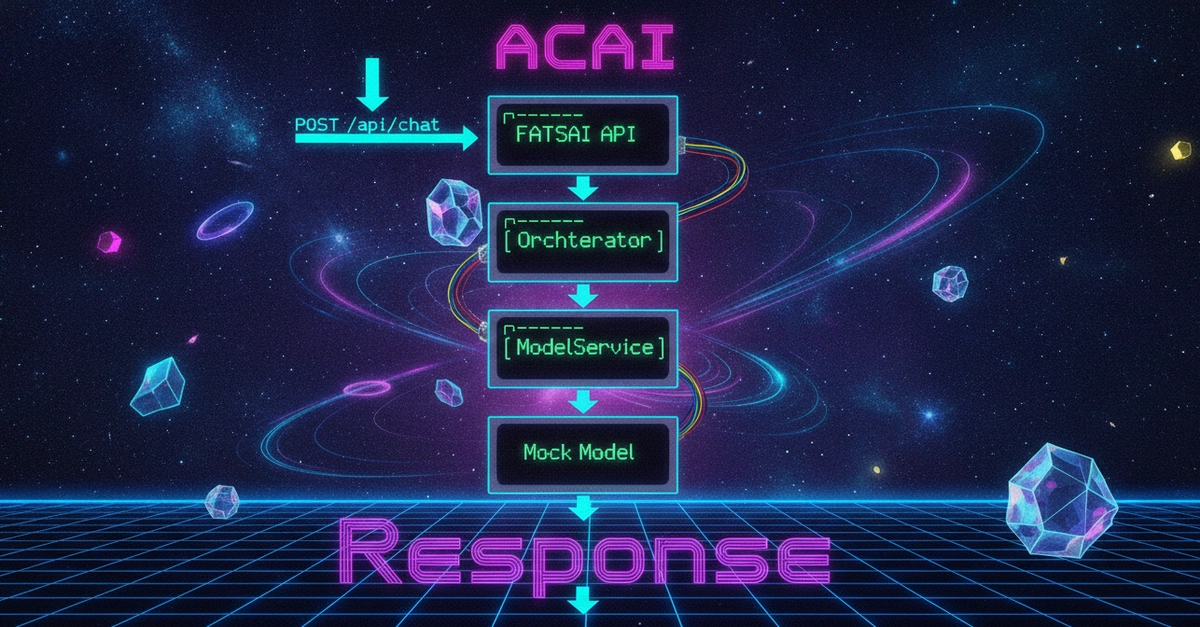
Most attempts at AI governance treat alignment as a prompt-level concern. You write a system message, hope the model follows it, and accept that any sufficiently creative attacker can talk the model into ignoring it. The Self-Alignment Framework Interface (SAFi) takes a different approach. Instead of asking a single LLM to judge its own output, SAFi splits cognition across five specialized faculties, each with a distinct role, a defined interface, and no ability to overstep its bounds. The result is a governed AI architecture that decouples generation from evaluation from execution.
Let’s walk through each faculty in order, following the actual loop the orchestrator runs on every turn.
Phase Zero: The Pre-Generation Barrier
Before the Intellect ever sees a user prompt, the Phase Zero gate (phase_zero.py) runs a deterministic security scan. It checks injection signatures from a threat intelligence module, per-persona blacklisted phrases, and an entropy-based heuristic that catches indirect prompt injection attempts (the so-called “ancient text” pattern where a high-entropy blob contains embedded instruction markers). Phase Zero makes zero LLM calls. If it flags a threat, the orchestrator short-circuits immediately to a governed redirect, and the Intellect is never exposed to adversarial content.