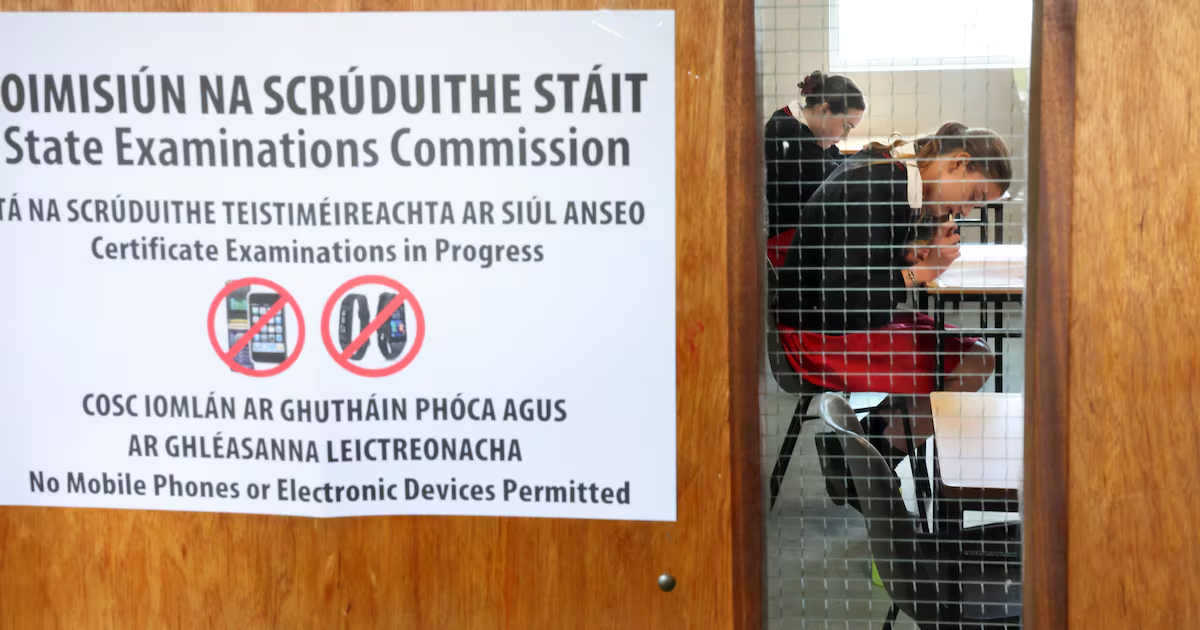
Irish teacher Hugh Gallagher suggests it’s better to stick to simple, accurate sentences when writing answers, as opposed to more complex ones, where mistakes can occurHugh Gallagher, author and Irish teacher at Stepaside Educate Together. Sun Jun 07 2026 - 06:01 • 3 MIN READAfter a well-deserved weekend break, Leaving Cert students start week two of the State exams with Irish paper 1 on Monday, with Irish paper 2 taking place on Tuesday.By this stage, students will likely have most of the heavy work done, but there are still a few tips worth considering ahead of the exams, explains Hugh Gallagher, author and Irish teacher at Stepaside Educate Together Secondary School.When it comes to the listening comprehension, “you see from year to year that there’s certain vocabulary repeated”, Gallagher says, “It’s like your topics to do with counties and towns. Inevitably, there will be a question on where was this person born? Or where was this event on? ‘Qualifications for jobs’ tends to get asked quite often as well. There’s often questions around college courses and CAO.”Gallagher says students shouldn’t be afraid of a long question in the listening comprehension. “The good thing about a long question is that the speaker will have to say all the words in that very long question. So you just listen on to the very end to catch the answer,” he says. When it comes to the reading comprehension, Gallagher advises students to underline the question words: “Who, what, where, when, why. And then go to the piece and highlight the sentence with those words. Check back then before you write your final answer to make sure that you’re only including the information that was asked for.”[ Leaving Cert exams are played on a very slanted pitchOpens in new window ]When extracting an answer from the text, Gallagher says, “don’t stop till you see a full stop. Students tend to pull out of an answer halfway through and it could be the next word that is the answer. For the essay, Gallagher says marks “are gained and lost” when it comes to accuracy. “Even if you’re writing simple sentences, it’s the accuracy in your tenses and your spelling that all the marks are going for.”Gallagher says he suggests to students that it’s better to stick to short, simple sentences that are accurate, as opposed to “fancy sentences” with “complicated grammar” where more mistakes can occur.Essay topics tend to feature the education system every second year, he explains. “It wasn’t asked last year. It’s just to be careful if the education system comes up – what angle are they taking? ... If it’s very specific to just second-level education, or if it’s the life of a student, or whatever it is.”An essay on teenage life is also likely, Gallagher says. “The last little essay hint would be to do with life online. The rise of AI and influencers and social media and how they impact students. Last year, the debate was to do with AI, and again from patterns in previous years, the debate sometimes follows up in the essay titles the following year.”[ The Leaving Cert is dense, demanding and far superior to the UK’s A-levelsOpens in new window ]It’s important that students understand the title, and don’t go off on a tangent rather than answer the specific angle they’re asked. “It’s super important to understand the title. And refer back to it often, in your paragraphs.”For the prose, Gallagher is tipping “Dís” and “Cáca Milis” to come up on the paper. “Regardless of which of the stories comes up, know how to talk about the relationship between the two main characters.“For poetry, the two tips would be ‘Mo Ghrá-sa’ and ‘An t-Earrach Thiar’,” he says. “For the poetry, just focus on imagery. Don’t learn off answers on fantastic themes, fantastic emotions. If they [students] have a bank of knowledge on just the imagery in the poem, they can use that to support any question that comes up.”For those taking ordinary-level Irish, Gallagher suggests the blog and the email as the two easiest options. “Veer away from writing the short story. Yes, it’s just past tense verbs, but you have to have a bit of a story, a bit of creativity there. With the blog, it’s predictable topics that are related to the oral topics.”With the email, meanwhile, Gallagher says “you’ll get marks for your structure there that you wouldn’t get for the other questions”.Gallagher suggests students listen back to previous listening comprehension tapes, rather than tuning into TG4 or Raidió na Gaeltachta this weekend. “Because then you’re listening to the guy you’re going to hear.”IN THIS SECTION
Last-minute tips ahead of the Leaving Cert Irish exams
Irish teacher Hugh Gallagher suggests it’s better to stick to simple, accurate sentences when writing answers, as opposed to more complex ones, where mistakes can occur
774 words~4 min read