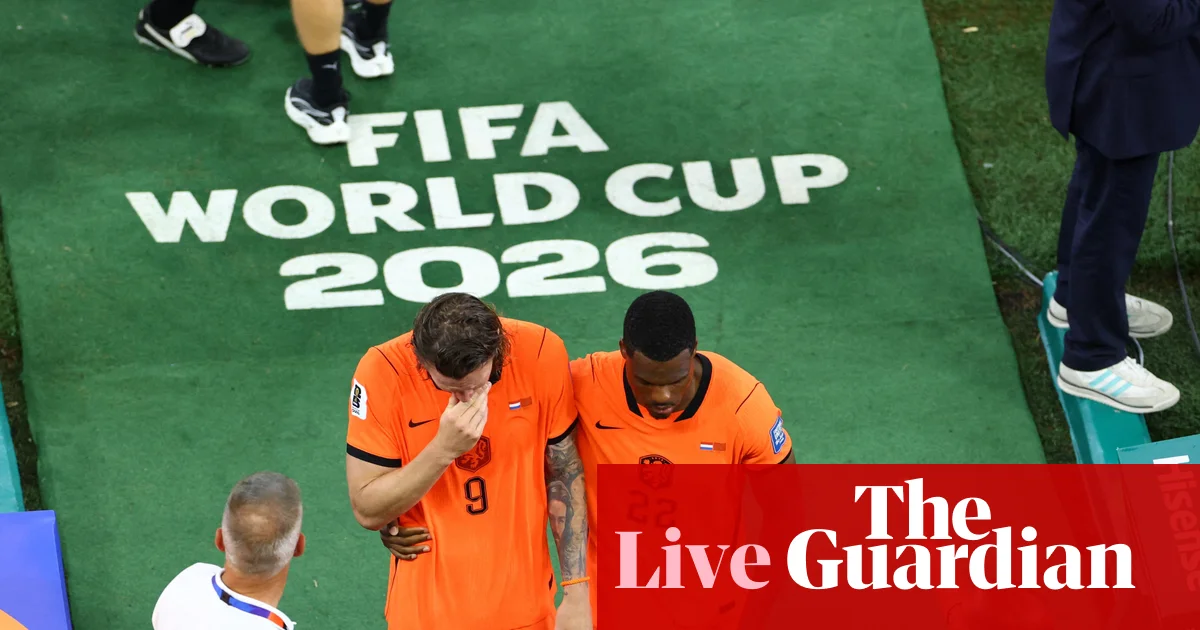
Get free access to the most comprehensive World Cup coverage in The Athletic app“I watched a little bit. In the end, you transform into a fan. One eye is crying, one eye is happy, because the guys were doing well.”In June 2014, Marco Reus was coming off the best season of his young career. His 23 goals for Borussia Dortmund had put him in the mix for a place in Germany’s starting XI at the World Cup.Then, just before half-time in their final pre-tournament friendly against Armenia, he went down under a relatively innocuous-looking challenge from Artur Yedigaryan. Immediately, he knew something was wrong. His left ankle briefly twisted in a direction that ankles should not twist. It turned out he had torn a ligament in that ankle. His World Cup was over before it began.There will have been a grim recognition and empathy in Reus, and many other players, as news of those who will miss the 2026 World Cup filtered in. On Saturday it was Lennart Karl, Bayern Munich’s 18-year-old who had the potential to be a starter and a wildcard for Germany. Before him it was Hugo Ekitike (France), Kaoru Mitoma (Japan), Rodrygo and Estevao (Brazil), Patrick Agyemang (USMNT), Serge Gnabry (Germany) and Xavi Simons (Netherlands). All of them have joined a grim brotherhood of players who, down the years, have had their World Cup dreams dashed by injuries.“As a young kid, you always dream of playing in a World Cup,” Reus tells The Athletic, “to have the privilege to wear the shirt. Injuries are part of the game, part of our life and you have to accept that. The important thing is just to be ready mentally… you’re just trying to understand the situation, focus on the moment to come back.”Reus then had to watch from afar as his team-mates went on to win the whole tournament. When they reached the final against Argentina, the German Football Association offered to fly him to Rio de Janeiro to attend the game. He declined, ostensibly to focus on his recovery. But you can also understand why the prospect of having to sit in the stadium and watch his friends win football’s ultimate prize when he was supposed to be there would have inspired, at best, mixed emotions.After the game, Reus’s friend and winning goalscorer Mario Gotze brought out a Germany shirt with Reus’ name on the back, carrying it around the pitch as he celebrated. A nice gesture, but one Reus did not see.“Honestly, I was already in bed,” he says. “I watched the game then went to sleep. It was a nice gesture. I saw it the next day. I was very surprised, and very happy that he did that. We’re good friends: it showed in that moment what his character was.”Injury against Armenia cost Marco Reus his World Cup place in 2014 (Daniel Roland/AFP via Getty Images)Reus, one of the great German players of his generation, was a little cursed when it came to the national team. He was first called up to the German squad just before the 2010 World Cup but had to withdraw with injury. He missed Euro 2016 too, and the 2022 World Cup. He did manage to play, and score, at the 2018 World Cup, and although Germany crashed out in the group stage, at least he did get to experience one tournament.But missing the one Germany won clearly hurt, as it did for others.Christian Vieri lost on penalties with Italy in the 1998 World Cup quarter-finals, and was the goalscorer when they were knocked out by South Korea in 2002, but redemption was in his sights in 2006. Struggling for game time at Milan, Vieri was told by Azzurri coach Marcelo Lippi he still planned to pick him and encouraged a move to Monaco in order to stay sharp, but he suffered a knee injury in March and was ruled out. He then had to watch his colleagues go on and win the tournament.“I’d say that I struggled in the years after that,” Vieri told Gazzetta Dello Sport in 2014. “I lost the dream of a lifetime.“But in my heart, I rejoiced with all the guys, who had always been team-mates of mine for the Azzurri. It was our generation’s time. We had played together from the age of 17 and were European champions with the under-21s.
Devastation and disbelief: This is what it is like when injury ends a player’s World Cup dream
Hugo Ekitike, Rodrygo and Estevao are among those who will miss out this time. We speak to players who have been through the heartbreak
2,019 words~9 min read