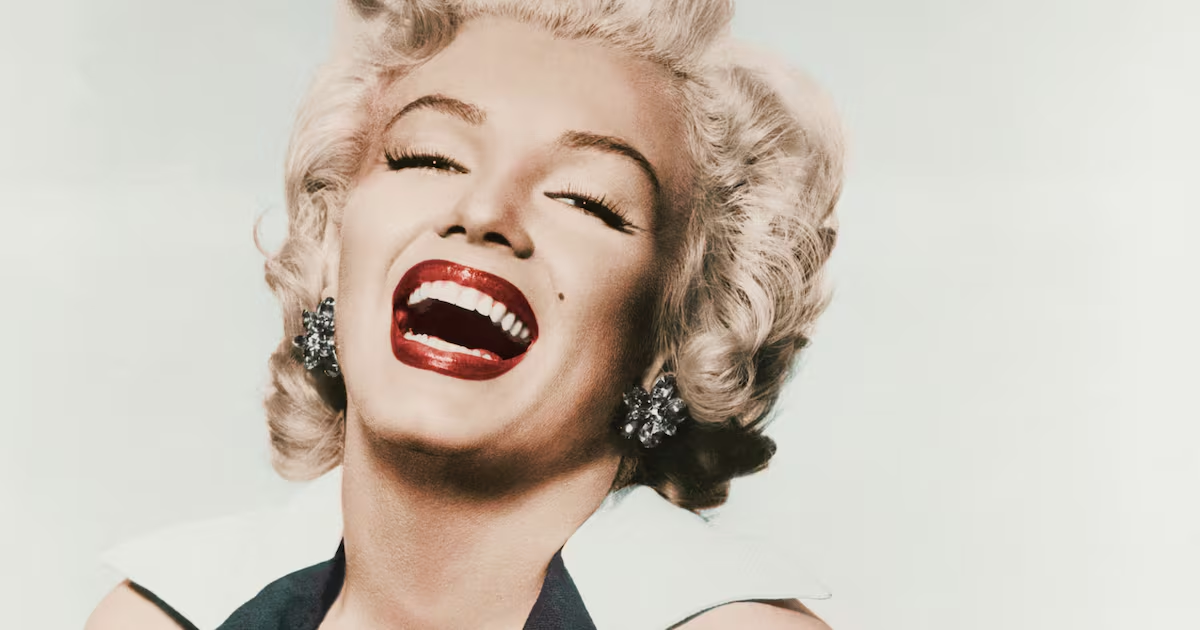
The “rest of the world” is in a huff with the United States. Nothing new there. But negative reaction to the Trump rearrangements is having a quantifiable economic effect. Last year saw the first decline in visitors to the US since the pandemic. “Travellers cite presidential rhetoric and policies manifesting in highly public wars – both figurative and literal – as some of the reasons for staying away,” CNN reported. Maybe we are finally out of love with the US.This comes as we process three near-simultaneous centenaries that speak to the possibilities, inspirations and contradictions the United States once offered. Miles Davis, chameleonic jazz trumpeter, entered the world in Alton, Illinois, on May 26th, 1926. Marilyn Monroe, then Norma Jeane Mortenson, was born in Los Angeles on June 1st of the same year. Allen Ginsberg, emblematic poet and prankster, arrived in New Jersey on June 3rd.[ Marilyn Monroe at 100: What her films reveal about the woman behind the mythOpens in new window ]None made it to the current century. Each caused different sorts of trouble. All contributed to an unstoppable, if sometimes guilty, excitement about what the United States would make of the postwar confusion.Every week sees another article pointing to the increasing significance of Korea and Japan at the core of international youth culture. This is put down to the decentralisation of media and increased freedom to cross virtual borders. It is also attributed to an unease about how the US conducts itself.Well, maybe. But it’s not as if the youth of the world, while listening to Elvis Presley, Bob Dylan or Michael Jackson, was not similarly unnerved about the McCarthyite blacklists, the war in Vietnam or the Iran-Contra embarrassment. Campuses still declared the United States a Great Satan. None of this interfered with addiction to the nation’s cultural effusions.Davis, Ginsberg and Monroe remain, in different fashions, impossibly engaging figures. None could have emerged from Dublin, Düsseldorf or Dubrovnik. Their personalities – even that of the often reticent Monroe – could not be contained by Old World borders.Monroe did not live to see the convulsions of the later 1960s. Ginsberg, whose Howl, a seminal epic, was published in 1955, could make a reasonable claim to be a John the Baptist for that era; so lauded, he lived through it as court jester to the likes of Dylan. Of those writers who emerged from the beat movement of the 1950s, he remained, unlike the surly Jack Kerouac or the terrifying William S Burroughs, a source of sentimental affection until his death, in 1997.Bob Dylan and Allen Ginsberg at Jack Kerouac’s grave. Photograph: Netflix Jazz giant Miles Davis in concert Davis proved the most adept survivor of the three. Always at home to controversy, he began, alongside greats such as Dizzy Gillespie and Charlie Parker, as a practitioner of angular bebop before going big band with Gil Evans and modal with a sextet that delivered the indestructible Kind of Blue in 1959. Davis lost a significant number of fans when, a decade later, he went electric for In a Silent Way, but he gained many more as Bitches Brew, a swirling, urban cacophony, became a crossover smash in the 1970s.Beaten bloody by racist cops while taking a break outside a Manhattan jazz club in 1959, Davis, never a cuddly personality, had every reason to retain suspicion of the prevailing white establishment. The attack, he said, made him “feel bitter and cynical again when I was starting to feel good about the things that had changed in this country”. There is a lot of the mid-20th-century United States in those few words. Davis remained thorny (and relevant) until his death, in 1991.Clark Gable, Montgomery Clift, Eli Wallach and Marilyn Monroe in The Misfits For reasons good and ill, it is, however, Marilyn Monroe who has attracted the most retrospective attention over the past week or two. Sixty-four years after her death, Sight and Sound, the prestigious British cineaste magazine, has her on this month’s cover to promote a fine appreciation by the film historian Farran Smith Nehme. The first consideration should be the work, a body of brilliance that stretched from characteristic comedy in All About Eve, from 1950, to racked distress in The Misfits, from 1961. It was, sadly, Monroe’s misfortune that she also came to stand for a kind of grand American betrayal against those who dared to represent the nation most thrillingly. Forget the silly conspiracy theories. We are still living with the poisonous side effects of fame that attended Monroe’s death, from an overdose, in 1962. “Who knows what to think about Marilyn Monroe or about those who turn her sickness to metaphor?” Pauline Kael, the great film critic, mused in the 1970s. “I wish they’d let her die.”Or let her live again. The films are still available, and they are still magical. For all the grimness of Monroe’s end, the work – Some Like It Hot in particular – speaks to a United States that, despite its abundant flaws, once greatly excited the discerning young. It may yet do so again.
A century on, Marilyn Monroe speaks to the possibilities the United States once offered
With Miles Davis and Allen Ginsberg, the film star contributed to an unstoppable excitement about the future
845 words~4 min read