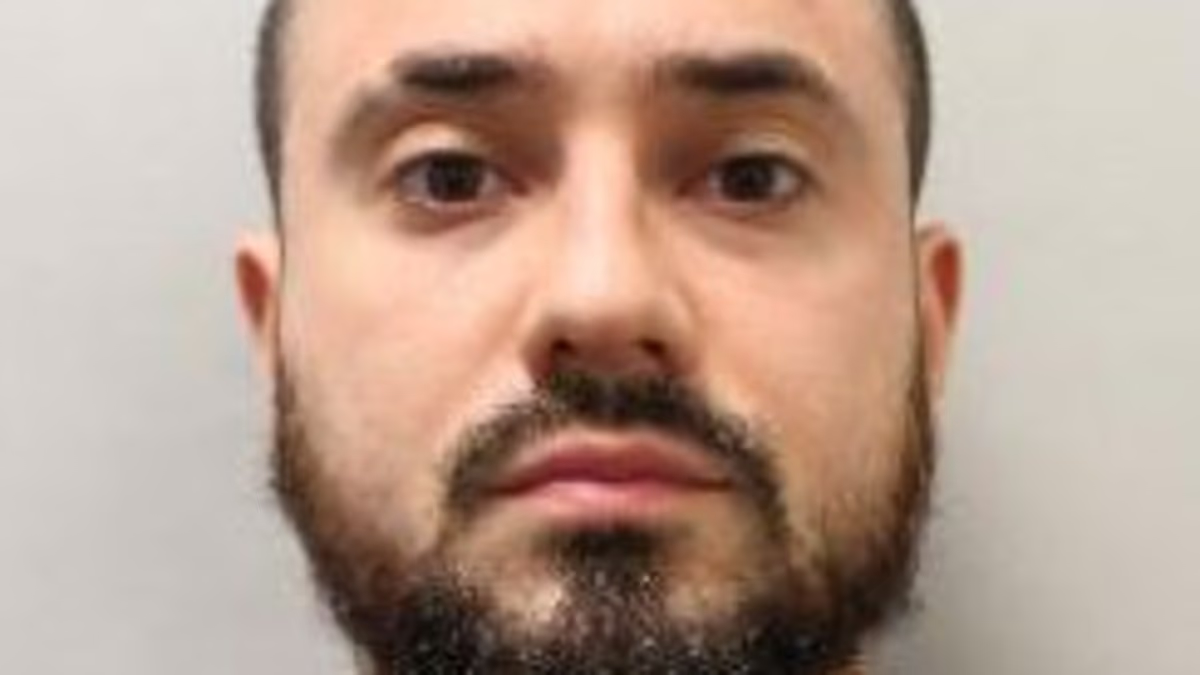
Shortly after 1am one night in July 2016, Gabriel Hay grabbed Hannah Walker by the back of her neck and slammed her face against the kitchen island in the basement of his family’s four-storey London townhouse.‘I was wearing a backless jumpsuit. He put his hand down the back of it. I said: "Stop, stop, stop." He wouldn’t,’ says Hannah.Her fear was compounded by the horrific realisation that the 19-year-old, whom she met when they were both 11, was not – had never been – a harmless, if overly sexed young man. ‘He’d done so many things to me, but always tried to play it like a joke,’ she says. ‘I went from thinking “Gabriel doesn’t understand consent” to “Gabriel’s a monster” and everything he’s done, he knows he’s been doing it.’Throughout his adolescence, Hay, a student at £30,000 a year Dulwich College, had shown signs of predatory behaviour. But it was shrugged off by Hannah, who attended the nearby ‘sister’ school James Allen’s Girls’ School (JAGS), and everyone else in their social circle as simply part of his personality. In the wider context of misogyny within their peer group, it was unremarkable.Even when Hannah finally decided she had to report Hay for attempted rape in 2020, four years after it happened, she worried she was overreacting: ‘When I told the police I said, “is this that bad? Am I being a bit dramatic?” They seemed shocked. They said: “This is illegal.”’Last May, Hay, now 29, was sentenced at Inner London Crown Court to 19 years in prison for rape, attempted rape, and two sexual assaults against three women, his first offence, sexually assaulting Hannah, carried out when he was 17. He received the maximum eight-year sentence for attempting to rape her.On sentencing, Judge Silas Reid told Hay that, had he been apprehended as a teenager, ‘it might have been thought that your attitude to consent and women was a youthful immature thing which you would grow out of. You did not.’So what were the chances Hay would ‘grow out’ of his predatory behaviour? And what does this case tell us about the ramifications of rape culture – the normalisation of sexual assault, rife in our schools in an age of internet porn and online misogyny?This question has been brought back into sharp focus after two teenage boys were spared jail despite being convicted of raping two girls, aged 14 and 15, in November 2024 and January 2025. Last May, Gabriel Hay, now 29, was sentenced to 19 years in prison for rape, attempted rape, and two sexual assaults against three women at Inner London Crown CourtAt their sentencing hearing, Judge Nicholas Rowland said he wanted to ‘avoid criminalising these children unnecessarily’ and the boys, now 15, were handed youth rehabilitation orders instead. Such has been the public outcry at his decision that the sentences are now being referred to the Court of Appeal.There is scant research, but studies suggest seven to 13 per cent of juveniles who commit sexual offences will reoffend as adults. Which may not sound much, but bear in mind this only includes those convicted of an offence. The vast majority aren’t even reported.‘There’s a prevailing principle to avoid criminalising our children,’ says Rachel Fletcher, Partner and Head of Crime and Regulatory at Slater Heelis Solicitors, who explains that, even if apprehended, young people are often sent to the Youth Offending Team – a government-run multi-agency organisation that establishes community services and reparation plans in place of incarceration. ‘However, we often find that children who have a record, whether on a school record or social services, find themselves investigated again which supports an escalation in behaviour,’ says Fletcher.And what of the young victims, whose abuse is often swept under the carpet to the point that they don’t even realise they are victims? For years, Hannah says, ‘I didn’t feel anything’. Only after she reported Hay, aged 23, did her trauma become clear – and then, she says, ‘I felt suicidal’.Hannah, now 28, a softly spoken marketing executive from London, whose name has been changed by the Mail to protect her anonymity, dated Hay when he asked for her number at a Year 7 disco thrown for their schools.‘He was charming, funny and so confident,’ she recalls. ‘I was in awe.’At 11, their relationship consisted of texting and the odd cinema trip. ‘We used to speak every night for hours,’ says Hannah, whose mother works in the courts system, and is separated from Hannah’s father, who had a retail business. Throughout his adolescence, Hay, a student at £30,000 a year Dulwich College (pictured), had shown signs of predatory behaviourWhen, after a few weeks, Hay started pushing Hannah to kiss him and let him put his hand down her pants, she wasn’t offended so much as put off. ‘I would say: “I think it’s gross.” I broke it off.’By the following year Hay had touched another female pupil’s genitals. ‘There was a big drama because nobody had done that before,’ recalls Hannah, who says the girl was bullied as a result but insisted she felt ‘great’ about it.Now Hannah believes it was bravado to give her a sense of agency: ‘She contacted me recently and said she feels he pressured her into it.’When Hannah was 14 – and dating Hay’s friend – Hay repeatedly tried to persuade her to touch his penis at parties.'It made me so anxious,' she says. 'But I never felt he was pressurising me. I felt it was part of growing up.' Hay was the most popular boy in their year, with charisma and the latest Stussy jeans. 'Everybody fancied him.'His obsession with sex was hardly unique among his peers. ‘Every girl I know has a story about a DC (Dulwich College) schoolboy and feels that they didn’t find it weird then, but do now,’ says Hannah. ‘DC boys feel they’re entitled to everything which makes it difficult to imagine a girl could say no.’They’d constantly discuss sex in pornographic terms when JAGs girls were in earshot.‘The stuff they said about what they wanted to do to a girl, how they rated them – it was so screwed up.’ If you engaged sexually with them, you were a "slut", she says. If you said no you were "frigid". Either way you were bullied.’Nobody considered telling the teachers – degradation was simply seen as a rite of passage. Nor, in a pre-Me Too era, does Hannah recall being taught about consent at her school.‘Back then I don’t think it was thought about.’ But it was shrugged off by Hannah, who attended the nearby ‘sister’ school James Allen’s Girls’ School (JAGS), and everyone else in their social circle as simply part of his personality. Pictured, the protest signs attached to James Allen's School fence in 2021But Hannah also believes Hay’s behaviour was ‘innate... because he had been doing it for so long’.His privileged background was arguably a factor, too. The second eldest of four siblings, he was brought up by his single mother, a lawyer. He told Hannah he wasn’t allowed to ask questions about his father. ‘He didn’t even know his dad’s name,’ she says. Perhaps he lacked a male role model in his life, or pursued sexual gratification to fill an emotional void.At parties alcohol was everywhere, along with cocaine and ketamine, says Hannah. She didn’t take drugs or get ‘blackout drunk’, but it’s easy to see how the issue of consent would get blurred. Hay groping girls was ‘not a big deal’, she says; shrugged off the next day with a ‘classic Gabriel’, or a ‘Gabriel can be a bit weird with girls’.Some did occasionally reveal Hay had forced them into sexual activity, recalls Hannah, but they were seen as having lied to justify hooking up with Hay when he had a girlfriend.‘Now we think that was probably all true. He got away with so much.’Leading therapist Susie Masterson, who works with women abused as girls, says consent is a ‘complex issue’ among children who often feel ‘at fault’ for being abused. Sometimes, when Hay did something, such as touching her vagina through her pants as she danced, Hannah was wary of making a fuss, because he was dating her friend. ‘I didn’t want her to be mad.’She adds: ‘Once he dragged me into a bathroom, I was so drunk.’ She was 18 and they were in a nightclub with a group of friends. ‘I remember he touched my vagina and thinking “what the hell’s going on?”.’ Her then boyfriend saw her run off in tears. ‘I felt I had cheated.’Shortly after, in April 2014, at a house party in Clapham, south London, Hannah was on the toilet when Hay barged in. As she stood up to leave he pulled her leggings down. ‘He had his penis out and was trying to push it in me. I walked out. I wasn’t shocked. I was used to him doing stuff like that. My main concern was that his girlfriend would think I was on board.’Hailing a taxi outside, Hay dragged her down the road by her arm. ‘I was fighting him off and smashed my phone because he wouldn’t let me go.’He gave up when other partygoers came out. When she told friends the next day it was laughed off. ‘We thought, “he’s such as freak”.’ She recalls a girlfriend jokily saying 'RIP Hannah'. Eleven years later, Hay would be convicted for this offence. ‘I look back and can’t believe we laughed.’Afterwards, Hay ‘acted completely normal’ and Hannah questioned whether she’d interpreted his behaviour wrong, ‘because surely he would act off with me?’ She convinced herself that ‘it can’t have been that bad, whatever’s happened’. Even when Hannah finally decided she had to report Hay for attempted rape in 2020, four years after it happened, she worried she was overreactingAfter Hannah left school she got a job in marketing and Hay worked in a bar. Their social circle largely disbanded until, when she was 19 in 2016, she was in a bar in Clapham with a friend back from university for the holidays when Hay appeared.‘He was being nice,’ she recalls. Her friend had to leave and Hannah’s phone had died so she couldn’t book a taxi home. Bar staff refused to charge it and Hay said she could charge it at his house nearby. With no other option, Hannah told him: ‘I don’t want anything to happen.’ He said, ‘I know. I promise.’After she returned from smoking a cigarette in his garden and went to retrieve her phone, she recalls, he slammed her onto the kitchen counter. When she escaped, he chased her around the kitchen island.‘I was scared, saying “Gabriel, stop, please”. He had his penis out. It seemed the more upset I was, the more excited he was sexually.’As she ran for the front door he kicked her in the back of the knees so she fell to the floor. 'I remember thinking "he knows how to make me weak". I was on all fours. He was on top of me. I was clawing at the carpet to try and pull myself away. My nail ripped off. He pinned me down by my neck and said, "I know you’ve wanted this for so long".'Even then, her primary concern was her reputation, ‘that he was going to tell everyone we slept together if he got to do this. Everyone would think I was a slut’.She managed to escape to a taxi. ‘I don’t know how,’ she says. The following morning, he messaged her on Snapchat, where messages disappear after 24 hours, ‘so I could never show the police’. It read: ‘That was so fun, I love playing with you.’Her friends were supportive but not overly shocked: ‘It made sense because of his past behaviour.’For months afterwards she felt ‘worthless’ but didn’t want to make a ‘big deal’ out of it by reporting him, her feelings still conflicted: ‘I was attached to him in a way. He was the first guy I had a crush on. He was a huge part of my life. I didn’t know if I’d feel right telling the police, having that on me if he went to prison.’Her family were also worried about the ordeal she’d go through if she reported him. She tried to put it out of her mind, and thought she had – that the shivers, flashbacks, anxiety and predisposition towards abusive boyfriends she developed were unrelated to what she now knows as PTSD.‘I didn’t value myself. I put myself in dangerous situations,’ she says.Four years later, in 2020, she heard, through friends, Hay had tried to rape another woman. ‘It made me cry and feel guilty I hadn’t reported him,’ she says. While his latest victim didn’t go to the police, Hannah did, persuading other girls she knew from JAGS and other local private schools to report what he’d done to them, too. Eight women came forward.Hay, finally ostracised from their social circle, was arrested and released on bail, with a curfew and tag. ‘He was still working in a pub, which I find crazy.’After reporting Hay she finally felt the full impact of his crimes. ‘I could only comprehend how bad it was when my body was ready – and then it was terrible,’ she says. ‘I went through a month of chills, nightmares, sweats. I thought: “I can’t live like this. Either I find a way to make all this stop or I’m going to kill myself.”’The effects of sexual assault at school can reverberate physically in adulthood, explains psychotherapist Tina Chummun. ‘Sexual trauma triggers a cascade of stress responses in the hypothalamic-pituitary-adrenal (HPA) axis, flooding the body with cortisol. In chronic states, this can lead to memory impairments, immune system suppression, sleep disturbance and chronic inflammation linked to conditions like gut disorders. Psychologically, I saw clients struggle with internalised shame, mistrust and fragmented self-worth.’Therapy helped Hannah to realise she was ‘allowed to feel pain’, but as the investigation dragged on, with police unable to find sufficient evidence to bring charges, the majority of the women who reported Hay dropped out.‘It’s a shame. But I understand it’s hard to revisit.’In April 2023, Hay raped a woman at his home after meeting her at the Saxon pub in Clapham, where he worked. Finally, police had enough evidence to reopen the case. In January 2025, police told Hannah he’d been charged with nine charges of rape, attempted rape and sexual assault – two of them against her. ‘I cried,’ says Hannah. ‘I was shocked there were so many.’Even in the week before his trial at Inner London Crown Court last year, Hannah still felt a sense of attachment and guilt towards Hay. Only when she heard Hay – who denied all charges – had accused her of making ‘malicious’ allegations, did it completely disappear. After that, she says, ‘I didn’t feel bad at all’. She gave evidence from behind a screen, her mother there for moral support. ‘It was intense, scary.’Hay’s mother, whom Hannah hadn’t seen since she was 11, but who, the court heard, had been at home when he tried to rape Hannah, was also there. She had, Hannah recalled, been friendly towards her as a child. ‘She didn’t acknowledge me.’Addressing him from the witness box, the woman Hay raped said she had considered changing her name. ‘I fear that you will try to find me,’ she told him.In addition to the attacks on Hannah, the court heard Hay had rubbed a woman’s breasts aggressively in the back of a taxi after her boyfriend got out to withdraw cash in October 2018.Pursuing her case to trial has given Hannah strength: ‘It’s completely changed how I see myself. It’s given me such a sense of self-worth, of understanding what’s happened, and that it’s not my fault.’If only Hay had been taught as much as an 11-year-old, the trajectory of both their lives could well have been very different.*Hannah’s name has been changed
Victim of rapist reveals how he preyed on her friends from age of 11
Last May, Hay, now 29, was sentenced at Inner London Crown Court to 19 years in prison for rape, attempted rape, and two sexual assaults against three women.
2,658 words~12 min read