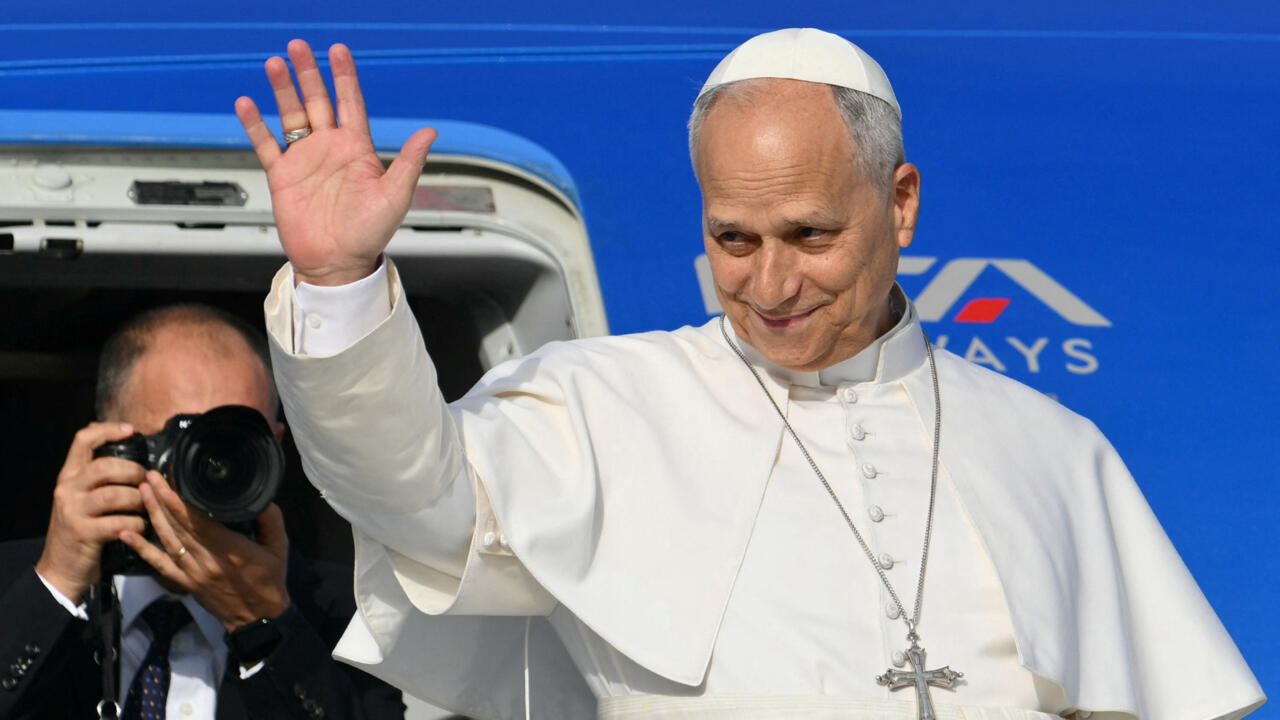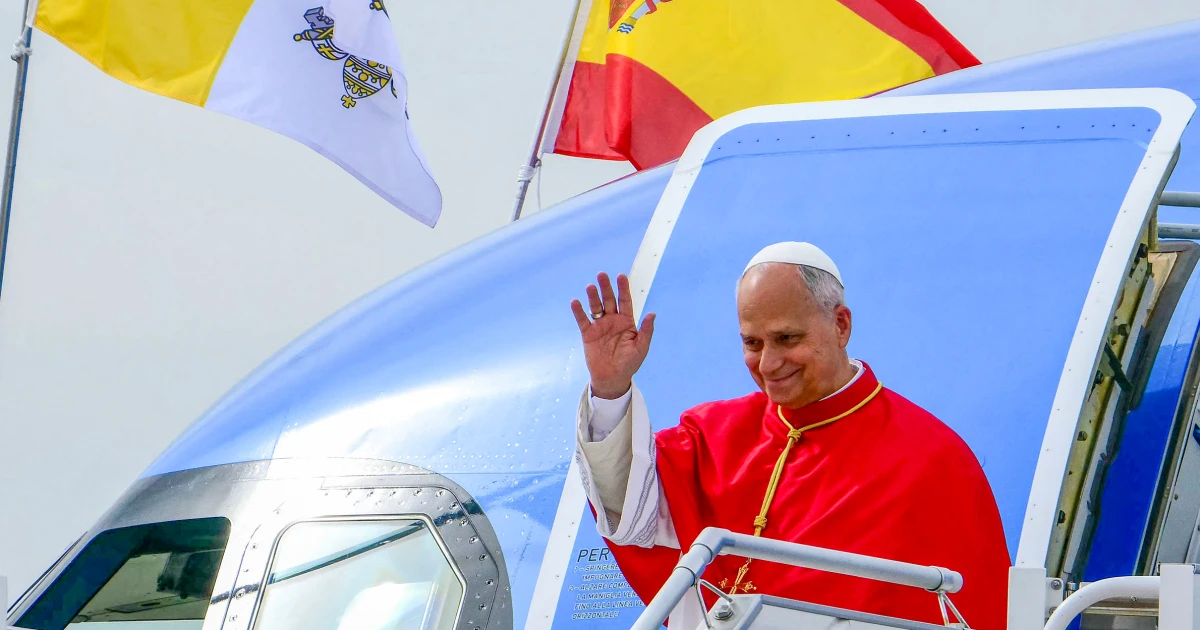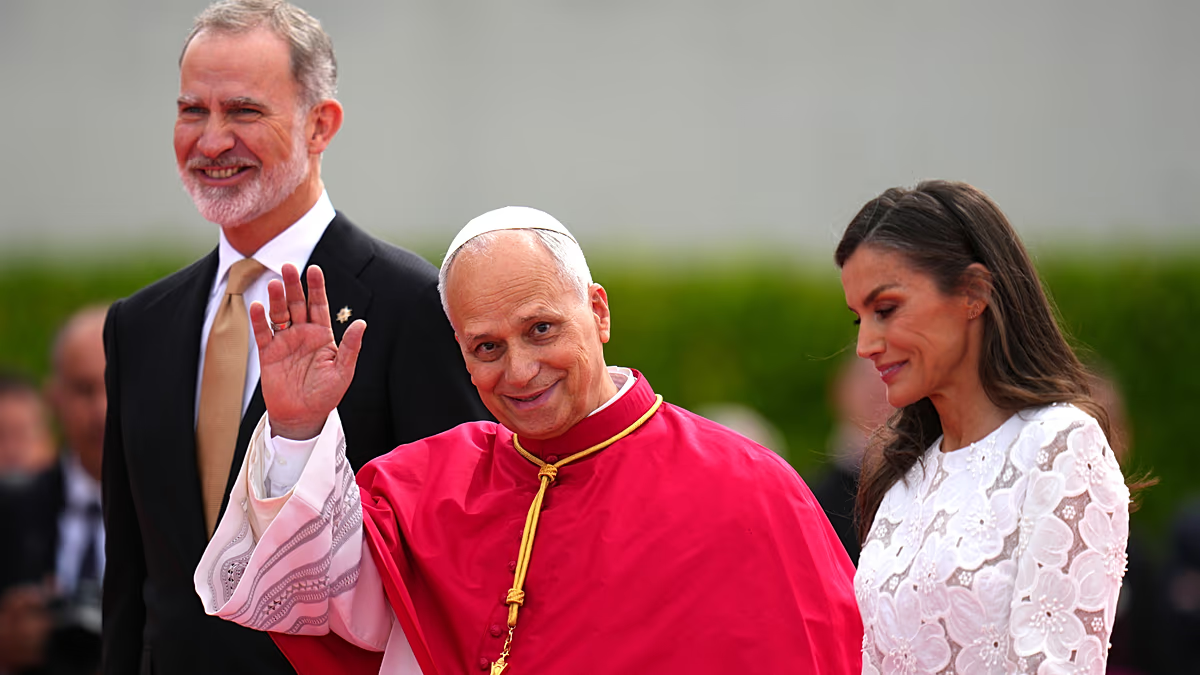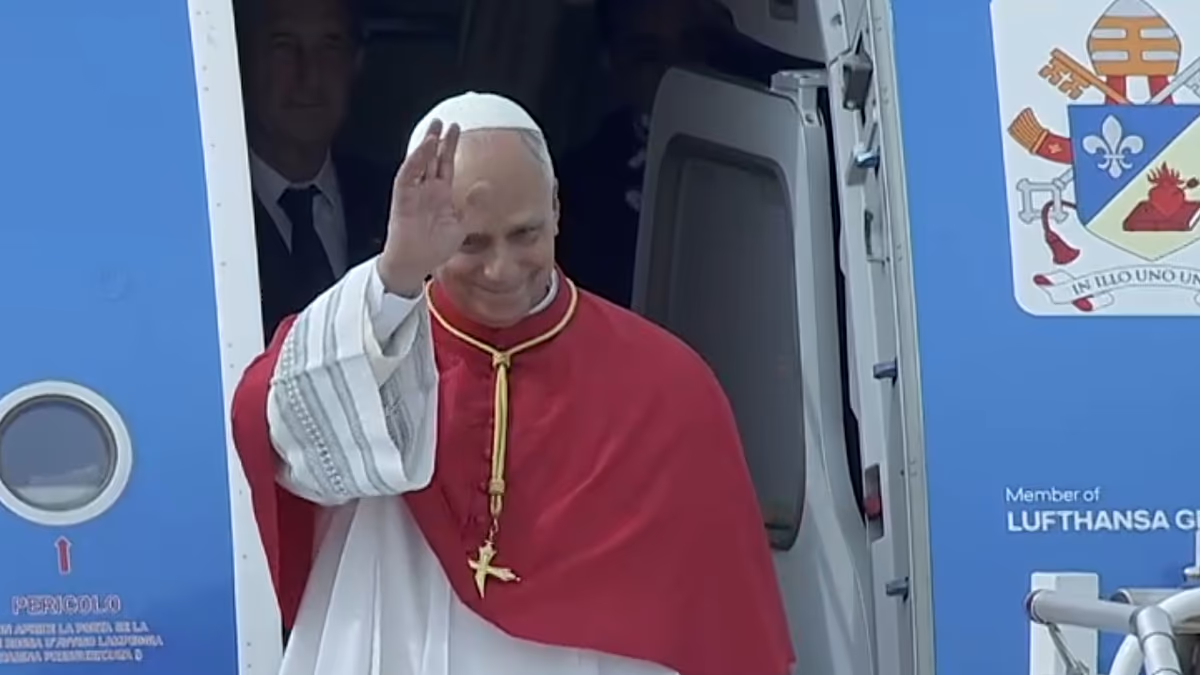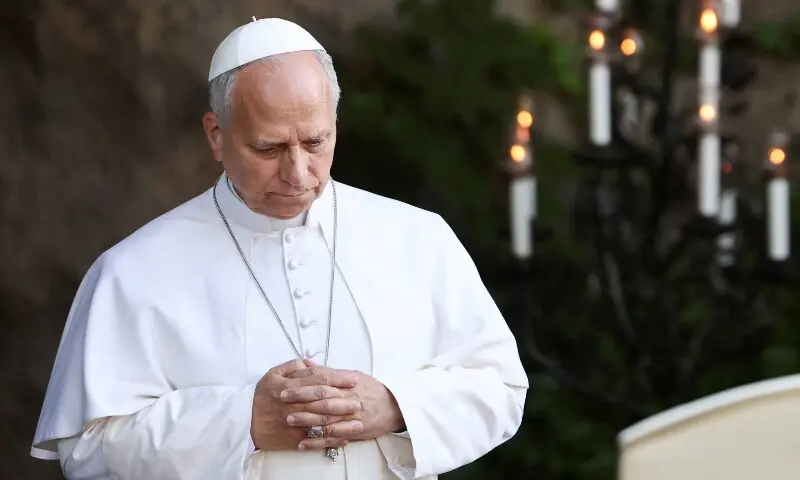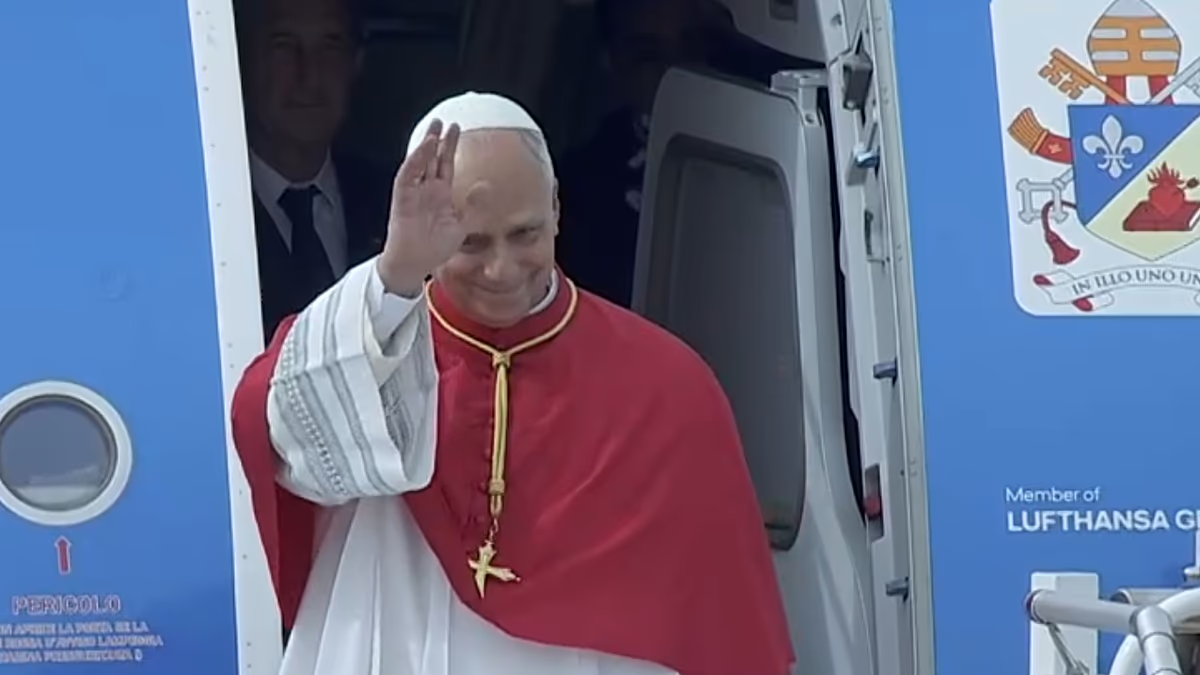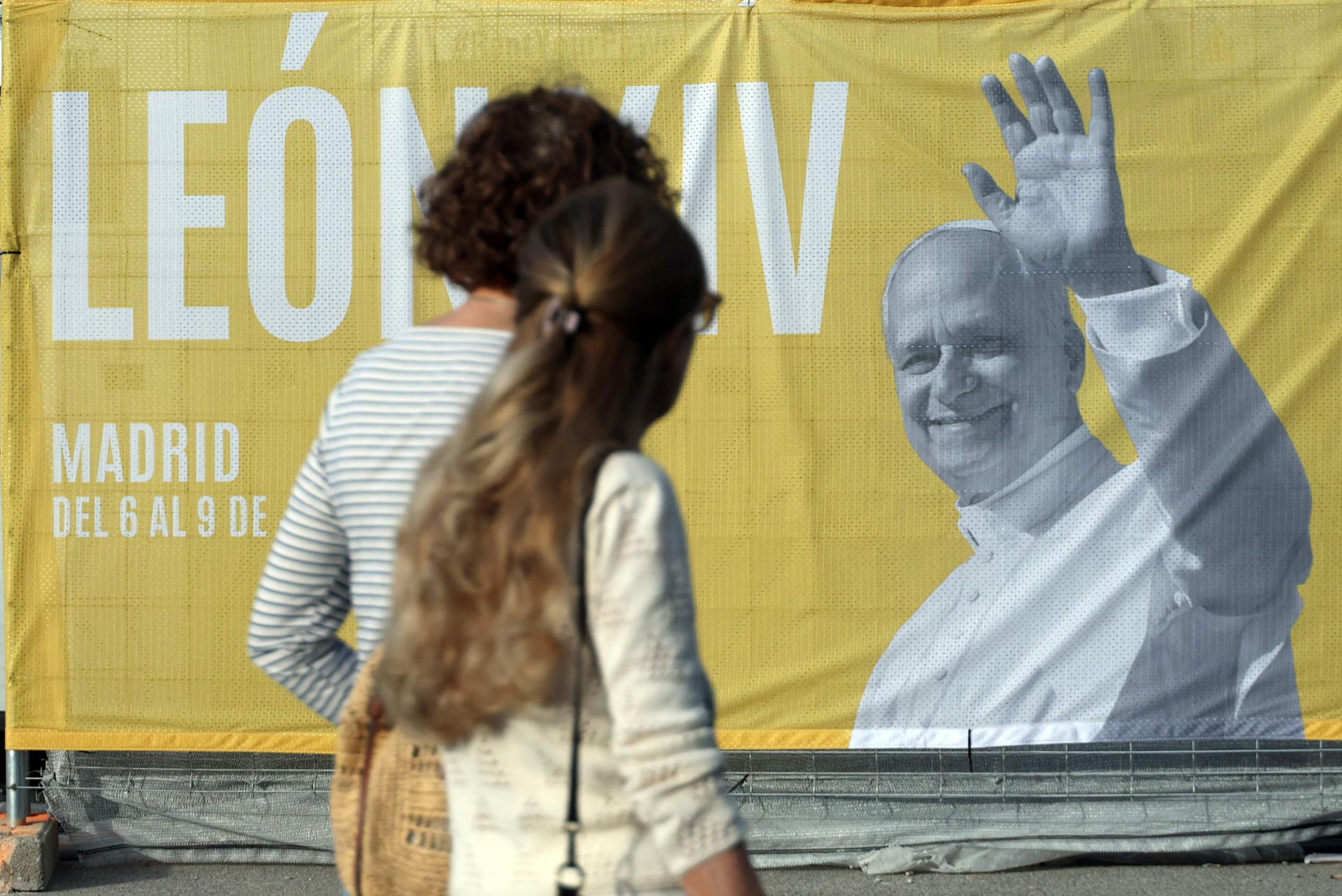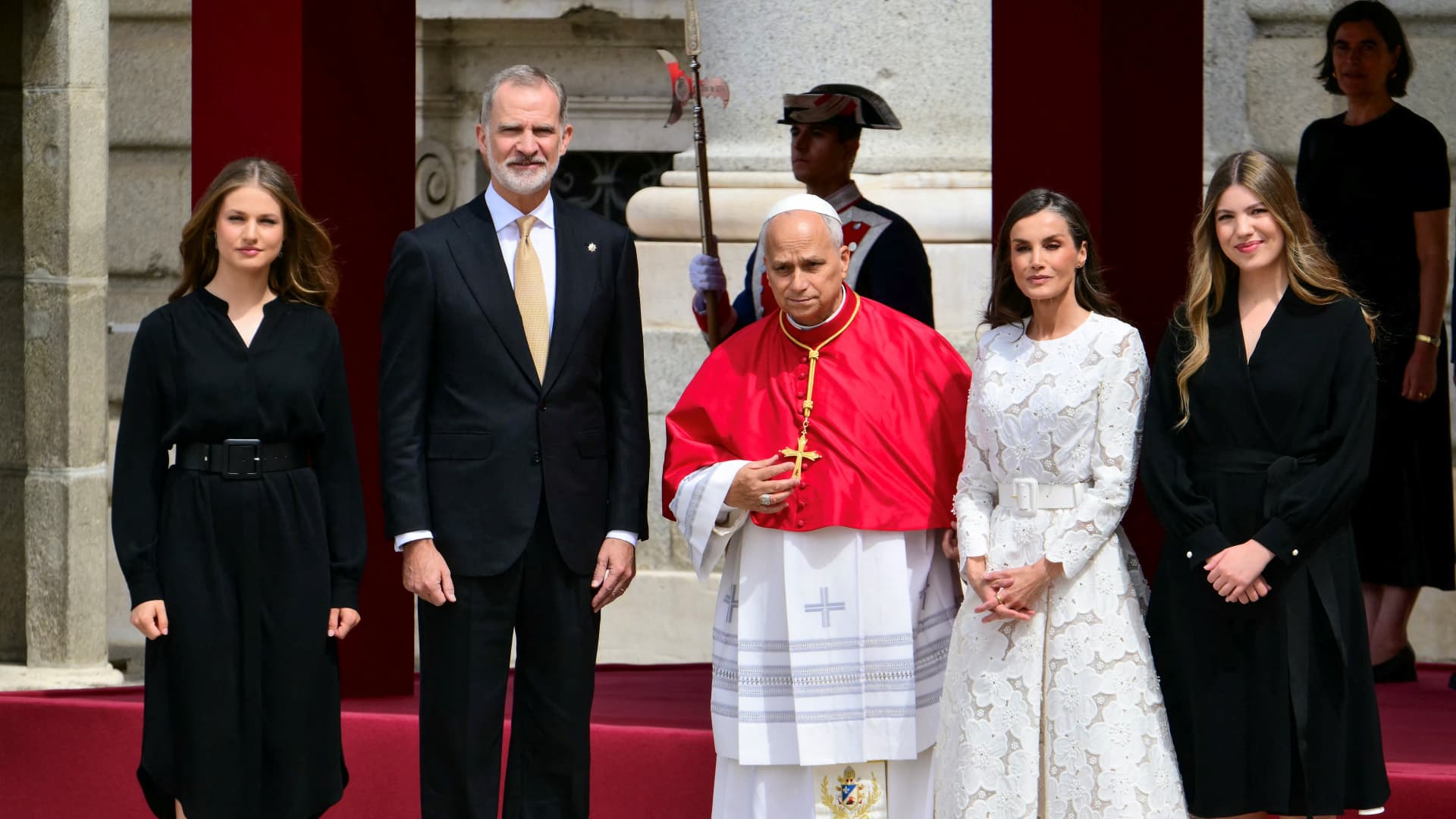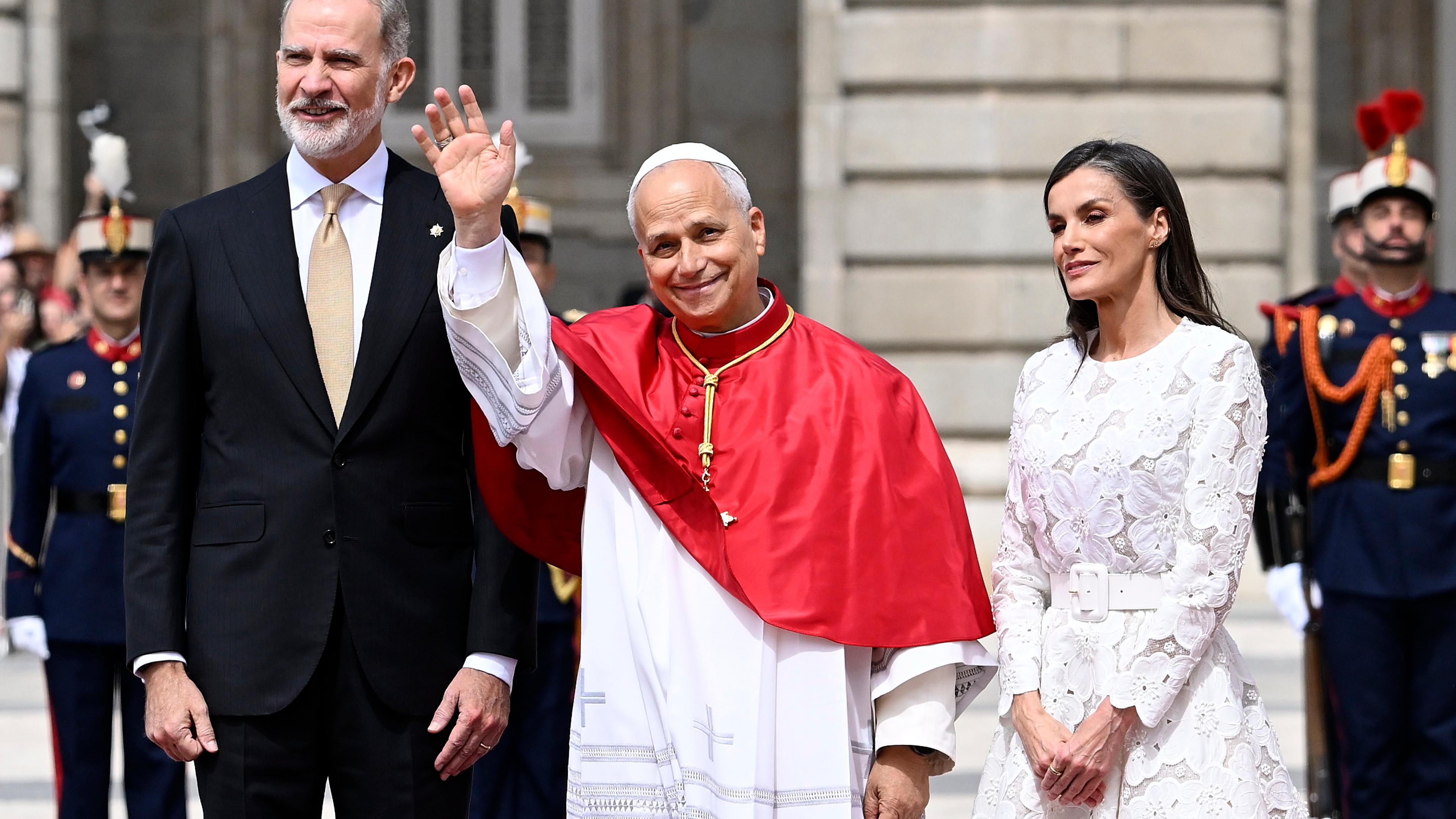
Pope Leo XIV received a ceremonial welcome when he landed in Madrid, Spain, on Saturday morning for his first major European trip since becoming Pontiff.The Chicago-born leader of the Catholic Church was greeted by King Felipe VI and Queen Letizia as he stepped off the plane to begin his week-long apostolic journey.During the country’s first papal visit in 15 years, Leo is set to meet with political, ecclesial, and civic leaders as he spends time in Madrid, Barcelona, and the Canary Islands.At a time where matters related to immigration are proving to be a polarizing topic between the different political factions in Spain, Leo will meet with those working on the front lines of migrant reception in the Canary Islands.The journey is set to honor Leo’s predecessor Pope Francis, who in the final years of his life expressed a desire to visit the Canary Islands, a major arrival point for migrants crossing the Atlantic from West Africa into Europe.Leo arrives weeks after Spanish Prime Minister Pedro Sánchez’s government approved plans to give legal status to around 500,000 undocumented migrants, enabling them to be formally integrated into the workforce.The Pope has publicly expressed enthusiasm about the apostolic journey to Spain, particularly the Canary Islands portion, as he thanked Canarians last month for the “hospitality” they showed when assisting passengers from the hantavirus cruise ship.According to a report released in 2025, some 55% of Spaniards identify themselves as Catholic, compared to 90% in the late 70s. Catholics in and around Spain have been eagerly awaiting the papal visit. Large crowds lined the streets for the Pontiff's arrival, and high numbers are expected to attend the processions and masses in the coming days.A crowd waits outside the Royal Palace in Madrid to witness the arrival of Pope Leo XIV on June, 6, 2026. Oscar Del Pozo—Getty ImagesWhat are the key moments to look out for in Pope Leo’s visit to Spain?Leo is scheduled to meet representatives of civil society on Saturday before leading a prayer vigil with young people at Madrid’s Plaza de Lima.On Sunday, the Pontiff will celebrate mass in Madrid’s renowned square Plaza de Cibeles, which will include a Corpus Christi procession.One of the most anticipated moments of the visit is set for Monday, June 8, when Leo is expected to meet Sánchez and address the Spanish parliament.The Pontiff is then due to hold talks with bishops and conclude the day with a visit to Almudena Cathedral—a major Catholic church in Madrid.Leo will continue his travels to Barcelona for another central event of the trip: the inauguration and blessing of the Tower of Jesus Christ at the Basilica of the Sagrada Familia on June 10.The tower is one of the most significant parts of Antoni Gaudí’s architectural masterpiece and will be inaugurated during the centenary year of the architect’s death.Alongside official ceremonies and liturgical events, Leo is expected to emphasize his concern for marginalized communities. In Madrid, he will visit a homeless shelter, while in Barcelona he is scheduled to visit a prison.The Pope will then travel to Gran Canaria, where he will meet organizations supporting migrants and refugees at the port of Arguineguín, long known as the “pier of shame” because of the overcrowded and difficult conditions faced by migrants arriving from West Africa.On the final leg of the trip, Leo will travel to Santa Cruz de Tenerife on June 12, where he is expected to visit housing facilities for migrants and refugees and meet organizations working to support their integration.Steven Millies, a professor of public theology at the Catholic Theological Union in Chicago, tells TIME that “going to these places is a way by which the Pope teaches the world that this is the most important mission for the church, to be present to people who are in difficult, vulnerable situations.”The visit will conclude with a Mass in Santa Cruz de Tenerife and a farewell ceremony at Tenerife Norte-Los Rodeos International Airport before Leo returns to Rome.When was the last time a Pope visited Spain—and what were the highlights?The last papal visit to Spain came in August 2011, when Pope Benedict XVI traveled to Madrid to mark World Youth Day, bringing together Catholic youth from around the world.During a welcome event at Plaza de Cibeles, Benedict encouraged young people to “build your lives upon the firm foundation which is Christ.”Among the defining moments of the trip was an address to university professors at the Basilica of the Monastery of San Lorenzo de El Escorial, where Benedict described universities as the “house” in which humanity seeks truth.Another notable stop came at the San José Foundation for disabled youth, where Benedict said a society unwilling to embrace its most vulnerable members becomes “a cruel and inhuman society.”The Cuatro Vientos vigil produced some of the most memorable images of the trip, as pilgrims and visitors endured severe weather but remained in place.Benedict later recalled that “in the evening a multitude of young people celebrating, not in the least discouraged by the wind and rain, knelt in silent adoration of Christ.”Pope Benedict XVI is welcomed by young pilgrims on arriving at Cibeles square during World Youth Day 2011 celebrations in Madrid, Spain, on Aug. 18, 2011. Denis Doyle––Getty ImagesHow Leo’s journey to the Canary Islands honors Pope FrancisIn 2023, a former fisherman who had fled Senegal and set up a life in Gran Canaria wrote a letter to Francis where he recounted his difficult journey from Africa to the Canary islands. Francis was said to have been deeply moved by the note and wished to visit the islands.In 2024, Francis welcomed bishops from the Canary Islands, alongside its President Fernando Clavijo Batlle, to the Vatican.The bishops presented Francis with a report outlining the difficult and perilous journey that migrants face heading to the islands and the challenges local authorities battled in providing reception and integration services.Francis continued to speak about the ongoing crisis publicly and reiterated his wish to visit the islands in January 2025, when the Diocese of Canarias reported that the Pontiff wanted to witness the migratory crisis and show support for those impacted.His deteriorating health ultimately prevented the trip from taking place. In April 2025, after a series of health difficulties, Francis died at the age of 88.Leo’s visit to Gran Canaria and Tenerife has been described as a way to carry forward a journey that had long been “in the heart” of Francis.“The trip to the Canary Islands is not just a fulfillment of Francis' promise to go there, but it's also a pretty frank continuation of Francis' determination to bring attention to migrants and to people in marginal situations,” says Millies.Pope Francis meets migrants at the Moria detention centre in Greece on April 16, 2016. Andrea Bonetti––Getty ImagesPope Leo greets U.S. Secretary Of State Marco Rubio during an audience at the Apostolic Palace on May 7, 2026. Simone Risoluti/Vatican Media—Getty ImagesThe geopolitical backdrop to Pope Leo’s visitPope Leo and Sánchez have both drawn the ire of U.S. President Donald Trump over their opposition to the war in Iran.Leo has repeatedly called for a diplomatic solution to the conflict and has been critical of any military escalation.His comments prompted repeated attacks from Trump, who accused the Pontiff of being “weak on crime” and “terrible for foreign policy.”Despite the criticism, Leo responded by saying he has “no fear of the Trump Administration or speaking out loudly of the message of the Gospel.”U.S. Secretary of State Marco Rubio traveled to the Vatican amid the ongoing tensions, and emphasized their “shared commitment to promoting peace.”Sánchez, meanwhile, is one of Europe’s leading critics on the conflict and has repeatedly described the war in Iran as “illegal.”He notably denied the U.S. access to joint military facilities for offensive operations early on in the war and closed Spanish airspace to American aircraft involved in the conflict.This has similarly drawn Trump’s rebuke, as the President threatened to cut trade ties with Spain in March.Tensions were further fueled by reports of a leaked Pentagon email suggesting the U.S. had considered suspending Spain from NATO as part of a broader effort to punish what it viewed as “difficult” allies.Leo and Sánchez met at the Vatican last week ahead of the Pontiff’s European trip. In a press conference afterward, Sánchez said the two had found much common ground on several key issues.Millies says that there could be a potential “joint statement” from the respective leaders during the visit, which could “again cast some light on all that this conflict has unleashed.”
What to Know About Pope Leo's Journey to Spain—and How It Honors the Late Pope Francis
Leo will meet with Spanish Prime Minister Pedro Sánchez during the trip. As vocal critics of the Iran war, they have both incurred the wrath of U.S. President Donald Trump.
1,412 words~6 min read