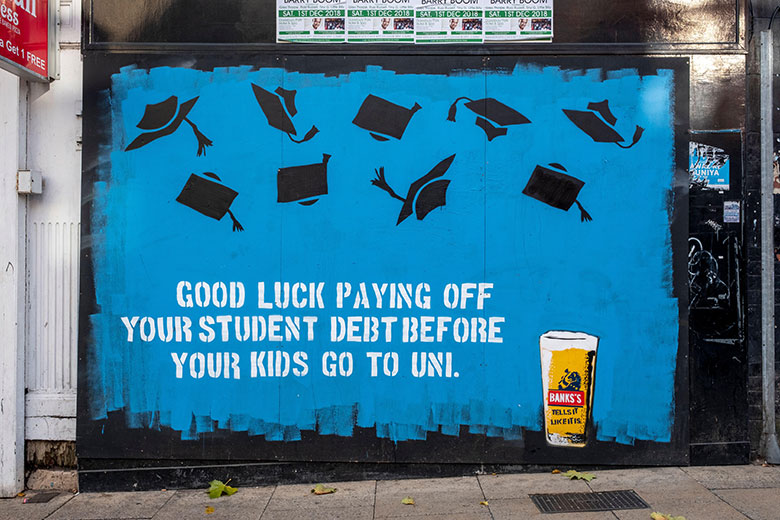
An inquiry into England's student loan system has been launched by MPs, as new survey data shows a third of people now believe a university education is not worth the time and financial commitment required12:24, 06 Jun 2026A new survey revealing that one in three people doubt the value of a university degree comes as "not surprising" to experts. MPs have launched an investigation into England's student loan system, gathering testimony from student organisations, academics and financial specialists.The National Union of Students (NUS) has urged the review to scrutinise graduate repayment thresholds and the interest rates applied to student loans. The Government has stood by the existing system, maintaining that repayments are earnings-linked to safeguard lower-earning graduates, while any remaining debt is ultimately cancelled after a specified timeframe.The investigation arrives amid fresh research indicating that public faith in the worth of a university degree continues to wane. Data from the most recent British Social Attitudes survey reveals that 34% of people now think a university education isn't worth the time and money involved, a dramatic rise from just 14% 20 years earlier.The findings show this marks the greatest level of doubt about degree value since monitoring commenced. The share of people who think university makes graduates financially better off over time has also plummeted considerably, falling from 50% in 2005 to 36% in 2025.Lukas Kaminskis, CEO of Turing College, suggested the statistics demonstrated people's anxieties about university costs and the resulting debt burden.He continued: "Falling confidence in the value of a degree shouldn't be interpreted as a rejection of higher education itself. What it reflects is growing concern about cost, debt and whether you should be studying for a passion or to keep pace with the realities of the jobs market."People are increasingly asking not just 'should I study?', or 'what should I study?', but also 'what skills will actually help me build a successful career?'. A degree remains a valuable route for many people, but it can no longer be viewed as the only route. Employers are placing greater emphasis on practical skills, adaptability and continuous learning."As industries evolve more quickly and adapt to new developments in technology, workers are recognising that education is not a one-off investment made at 18, but something that continues throughout a career. The challenge for education providers is to demonstrate clear outcomes and help people develop skills that are genuinely in demand."If students are studying to expand on their passions and interests, universities should be demonstrating that there is a material benefit to this once they've completed their studies. The conversation should move away from degrees versus non-degrees and focus instead on how we equip people with the knowledge and capabilities needed to thrive in a changing economy."Aaron Strutt, product and communications director at London-based Trinity Financial, suggested that gaining industry-specific qualifications would be far more advantageous than pursuing a university degree.He said: "The level of debt most students take on when they go to university or study for a degree is huge and it follows them around for decades. In the mortgage and finance industries, many qualified advisers do not have a degree but hold industry-specific qualifications."There are also lots of apprentices learning their trade and going on to have successful careers. As a country, we clearly need educated people in specialist roles, but at the moment, many of them have to accumulate huge debts and then pay high interest rates."This debt is also taken into consideration for mortgage affordability purposes, meaning the amount graduates can borrow when they buy a home is reduced. It is not surprising that younger people are being put off going into higher education."Nouran Moustafa, practice principal and IFA at Roxton Wealth, argued that degrees were no longer a "golden ticket".She said: "University is still worth it for some people, but the days of pretending every degree is automatically a golden ticket are over. A degree has to be judged like any major financial decision: cost, career route, earning potential, personal ambition and the alternatives available. I am not surprised confidence has fallen."Students are being asked to take on huge debt while the graduate job market feels more uncertain, rents are high, and many entry-level roles no longer give the same clear progression. The inquiry is needed, but it must be honest. The student loan system is called a loan, behaves partly like a graduate tax, and is explained badly to young people making one of the biggest decisions of their lives."We need better financial education before university, stronger vocational routes, clearer data on graduate outcomes by course, and a system that does not punish ambition. The question should not be 'uni or no uni?', it should be 'which route gives this young person the best future'."Martin Rayner, mortgage broker and financial adviser at Compton Financial Services, argued that university should not be treated as the "default option".He continued: "It is no surprise that more people are questioning whether university is worth the cost. Yesterday we advised two first-time buyers. One had an £81,000 student loan and the other £40,000. These loans will never be repaid. That helps no one. The problem is that we have spent years treating university as the default option."For some careers, a degree is absolutely worth it and remains the best route into a well-paid profession. For others, the financial return is far less clear and alternative routes such as apprenticeships may make more sense. Young people need honest information before taking on decades of repayments."An inquiry is needed because we have graduate unemployment alongside major shortages of skilled tradespeople. We are encouraging more people into higher education while employers struggle to recruit in sectors where demand is highest. That raises important questions about whether the system is delivering value for students, taxpayers and the wider economy."Antonia Medlicott, founder and MD of London-based Investing Insiders, said the inquiry into student loans was needed.She said: "This inquiry is long overdue. The student loan system has been reformed repeatedly without anyone stepping back to ask the important question: should every young person go to university in the first place? The conversation we are not having is about return on investment."A degree in a subject with poor graduate employment outcomes, funded by £50,000 or more of debt, is not a good financial decision. For too many students, it is an expensive way of delaying adulthood, and there are better, lower-cost options available. Apprenticeships need to be a genuine first option for many."And we should be talking about the value of work experience, including overseas voluntary work, which could help address the growing concern of the number of NEET youths in the UK. Kids need practical employment skills. Not an expensive degree in a subject that won't result in a job. Of course, there will always be professions where a degree is necessary."Kate Underwood, founder of Southampton-based Kate Underwood HR and Training, said people should start to learn on the job.She explained: "For two decades, we sold young people one dream: rack up debt, get a degree, win at life. A third now call it out, and small business owners have known the maths was off for years. As an HR professional and small business champion, here's the truth from the shop floor: too many universities aren't equipping students for the real world, yet some graduates walk in with an entitlement towards those who've been working and learning since they left school. That's so wrong."People learn in different ways. University is right for certain professions - medicine, law, engineering - but learning on the job is right for others. We have to quit treating a degree as elite for every role and start making all pathways equal. Small firms are crying out for talent, yet we still funnel every bright kid towards a campus instead of an apprenticeship that pays from day one."That's a skills gap we're creating on purpose. An inquiry? Yes, but ask the real question: why do we value paper over people?"Colette Mason, AI ethics consultant at London-based Clever Clogs AI, said AI was changing how we perceived knowledge.She added: "The jobs market has quietly moved the goalposts. Knowledge work was the pitch. AI is now eating knowledge work. Graduate schemes that existed five years ago are contracting. The analytical, administrative, and writing-adjacent roles that justified the debt are exactly where AI displacement is landing first."The faceless application process makes it worse. You used to be able to walk a CV in, read a room, make an impression. Now you submit into a void, get screened by software that was never told what a person actually looks like, and hear nothing. This is a structural signal that the labour market values speed and compliance over judgment and character. A degree used to buy you into the room. It no longer guarantees the room exists.Article continues below"An inquiry into loan mechanics while the underlying value proposition collapses is the institutional equivalent of polishing the furniture while the house burns. The money is better spent on a deposit on a home or your own tech stack for AI."
One third say 'not worth the money' in new student loan update
An inquiry into England's student loan system has been launched by MPs, as new survey data shows a third of people now believe a university education is not worth the time and financial commitment required
1,513 words~7 min read