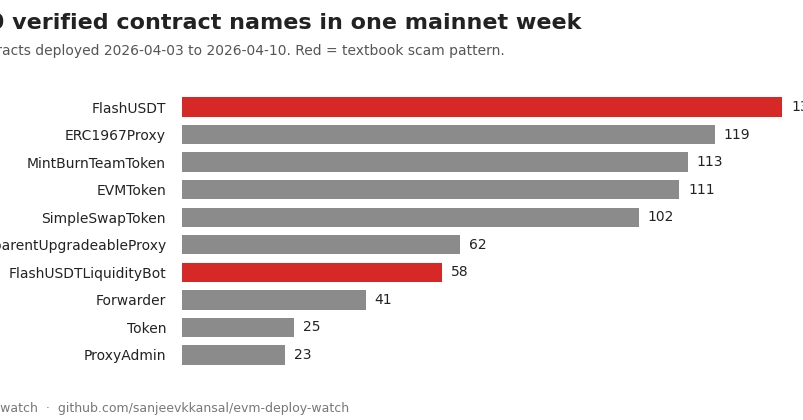
I pulled every top-level contract deployed on Ethereum mainnet in the week ending 2026-04-10. There were 8,257 of them. I enriched each one with its deployed bytecode, verified Solidity source where available, and its deployer's first-tx history. Then I scored each contract against five rule families (contract name, bytecode shape, source patterns, deployer reputation, known-drainer hashes) and used Claude Opus 4.7 to write structured walkthroughs for the top scores.
192 contracts came back as high-confidence scam patterns. All 192 are one specific scam family: "FlashUSDT" and its liquidity-bot variant, a fake-Tether template used in off-chain social engineering. Manual review of a stratified sample confirmed 100% precision in the very-high score band. Cross-referencing against ScamSniffer's public blacklist found zero overlap, because public scam lists track established drainer infrastructure, not freshly-deployed scam tokens. The lead time is the story.
Method
The pipeline is four stages. Each stage writes JSON to disk so the run is resumable and the dataset is inspectable end-to-end.
Ingest. Block-by-block scan of mainnet blocks 24,795,371 to 24,845,605 (seven days). For every transaction with to == null, record the deployed contract address, deployer, gas used, and init bytecode. ~17 minutes against QuickNode at concurrency 10. The v0.1 ingest catches only top-level deploys; contracts spawned by internal CREATE and CREATE2 from factories are out of scope for this run.