Hong Yoo
Style, Eat, Travel
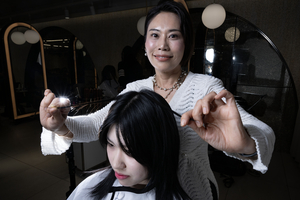
Juno Hair veteran Jeong Ok on the personalized 'diagnostic cuts' overtaking Korea’s salons and global demand Jeong Ok, Juno Hair sales support director, poses for a photo at Juno Hair’s Seoul National University Station branch in Gwanak-gu, Seoul, on May 20. (Im Se-jun/The Korea Herald) When Jeong Ok visited a busy Tokyo salon recently, she thought she had walked into a Korean shop. K-pop was playing. The hair designers were styled the Korean way. She got a "hello" in Korean before the conversation switched to Japanese."The styling and the makeup were all K-style. And it was a Japanese salon," said Jeong, an executive overseeing sales at Juno Hair and a 31-year veteran who still cuts hair at the brand's Seoul National University Station store.That visit helped Juno Hair decide to open a Tokyo store last December, its second master franchise after Thailand. Founded in 1982, the brand now runs roughly 180 stores in Korea and eight overseas across the Philippines, Thailand, Singapore, Japan and Vietnam. Its newest, a Ho Chi Minh City flagship, opened in March. Beyond salon services, Juno Hair also operates an in-house academy to train hair designers, helping standardize techniques and maintain brand consistency across branches.Jeong, who joined Juno as an intern in 1995 and has run her current store since 2006, has watched Korean hair fashion shift from importing Japanese and Western looks to exporting its own. Tassel cut with root volume and C-curl perm (Juno Hair) The 'made but not made' lookThe current K-hair direction starts with what Jeong calls a "personal diagnosis." Designers analyze a customer's face shape, hair texture and proportions before recommending a cut or color, rather than applying the same trending look to all faces."Korean design used to be excessive. Now it's leaning heavily toward 'made but not made,' that 'kkuankku' feel, very natural," Jeong said in an interview with The Korea Herald.Color tells the same story. The bright, saturated tones that defined a salon visit a decade ago have given way to softer hybrids."The trend now is browns with a slight pastel mix, a brown with a hint of pink, or a brown with a hint of green. Indoors, it just reads as brown, but outside, in sunlight, you catch the reflected tone," she said.Exporting K-looksChinese customers, Jeong said, favor visible transformation."China likes things bold. The hair has to show you did something clearly, and the makeup gets heavier too," she said.Japan is the more striking case. Korean stylists once studied Japanese shaggy cuts and lightweight layers, but the flow has reversed in recent years. The heavier cuts and thick, loose wave perms trending in Korea are now spreading across Tokyo salons. Many Japanese customers had already followed Korean designers through social media and walked in familiar with the Juno name.Western customers bring a different challenge, often requesting exact looks from K-dramas or K-pop."Westerners have smaller faces, but Korean hairstyles are all about making our faces look smaller, so we walk them through what change they actually want," Jeong said. Layered cut with C-curl perm (Juno Hair) Old cuts, new namesHair trends cycle the way fashion does, Jeong said, but they return under different labels."The cut we used to call shaggy is now the hush cut. The straight bob is now the tassel cut. What our mothers' generation called the 'geoji,' or beggar cut, is what young customers now call the high-layered cut," she said.She traced the renaming to social media, where influencer designers attach new labels to old variations. The cut underneath is often nearly identical to a style that ran a generation earlier.The bigger shift among cut, color and perm is in care, which now ranks behind cut and color, with the perm receding."A head spa used to be requested only when there was a scalp problem. Now it's something you do to relax and recharge," Jeong said.Foreign visitors have driven the category. With Korean tap water purer than tap water in much of Southeast Asia and on par with that in the West, overseas customers often book head spa appointments to repair damage from harsher water and stronger sun.Why Korean designers travelEach overseas Juno store relies heavily on Korean designers. For instance, eight Korean stylists staff the Singapore Orchard store that opened last year."Korean designers understand the styles customers bring in, and they know which areas to add volume and which to bring down. That structural understanding is hard to teach," she said.Social media now drives much of that demand, drawing customers from overseas and from cities outside Seoul. Jeong expects hair to become a primary reason to visit Korea within five years, not an add-on to a shopping or food trip."Vietnamese clients with means already fly to Singapore for their hair. I think we're approaching a moment where a trip starts with 'I'm going to Korea to get my hair done,' and shopping or skin treatments follow," she said. Jeong Ok, Juno Hair sales support director, talks to The Korea Herald on the latest K-hairstyling trends in Gwanak-gu, Seoul, on May 20. (Im Se-jun/The Korea Herald) Why she keeps the scissorsJuno Hair's executive ranks are unusual in that several senior leaders still cut hair. Jeong said the dual role is deliberate. The executive position, she said, is the side role. Being a stylist is the real one. She plans to keep doing hair until she is 85, citing Master Song Boo-ja of Juno, who styled stars Na Hoon-a and Lee Mi-ja decades ago and still works today."The day I put the scissors down is the day I lose my instinct for the work," she said. "If I'm running operations without it, the designers working for me sense it. Without the technique, the title alone doesn't carry weight on the floor."