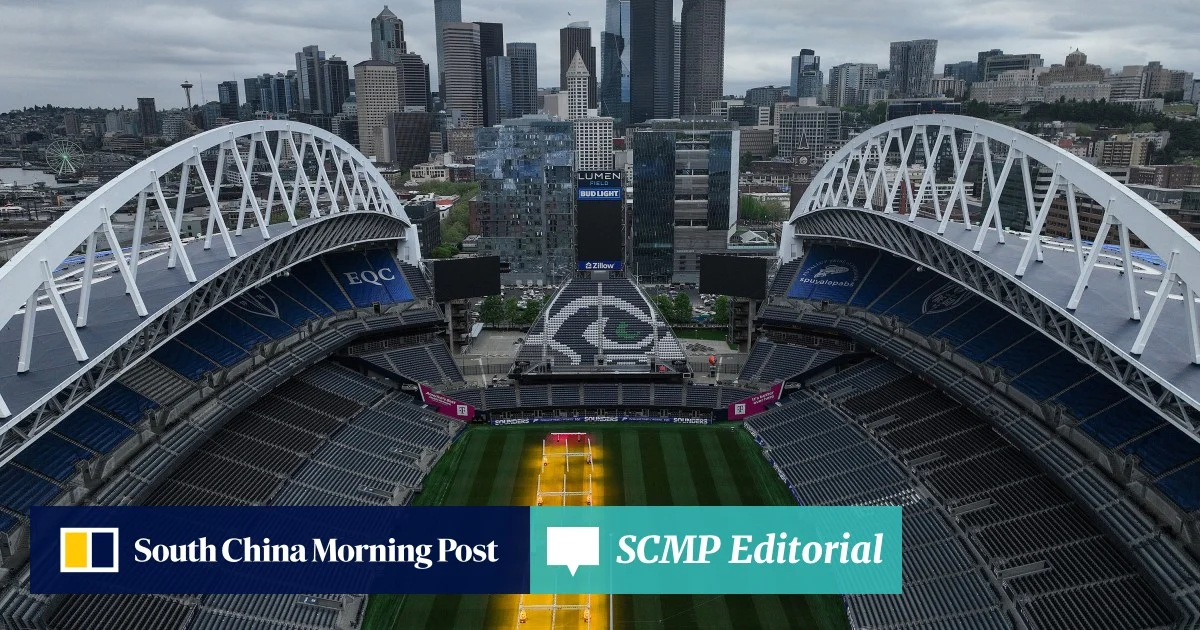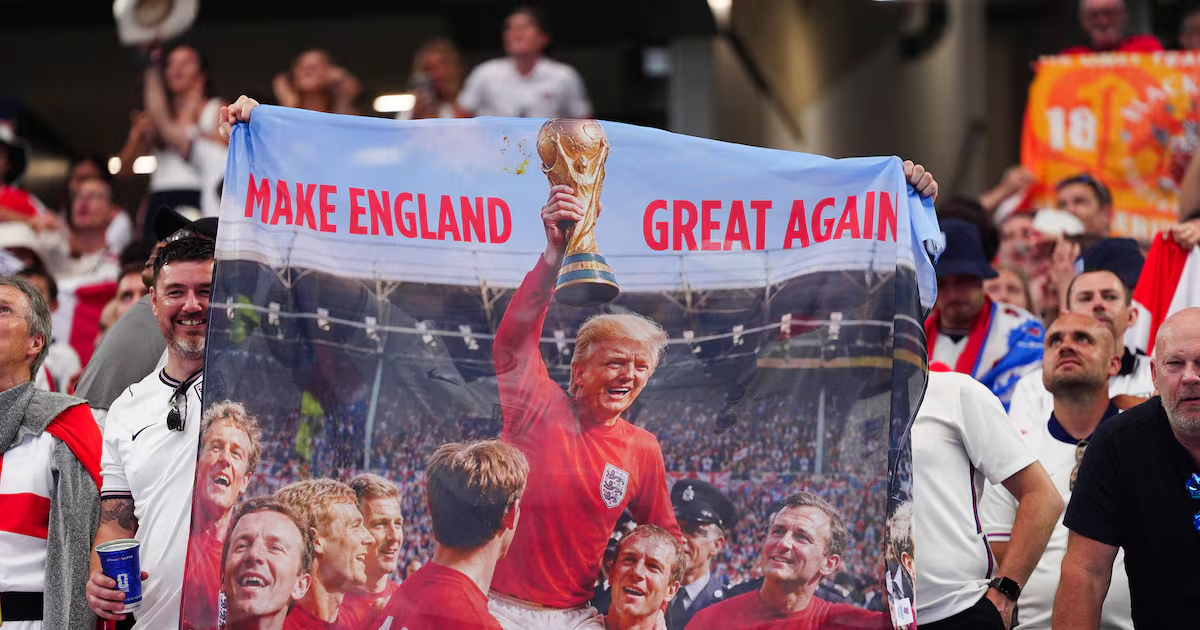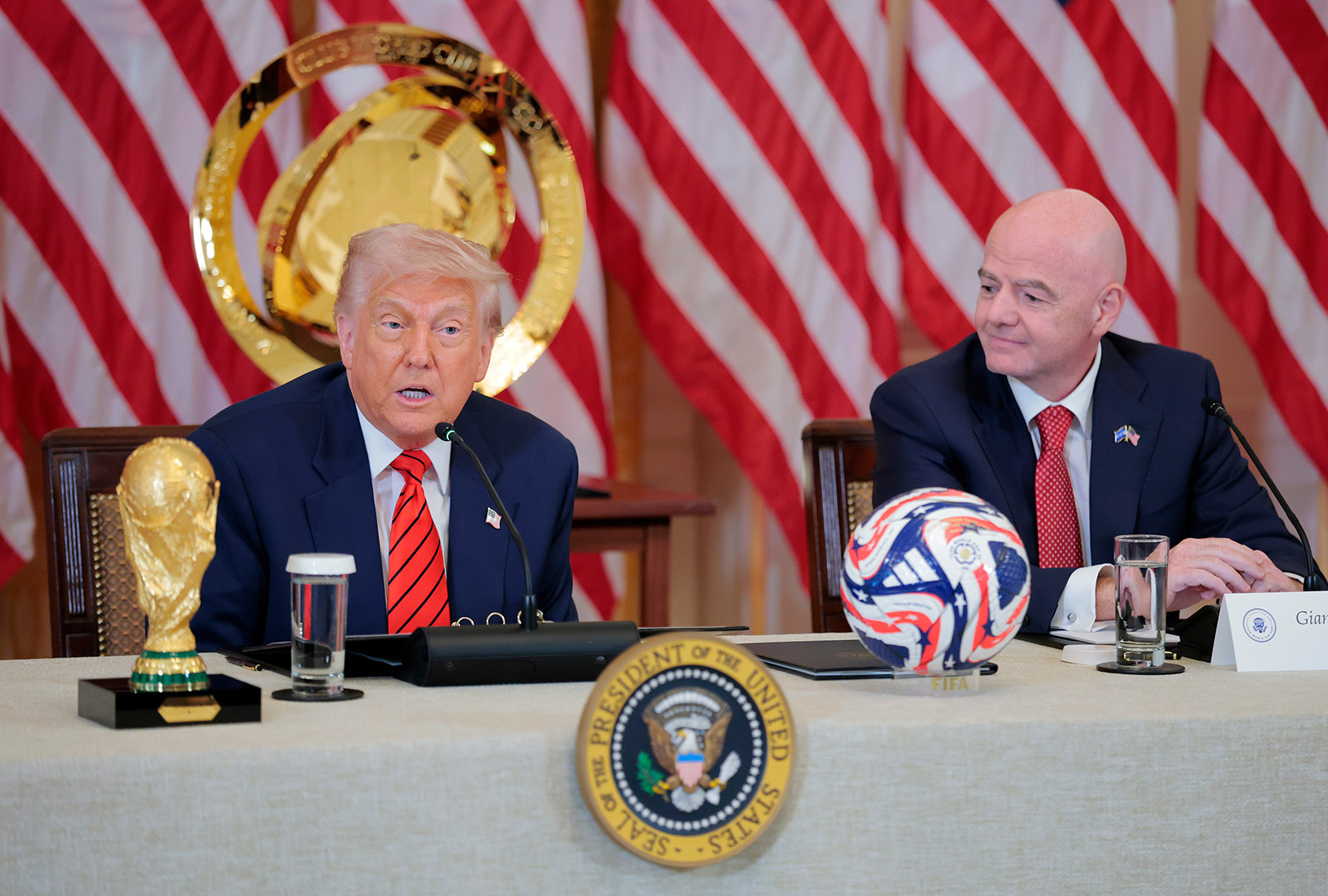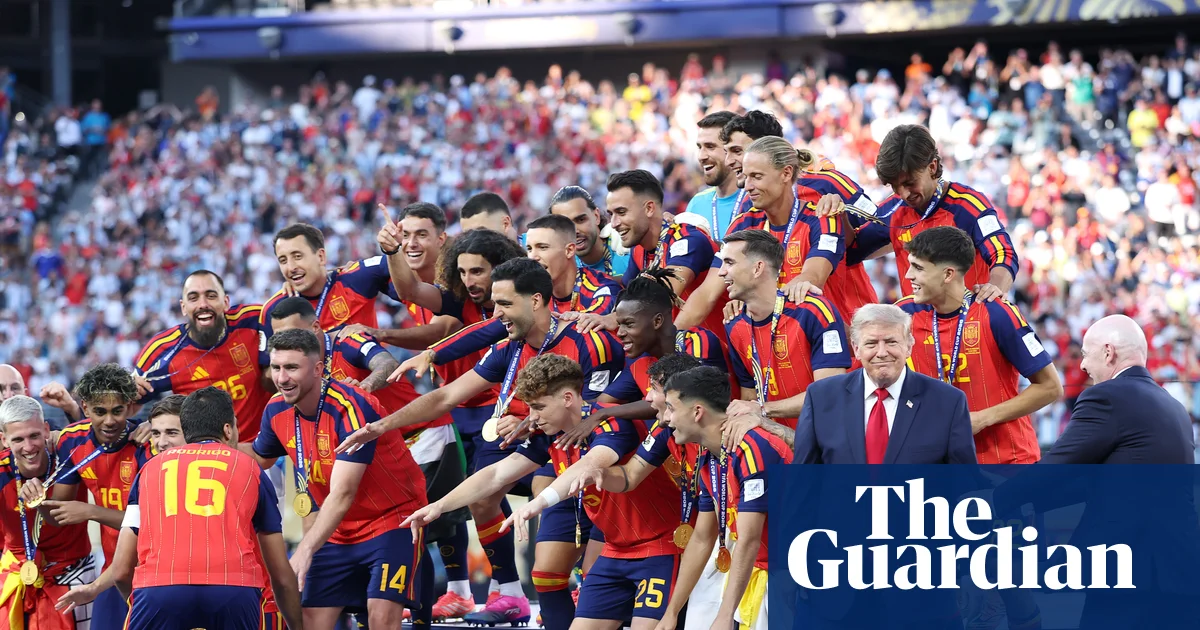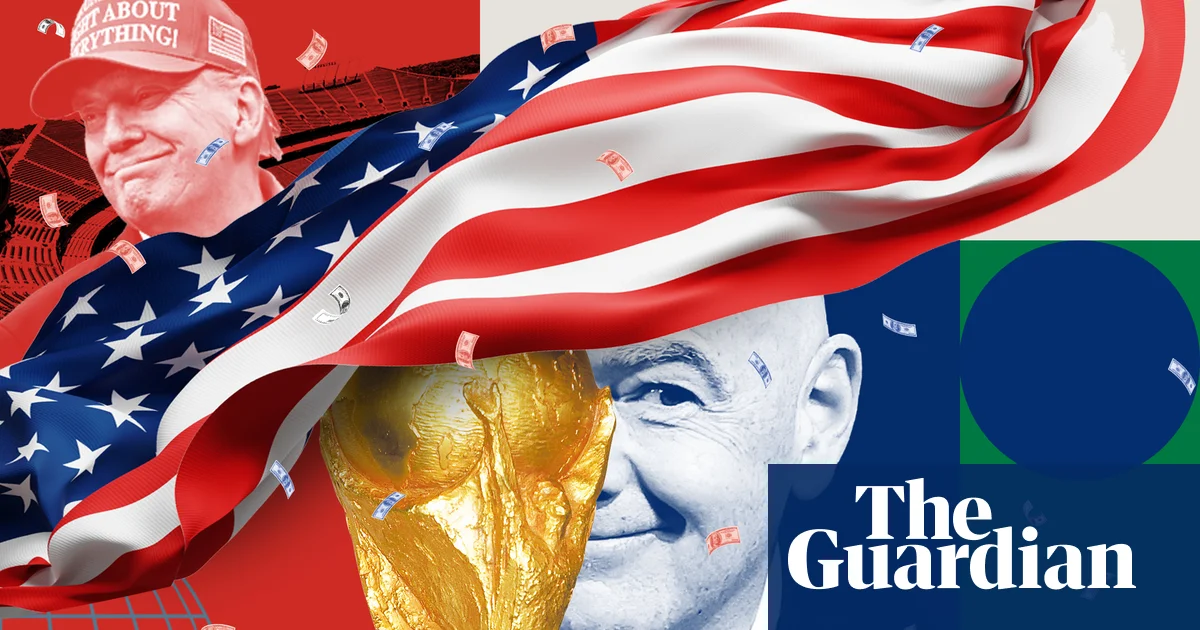
This is the end, of our elaborate plans, the end. Of everything that stands, the end. It seems fitting that football’s latest stopping point on its voyage upriver into the blank parts of the map, a mission so choice that when it’s over you may never want another one, should be a World Cup overseen by a haunted-looking man with a messiah complex, out there operating beyond the pale of acceptable sporting governance, the warrior-poet Swiss lawyer football never knew it needed.The 2026 World Cup in the US, Mexico and Canada will finally kick off in earnest on 11 June at the Azteca Stadium. From there the tournament will unspool across 39 days, 16 host cities, 104 matches and a 6,000-mile span from Mexico City in the south to Vancouver in the north to Boston in the east. Ten years in the making, the end product of a century of powerplay and hyper-grift, this is by almost any metric not just the largest sporting event ever staged, but the largest event, as we say in America, period.How football explains the world, part 95. It has been estimated the tournament will generate $80bn (£59.7bn) in global economic output across its full timeline, roughly equivalent to the GDP of Belarus. Basically, if the World Cup were a country someone would have stationed nuclear weapons on it by now. Here we have big sport in its final global form. But also, in the spirit of the times, a spectacle configured in the image of a single opportunist overlord.This is Gianni Infantino’s world now, a man who carries with him at all times that oddly alluring sense of complete conviction in his own inauthenticity, whirling his arms like a Las Vegas illusionist, doling out favours on a round of applause, beaming piously around the walnut table of power, even as his own peace prize overlord initiates eight separate military actions inside a year, and all the while saying things like joy, love, unity, hope. Or as Shakira might put it, Dai, dai, ikou, dale, allez, let’s go.This is what the summer of 2026 has in store for us on its six-week sprint through Trump’s America, a place of triple-speak and power-flash, and in its own way the perfect state of the art sporting spectacle. Welcome to the heart of darkness.The Atlanta Stadium will host eight games through the tournament, including one of the semi-finals. Photograph: Robin Alam/ISI Photos/Getty ImagesAnother paradox: for all its modernity the 2026 World Cup also feels like the end of many things, a last great firework show before the start of whatever comes next. Most obviously, the end of any remaining notion of football as the people’s game, a heist that is by now on its second or third victory lap.The end of any sense of scale in the staging of these events. The end of football consumption in its old form, the transition from analysis and dissent to noise and colour, the brain-blurts of in-house content providers. Beyond that the World Cup provides a window on America at the end of its own century, still the heart of global culture, even as it seems both exhausted and gripped with wild energies, a country that is all played out.There is always a little pre‑tournament hysteria, and nowhere does hysteria quite like America. But it isn’t hard to offer up a simple list of all that is wrong with this picture. Qatar 2022 felt like an end point on the journey into dictator-ball and propaganda spectacle. Well, hold my Bud Light.Three short months ago the US assassinated the head of state of one of its competing nations, and this seems, at the time of writing, to be just fine. Donald Trump’s immigration militia is still out there lassoing its own populace, a process that could yet entwine itself around tournament matches. The World Cup is itself an act of economic violence, with vertiginous travel costs and premium seats for the final approaching $33,000 (£24,000) at face value. This is a spectacle designed to tell you, very clearly, that you are nothing but a set of passive eyeballs, an economic activity drone.Gianni Infantino took the Club World Cup trophy with him when he talked to Donald Trump at the White House. Photograph: Mark Schiefelbein/APAs for the sport-washing of atrocities and abuse, football hasn’t just offered itself up to Trumpism, but become an active player in the process, Infantino following his latest despot-crush around like a lovesick nine-year-old, giving him a ball, a trophy, a friendship band.In any sane not-for-profit organisation the cosying up to successive despots would be grounds to be ejected from office. But this is Fifa, and Infantino will instead use the flood of cash to shore up his own position before next year’s third‑term presidential elections, leveraging his status as a kind of human logo, Brand Football, essence of human greed and vanity minced into a smooth, pink, fleshy mulch and crammed into a blue suit and white Stan Smiths.It is in its own way a remarkable act of transformation, the unremarkable Swiss administrator who stepped into the Blatter vacuum and revealed a Napoleonic facility for power, who has exchanged corruption for a golden helicopter ride around the world of despot-populism. Under Infantino Fifa has become a one-man deal with the devil, where the devil never actually needs to ask for his payback, because the devil is already on the payroll.So. Why are you going then? Why is the Guardian giving air and light to this event? If you don’t like it, why not boycott?It is good question deserving of a proper answer. Which is, that this fails to understand the point of journalism. Ignoring this event will not affect what Trump does or how Fifa acts. No-platforming football is a bizarre idea. The sport won’t suffer. It’s too big, too visible.By turning away you vacate the space entirely. Infantino would be delighted if nobody present pointed out his flaws or tried to call him to account. For this World Cup, Fifa has already roped in its own band of influencers and message amplifiers to provide fawning coverage via their Miami office. Words, dissent, analysis, the things that ultimately did for the House of Blatter: this only happens when that much derided thing, independent media, is in the room. Boycott the show and the space is filled entirely with paid noise. Money is driving us that way. But not quite yet.England fans have high hopes. Photograph: Tom Jenkins/The GuardianAlso, someone has to tell the other story, about the beauty and allure of this global spectacle, still the greatest show on earth, even with its own sclerotic Uncle Sam dancing along at the head of the parade.So we have a tournament still to play. When it comes to a winner it is hard to look past the usual teams. France have the best squad, and still provide the model of how to coach and source players. Spain have talent, a system, a way of playing and just know how to ease through tournaments. Portugal have an excellent squad, but they also have the world’s most famous man, football’s own late-stage Elvis, still demanding to be wheeled out on stage in his white suit to play the hits.All eight World Cups played in the Americas have ended with at least one South American finalist. Brazil and Argentina are still the obvious choices, for historic and also talent reasons. Brazil have a great goalkeeper, a very good defence and elite elements in attack. In Carlo Ancelotti they basically have football’s dad, a manager who knows how to make elite players feel good.Ideally we might see a surprise. Morocco are a very good team. Norway are easy in their own skin and have a striker with 55 goals in 49 games, and 12 in his last five at the time of writing. Nobody will fancy playing them in a quarter-final in Foxborough, Massachusetts in early July.And so to England, who are currently third favourites on UK betting exchanges, which says more about expectation (greatest hand of sword-from-the-stone talent in the world) than past performance (two losing semi-finals outside England since 1930). But England do have a strong chance of getting to the final stages. They have the familiar mix of very good if not world-beating players (apologies, Premier League hype machine) and some gaps measured against the very best (centre‑back, right-back, left-back, midfield).Against this England have not just an elite overseas manager, but the right one this time, a step on from the mute entropy of Fabio Capello and Sven-Göran Eriksson’s repackaged pomo template, Charles Hughes in an Italian suit. There will be less stuff about the onerous majesty of Englishness, fewer stirring open letters, more boggle-eyed in-game tactical interventions from the man in the golf-casual leisurewear.The dome of Science World in Vancouver is transformed into a giant official World Cup match ball. Photograph: Xinhua/ShutterstockAlso, the tempo of this tournament may suit England. A prediction: the games will be long, arduous, heat-sapped affairs between tired players. There will be a great deal of drinks-break rejigging. Football will be broken into units of time and phases of play. There will be complaints about this in the group stages, with mediocre games at difficult kick-off times because Fifa has chosen to degrade its product in search of scale.But this may suit England’s strengths. Harry Kane will be coming off a Ballon d’Or-curious season, and old enough to marshal his energies. There will be a strong set-piece element and plenty of video assistant refereeing. Thomas Tuchel is good at delivering high-speed tactical input. They may just tick their way through this thing to the sharp end again.Beyond this we have an undeniably operatic cast of characters. Lionel Messi now lives in Florida and is still a genius. Cristiano Ronaldo will take his global personality phenomenon around a country he has stayed away from for the last 10 years. And the US does actually have a football culture. This is a game already loved by the pre-converted and by large parts of its immigrant population.So much of the backbeat to this World Cup has been about the country itself, the basic question of whether America still works. Is it a good or a bad place? Does this shared experiment still have love and optimism and a welcome to give? Has it betrayed its status as the cultural and economic centre of the last hundred years, the wellspring of music, culture, mega-brands, a system of being?Or is this show being run by a bunch of four-star clowns who are going to end up giving the whole circus away? All that seems certain is it’s impossible to take your eyes away from a dying star; and that we will, above all, be watching.
Power and glory: World Cup promises a spectacle impossible to ignore
Ten years in the making, the greatest show on earth is set for a six-week sprint through Trump’s America
1,794 words~8 min read