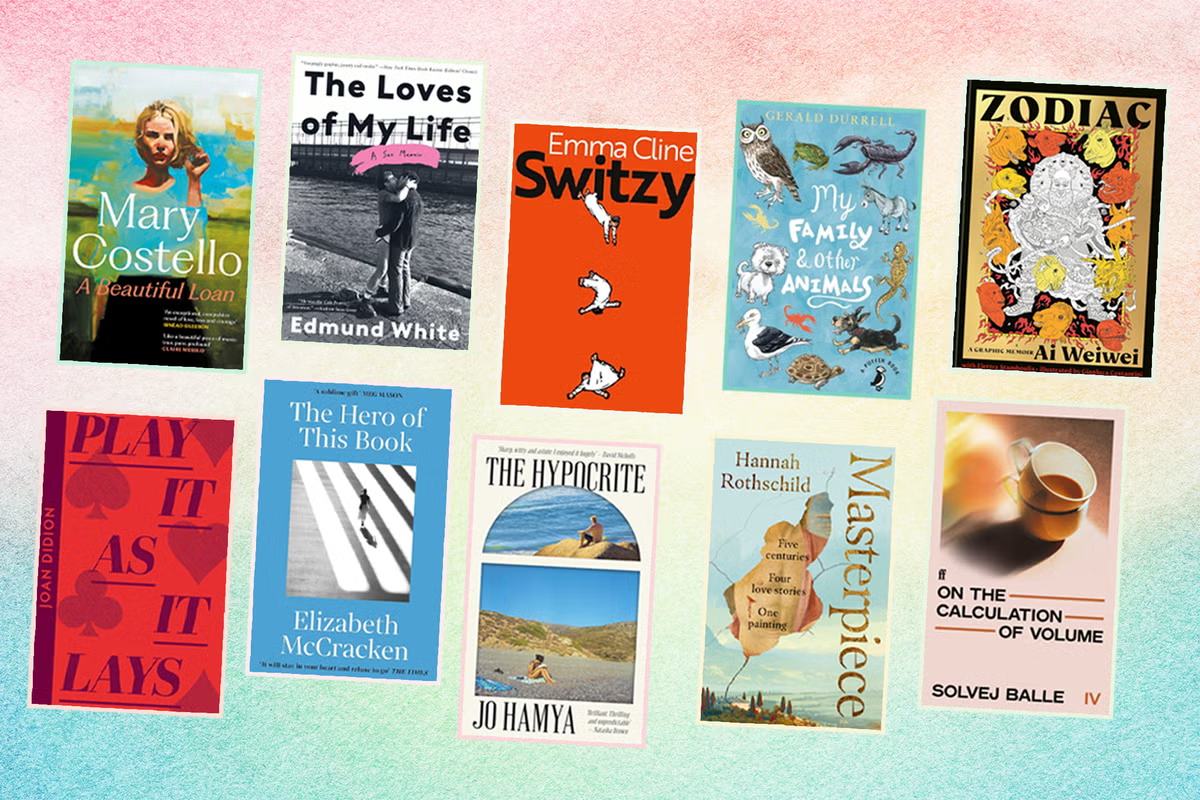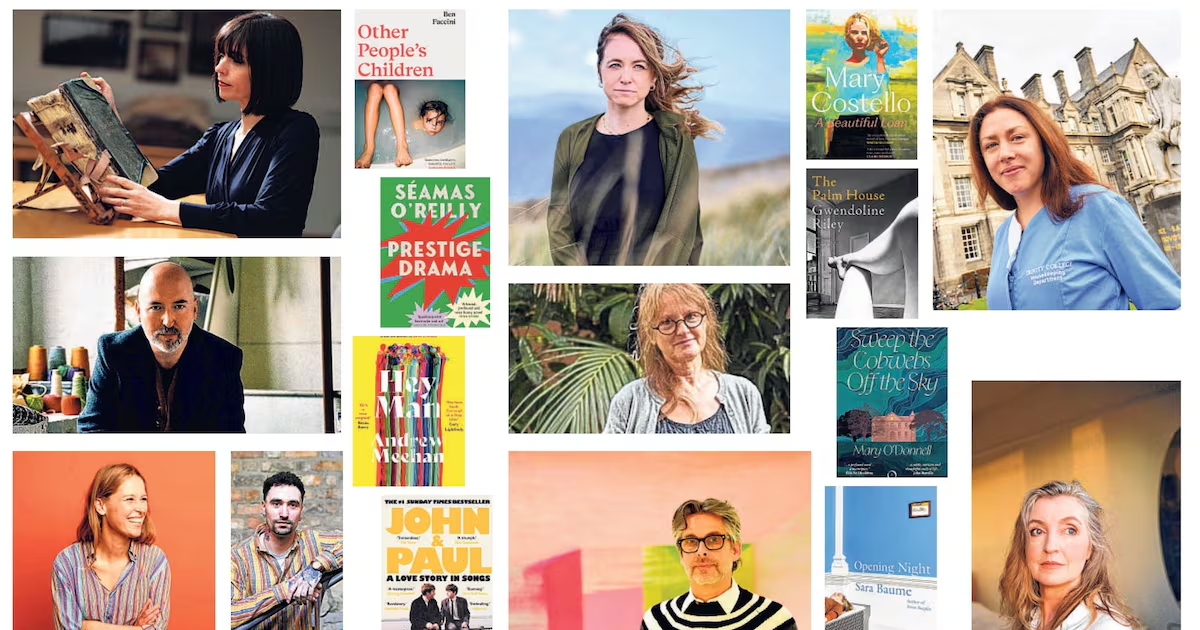
New fictionSaid the Dead by Doireann Ní GhríofaSomething very special happens when an author’s talent and tradition come together the way they have here. This book lifts off the page, delivering a moment of transcendental clarity and empathetic pain for the lives of those institutionalised as mad in what used to be known as the Cork District Lunatic Asylum. The prose is perfectly rendered and the tone is beautifully sustained. I had an amazing sense of deja vu as I was reading it – the feeling that this was the book I had been waiting for. It is published in a busy year for Irish writing. Highlights so far are Niamh Campbell’s Make Strange and Sally Hayden’s This Is Also a Love Story. Anne EnrightHey Man by Andrew MeehanI was lucky enough to receive an advance copy of Hey Man, and I think it is truly special. Andrew Meehan is one of those rare writers who achieve what I always hope for in fiction: wild originality, deep emotional truth and genuine hilarity, often all in the same sentence. It’s a tender story of a lifelong male friendship written with a remarkable lightness of touch, drawing readers effortlessly into a world that feels both utterly distinctive and profoundly human. I missed the world of Hey Man the moment I finished it and immediately wanted to begin again. I can’t recommend it highly enough. Meehan’s voice is such a blast of fresh air that I’m planning to read Best Friends next, an unsentimental story about an unlikely romance between two complicated people in their 70s, set just down the road from where I now live. Julia KellyAngel Down by Daniel KrausThe book I am saving for summer is the recent Pulitzer winner because I love the concept: five first World War privates are sent to save an injured soldier in no man’s land but discover instead a wounded angel. Edel CoffeyAll Them Dogs by Djamel WhiteMy highlight of 2026 so far. Set among Dublin’s criminal underworld it offers a surprising twist early on that sets it apart from other books in this genre. While the central character, Tony, displays both swagger and a willingness to commit violent acts, even against women, there’s a tragedy to him that’s moving, a sense of a life that could have been lived more productively. John BoyneA Beautiful Loan by Mary CostelloHer best novel yet, which is saying something. Ostensibly a simple story of the men in one woman’s life, it shows the true purposes of love: of people, of other creatures, of art and of ourselves. Breathtakingly rich and inspiring. John Self Mary Costello has a gift for creating small worlds with big themes. A Beautiful Loan thoughtfully blends existentialism, desire and philosophical yearning. Sinéad Gleeson Mary Costello examines the life of a quiet, intellectual young woman who loses her already fragile sense of self when she falls in love, first with an emotionally distant man and then with a culturally and religiously controlling one. The experience of obsessive love is brilliantly described, and there is a lovely flow to Costello’s prose, as beguiling as her thoughtful and intelligently explored themes. Éilís Ní Dhuibhne Sweep the Cobwebs Off the Sky by Mary O’DonnellA profound novel about the life of a dutiful daughter, caring for her once beautiful, charming mother, now suffering from dementia in her old age. The complex relationships of mother and daughter, and of sisters, are explored with compassion and sharp psychological insight. A mature, wise study of human nature. Éilís Ní Dhuibhne Other People’s Children by Ben FacciniA slow-build story that executes one of the best narrative reveals I’ve read in ages, embedded within a story of one man’s attempt to keep everyone in his family happy. It’s so plausible, it hurts. John SelfJohn of John by Douglas StuartDouglas Stuart’s Booker-winning novel Shuggie Bain is a masterpiece, quite simply one of the best books I’ve read since I was a teenager, when books and music made sense of the world. So the prospect of a new Stuart novel – John of John, a great title – is very exciting. I know nothing about it other than the fact that it’s set on the Hebrides. It’s a new Douglas Stuart; that’s all I need to know. Roddy Doyle This island-set novel is a beautiful reckoning on community and intergenerational obligation. Sinéad GleesonPrestige Drama by Séamas O’ReillyI love novels with loads of voices. And I also love short novels that can be read in one sitting. So Prestige Drama, 170 pages of terse, vivid polyphony, is a perfect book for me. Set around a TV drama about Troubles-era atrocities that’s being filmed in and around contemporary Derry, it’s about how we remember the past and how it gets spun into stories in the present that may or may not be helpful. It’s really rich and funny and moving and also – and I appreciate this – angry. Patrick FreyneFew and Far Between by Jan Carson Another writer exploring the traumas of the past via a high concept. Few and Far Between is set in an eerie alternative reality in which, on fictional islands in the middle of a dying Lough Neagh (toxic algae), guilt-ridden refugees contend with literal and figurative ghosts. It’s excellent and strangely cathartic to read. There’s something going on with Northern Irish writing right now (I’d suggest there was something in the water, but Carson would just tell me it was toxic algae). Patrick FreyneImperfect Beings by Dermot BolgerA new book from Dermot Bolger, one of the great Irish writers of his time, is always a reason to celebrate. Having recently read and loved his wonderful collection of short stories, I’ll be returning to it this summer. Joseph O’ConnorThe Visit by Neil TullyThis debut novel is set in New Ross in 1963 as JFK is about to return to the ancestral homeplace. Local loyalties and memories provide the drama in this hugely compelling, beautiful read that has gentleness as well as an undercurrent of roiling unease. Joseph O’ConnorLittle Vanities by Sarah GilmartinI love Sarah Gilmartin’s writing. Her third novel is the work of a very gifted novelist. Here the focus is on the nexus of relationships between four long-time friends, but the book is also skilfully suggestive of wider realities about the Ireland in which they came of age. Joseph O’ConnorThe Woman in the Water by Henrietta McKerveyThis novel takes its spark from Daphne du Maurier’s classic Rebecca, fanning a deliciously mysterious flame. An effervescently enjoyable book from a terrific storyteller. Joseph O’ConnorThe Palm House by Gwendoline RileyThis novel is an absolute joy. It’s a loose, engagingly meandering story, or cluster of stories, about two old friends, Laura and Puttnam, who work in the dustier, more highbrow corners of London media. Puttnam is on the verge of retiring from a cultural journal called Sequence – beloved but struggling – at which Laura has freelanced over the years. The book meanders through their working lives and romantic relationships, and Riley’s prose is as beautifully sharp as ever, but this is a surprisingly warm and tender book, given the merciless astringency of her previous novels. Mark O’ConnellInto the Wreck by Susannah DickeyA few weeks back, I went to Museum of Literature Ireland to see Susannah Dickey give an extraordinary 40-minute reading from this, her third novel, which centres on a Donegal family and is told from five perspectives. That evening Dickey held the entire audience rapt, and I want to read the book myself now. (After the event I heard a stunned reader ask the author, “How do you know so much about life and marriage? I’m twice your age and don’t know the half of it.”) Thomas MorrisOn the Calculation of Volume by Solvej BalleI’ve been fascinated recently by this utterly strange and original sequence of novels, about a woman caught in a time loop, endlessly repeating an unremarkable November 18th. The first three books of the seven-book sequence have been published by Faber, beautifully translated by Barbara J Haveland. The most obvious point of comparison is the film Groundhog Day, but apart from the central conceit it couldn’t be more different. It recalls, variously, the stories of Borges, Chris Marker’s La Jetée and the films of Charlie Kaufman, but it’s entirely original. It’s a haunting and melancholy reflection on freedom, loneliness, mortality and time itself. A hell of a thing. Mark O’ConnellTo the Moon and Back by Eliana RamageI was thoroughly charmed by this novel about a girl who desperately wants to be an astronaut. Its heroine, Steph Harper, is also gay and Cherokee, and there are times when her identity – together with her family and love life – threatens to ground her. Spanning three decades, this cosmic coming-of-age is – like Steph – unsentimental, funny, and ambitious, about the sometimes-selfish decisions we make in order to be ourselves. Plus, it’s an exuberant read for anyone still buzzing from Artemis II. Mei ChinVenetian Vespers by John BanvilleI’m a great fan of John Banville, so this will be my treat. Paschal DonohoeComing soonThe Summer Boy by Philippe BessonI was a big fan of Lie with Me, this French writer’s 2019 novel, so I’m looking forward to this new book, which has the perfect title for the season. Set on a small island where a group of teenagers are spending a final summer before entering adulthood, the story offers a mystery when one of their number vanishes forever. Besson has a gift for writing about the anxieties, joys and terrors of young love and I dare say that will be on display here. John BoyneDrunken Driving by Martina EvansThe poet Martina Evans is one of my favourite authors in any mode. Her genre-mixing new collection is edgy, hilarious, unsettling, brilliant. Joseph O’ConnorNatural Disaster by Lisa Owens An existential quest narrative meticulously tuned into the inner life of its protagonist as they attempt to navigate an endlessly expanding labyrinth of Borgesian complexity. That is to say it’s a funny, sad, tender and perfectly-observed novel about a woman seeking to make the last day of her maternity leave a special one for her two children. I suspect a lot of readers will come away from this novel feeling understood in a way that’s genuinely rare. Thomas MorrisExperts in a Dying Field by Patrick FreyneI very much enjoyed Patrick Freyne’s debut novel, about the long aftermath of an almost-successful rock band, its former members and their circle of friends. Its humanity and intricate comedy will be familiar to readers of Freyne’s journalism and essays. It’s a lovely, tender and funny book, full of empathy and scruffy wisdom. Mark O’ConnellI’ve spent years in sweaty venues watching bands play, and this brilliantly captures the chaos and camaraderie of band culture. Sinéad GleesonOpening Night by Sara BaumeThis stunning book explores the author’s friendship with the artist Mollie Douthit and the perilous instability of living a creative life. Sinéad Gleeson I am a completist when it comes to Sara Baume’s work: she is an artist of profound integrity. This is next on my list. Anne Enright The Red Mouth by Sheila ArmstrongThis novel floored me. Sheila Armstrong is a truly remarkable literary talent. Reading her is like discovering the work of Claire Keegan or Donal Ryan for the first time. A writer already touched by greatness. Joseph O’Connor Perfect for reading under a tree in a summer garden, richly immersed in nature as it is. Éilís Ní DhuibhneStations by Louise KennedyLike many others, I am looking forward to how Louise Kennedy approaches the 1980s in her new novel. Expectations are understandably high given the impact of Trespasses, her brilliant 2022 novel. Diarmaid FerriterContrapposto by Dave EggersI can’t wait to read Eggers’s latest, a Dickensian tale about a poor boy who skyrockets into the art world, and his lifelong friendship with a girl he unrequitedly loves. Eggers’s prose is always a joy; his storytelling and juicy characters never fail to hook me. Besides, one of my guilty pleasures is listening to friends hotly debate the accuracy of novels set in worlds they know well. Because my best friend (and reading comrade-in-arms) is an art curator, not since Donna Tartt’s Goldfinch am I expecting so much fun. Mei ChinClassicsAn Awfully Big Adventure by Beryl BainbridgeDaunt Books is republishing Bainbridge’s novels, many of which I read when they first appeared, and some of which I missed, so I’m enjoying rediscovering one of the great British writers of my youth. So far An Awfully Big Adventure and The Bottle Factory Outing have arrived in shops, with more to come as the year progresses, giving younger readers a chance to enter her funny and occasionally macabre world for the first time. John BoyneStill Life by Sarah WinmanSarah Winman’s 2021 novel is many things: a love letter to Florence, a treatise on the healing and redemptive power of art, a rollicking adventure brimming with magic realism, and a big-hearted story about love. When Ulysses Temper, a cockney army private, picks up a 64-year-old English art historian, Evelyn Skinner, at the side of a Tuscan road in the latter days of the second World War, it sets in motion an unlikely friendship that lasts a lifetime, with a cast of characters so wonderful that you’ll miss them immediately after you turn the last page. John WalsheThe Member of the Wedding by Carson McCullers I adore McCullers’s work, and this novel, published in 1946, reminds me of summer afternoons and evenings, both real and imagined. (“It happened that green and crazy summer when Frankie was twelve years old.”) Thomas MorrisGentlemen of the West by Agnes OwensMy rediscovery of the season is Agnes Owens, whose centenary is a good opportunity to read her reissued debut novel, a chaotic comic story of a young bricklayer whose life is structured around work, the pub and arguing with his mum about the quality of her dinners. You’ll then want to read her other books too. John Self The Ragged-Trousered Philanthropists by Robert TressellI’m rereading this novel I first read when I was 20. It’s a depiction of the lives, and the desperation, of a group of men who are working on a house renovation. Nearly 50 years since I read it the first time, it’s still brilliant, still shocking. It’s set in England about 120 years ago, but early in the book some of the men discuss American tariffs and give out about immigration. We’ve come a long way. Roddy DoyleThe House of Mirth by Edith WhartonWhenever I feel nostalgic for New York in the summer, this is what I reach for, with its bummed cigarettes and missed Grand Central trains. With devastating accuracy, Wharton depicts the calculations her heroine, Lily Bart, must make to appear to have more money than she has, just so she can move ahead. The writing is exquisite without a word wasted, but also compassionate, with a wondrous ability to make you feel differently about every character each time you reread it. Forget Love Story, this is the finest depiction of the city’s reckless glitter. Mei ChinIt’s been more than a decade since I last read The House of Mirth, but it’s sitting atop my stack of summer reading. I’m looking forward to revisiting gilded-age New York, country estates and Monte Carlo, but most of all I want to see Lily Bart again. I always hope for her to sort things out, even though I already know the society she was born into and the surrounding vipers will systematically make the possibility of a secure future impossible. The unhurried pace of the viciousness is a marvel, creating a current that Lily has little chance of escaping. Elizabeth MannionWatership Down by Richard AdamsThere’s something quietly healing about this novel that repays repeated reading. Read it for the rabbit’s-eye view of a pastoral idyll as our heroes slowly hop through the fields and hedgerows of a lush and tangled landscape. Or read it for its timeless story of a plucky band of refugees fleeing climate catastrophe and establishing multispecies collaborations to outwit the fascist General Woundwort. But do read it. Declan BurkeCry to Heaven by Anne RiceI’m a fan of Tom Ford’s films, and so, when I discovered that his next one will be based on Rice’s 1982 book, I bought it immediately. It tells the story of 18th-century Venetian castrati and opera singers. As well as the obvious attractions (I’m referring to opera and Venice here), there’s also the novelty of reading a book that was written before the internet – there are noticeable differences in pace and linguistic rhythms. Edel CoffeyThe Amazing Adventures of Kavalier and Clay by Michael ChabonA quarter-century after publication, Chabon’s dazzling novel remains as timely as ever. This book is many things at different points in its almost 700 pages, most broadly an epic exploration of art’s complex relationship to fascism, freedom and resistance. Set amid the birth of comic books, the flight from the Third Reich, and the post-war United States, it’s also a deeply moving depiction of creativity and the magic of escapism. Brian CliffA Fatal Inversion by Barbara VineAs John Banville often laments, summer can be a hateful season for those who prefer reading indoors. Ruth Rendell’s award-winning 1987 crime novel (officially by Vine, her pseudonym for darker stories) confirms our prejudice that lounging around in the sun causes nothing but trouble. Largely set during the scorcher of 1976, it concerns a teenage hedonist who inherits a Suffolk mansion and starts a Garden of Eden-like commune with various sexual serpents. A true classic of this genre. Andrew LynchThe Outsider by Albert CamusI’m looking forward to reading Camus again, the better to understand Mary Costello’s new novel, and a few good Somerset Maugham novels. Éilís Ní Dhuibhne The Grapes of Wrath by John SteinbeckA new country and new job have made me return to an old favourite. I am rereading the novels of John Steinbeck. So, summer reading is set aside for The Grapes of Wrath and East of Eden. Paschal DonohoeNonfictionHome Economics by Caitríona LallyTo fully enjoy a holiday you have to be aware that there are other people working. That’s why I’m looking forward to reading Caitríona Lally’s memoir, which, among other things, is an account of the work she did for Trinity College Dublin’s housekeeping department – cleaning up after the toffs. I love Lally’s fiction; it’s funny and wild, and a quick glance at the first few pages of Home Economics suggests that her non-fiction has the same qualities. Roddy DoyleA Rebel and a Traitor by Rory Carroll“I just cut out any boring bits,” is how the English satirist Craig Brown claims to have reinvented the biographical genre with his kaleidoscopic studies of The Beatles and Queen Elizabeth II. Rory Carroll is now doing something similar for Irish history. A Rebel and a Traitor breathes new life into the familiar story of the tortured soul Roger Casement and his Easter 1916 crusade that ended on a hangman’s rope. A worthy follow-up to Carroll’s bestseller Killing Thatcher, it has a magpie eye for illuminating human details that creates a multifaceted narrative as gripping as any thriller. Andrew LynchThe Butterfly Season by Lea KorsgaardThe Danish journalist and author Lea Korsgaard set out on an unusual quest to see all 64 butterfly species from her native country in one calendar year. The resulting book, complete with 72 “clumsy and beginner-like” watercolour pencil drawings by Korsgaard, was a sensation in Denmark, selling more than 30,000 copies. It’s an entertaining road trip, a moving meditation on nature and a damning indictment of humanity’s often destructive relationship with the creatures with whom we share our planet. John WalsheJohn & Paul: A Love Story in Songs by Ian LeslieThere is still much life in the story of the Beatles, as illuminated in this engrossing and humane account of one of the greatest musical partnerships, as he charts the complex relationship between Lennon and McCartney. The extent of their dependency on each other is clear: “No John without Paul and vice versa.” There were tensions between them, of course, but fragility existed alongside an enduring bond that served the music so well, and this book makes you think about some of their greatest songs in new ways. Diarmaid FerriterBelfastmen by Tom HulmeA history of the experiences of gay men in Belfast in the late 19th and early 20th century, full of surprises and rich detail about their meeting places, relationships, desires, defiance and distress. Hulme brings an impressive vigour and freshness to his subject matter. Diarmaid FerriterIn Another World by Graeme ThomsonPop musicians deserve biographies with the same respect for truth as those of any monarch or politician. That has been Thomson’s guiding principle in his superbly researched books about Elvis Costello, Kate Bush, Philip Lynott and others with Irish connections. Last month saw the publication of this profile of the 1980s English postrock pioneers Talk Talk. While only a moderate fan, I’m looking forward to seeing if Thomson’s in-depth treatment can convince me of their case for greatness. Andrew LynchThe Beginning Comes After the End by Rebecca SolnitHope can feel as if it’s in short supply these days, so the optimism of this book arrives like a breath of fresh air. Taking the long view, Solnit argues in a series of essays that the world has changed for the better over the course of her lifetime. Despite the headline-grabbing news of various bad actors seeking to turn back the clock, Solnit is adamant that positive change – social, political, climate – is not only a possibility but inevitable. Declan BurkeStrangers by Belle BurdenWhen Burden and her husband fled their Manhattan home with their teenage children for the safety of their Martha’s Vineyard summer house during Covid lockdown, Burden discovered her husband was having an affair – and their 20-year marriage was suddenly over. The book traces the fallout. Edel CoffeyLondon Falling by Patrick Radden KeefeThe New Yorker staff writer and author of Empire of Pain and Say Nothing investigates the mysterious death and bizarre life of a young British man who posed as the son of a Russian oligarch, skilfully peeling back murky layers of modern Britain. Edel CoffeyA Short History of America by Simon JenkinsI really enjoyed this one. As the United States approaches their anniversary of independence, this is the perfect read. Paschal DonohoeCrimeA River Red with Blood by John ConnollyPublished this month, but already packed away in the suitcase for a holiday read, is the 23th offering in the most distinctive detective series in the crime-fiction canon. Connolly’s blending of realistic private-eye conventions into a world darkly tinged by supernatural malevolence is written in a timelessly formal style; the author’s ceaseless reinvention ensures that each successive novel delivers a fresh perspective on Charlie Parker’s world. Declan BurkeIf These Walls Could Talk by Michelle McDonaghMichelle McDonagh’s latest rural noir thriller is about the disappearance of a Galway property developer whose wife discovers that her missing husband had more skeletons in his closet than a medieval ossuary. McDonagh, a former Connacht Tribute reporter, has a knack for drip-feeding information in such a fashion that you will keep turning those pages. The perfect holiday thriller. John WalsheBest Offer Wins by Marisa KashinoThis psychological thriller takes place in Washington, DC, as its narrator, Margo, hunts for a house that will let her, and her dead-weight husband, Ian, escape the tiny apartment they shared throughout Covid. Refusing to be defeated by the realities of the grotesquely competitive housing market, the increasingly manic Margo rationalises her way into a series of catastrophic and unnerving choices. Slyly paced, wonderfully tense and darkly witty, this debut is one of the year’s standouts. Brian CliffEl Dorado Drive by Megan AbbottHer best mystery yet, it takes place in a fading Detroit suburb where the country club’s G&Ts come with a generous dash of “private miseries”. The plot follows the three Bishop sisters, who join a women’s support group before realising it’s actually a pyramid scheme that requires exploiting other women – “Even the ones you loved.” Abbott unfolds the murderous consequences with a finely calibrated empathy as gimlet-eyed as any noir. The paperback is perfectly timed for a summer read with hidden edges. Brian CliffThe Spellman Files by Lisa LutzLutz’s marvellous Spellman series follows a chaotic San Francisco family running a semi-solvent PI firm. All six novels are terrific, but The Spellman Files introduces its narrator, Izzy, in a jewel of an opening scene, neatly setting the stage for everything that follows. Lutz makes this very funny series work both as serious mysteries and as emotionally rich family novels. Rumour has it that a welcome seventh entry may be on the horizon, so now’s a good time to catch up. Brian CliffThe Wharton Plot by Mariah FredericksI recommend chasing Edith Wharton’s Mirth with this terrific historical novel, which merges the murder of the writer David Graham Phillips with Wharton’s well-known dinner with Henry James, Walter Berry and Morton Fullerton at the Belmont Hotel, in New York, in which she asked their advice about her troubled marriage. It’s well worth bringing to the beach. Elizabeth MannionSportMy Greatest Race by Ciara Mageean The popular Co Down athlete’s autobiography. Mageean should be preparing for her final Olympics, but a cancer diagnosis in the summer of 2025 has changed everything. This deeply affecting book covers all the ups and downs of her athletics life and takes the reader deep into her diagnosis and ongoing treatment. A brilliant, honest, engrossing book. Malachy ClerkinWe Need to Talk About Roy by Dave Hannigan A Roy Keane biography with a difference. Hannigan played against Keane in the Cork schoolboy leagues as a youngster, made a documentary about him as a young journalist and has written about him on and off for 30 years. His book is based on the thesis that Keane’s life has been reflected time and again in the changing Ireland of the times. A fun theory, explored with typical wit and verve. Malachy ClerkinRory by Alan Shipnuck The veteran American golf writer’s biography of Rory McIlroy. Although plenty of it will be familiar to McIlroy devotees who’ve been paying attention to his interviews over the years, it nonetheless gives a rounded and entertaining account of Ireland’s one truly global sporting superstar. Malachy ClerkinWorld Cup Fever by Simon Kuper Although this actually came out towards the back end of last year for the Christmas rush, with the World Cup just days away, now is the time to get stuck into it. It’s a personal account of attending the last nine World Cups, written by one of the great soccer authors of the past few decades. Malachy ClerkinKilling Maradona by David ArrowsmithAnyone who saw Asif Kapadia’s superb 2019 documentary on Diego Maradona’s time in Naples will not be shocked by the influence of the criminal underworld on his life, nor on the part cocaine played in his downfall. David Arrowsmith has previous in this area with Narcoball, his 2024 book about football in Pablo Escobar’s Colombia, and the late cartel chief rears his head again in the story of Maradona’s tragic fall from grace, on the 40th anniversary of his greatest triumph, leading Argentina to World Cup glory in Mexico. John WalsheCompiled by Martin Doyle
Summer reading hitlist: New novels, classics and nonfiction books recommended by writers
Gripping thrillers, sport memoirs and the best recent fiction to pack in your holiday suitcase
4,537 words~21 min read