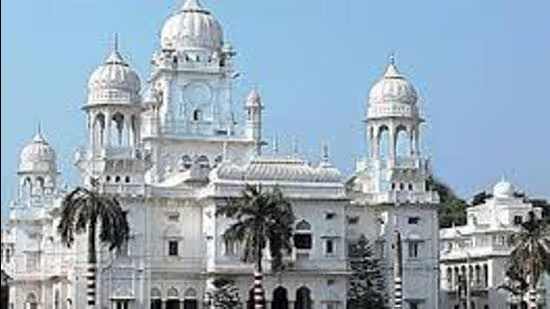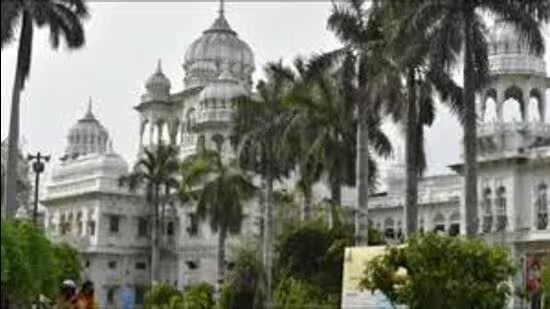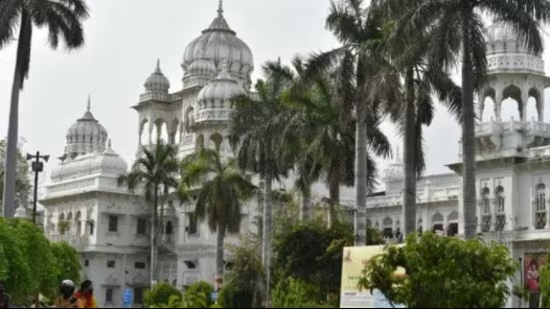
LUCKNOW A string of anomalies across key departments at the King George’s Medical University (KGMU) has triggered concerns over institutional oversight, internal controls and accountability mechanisms at one of Uttar Pradesh’s premier government medical institutions. From a cancer drug scam in the urology department to questionable stent implants in cardiology and an active broker nexus in ophthalmology, the hospital is grappling with systemic failures that allegedly allowed transactions worth lakhs to bypass multiple layers of scrutiny.From a cancer drug scam in the urology department to questionable stent implants in cardiology and an active broker nexus in ophthalmology, the hospital is grappling with systemic failures that allegedly allowed transactions worth lakhs to bypass multiple layers of scrutiny. (File Photo)While disciplinary action has been initiated against certain employees in individual cases, documents and official records reviewed by HT raise a broader question: how did transactions involving lakhs of rupees, medical procedures and procurement decisions pass through multiple layers of scrutiny without triggering red flags?“We are taking strict action in these cases. Suspensions have been done and further probe will be conducted to ensure such acts are not repeated,” said deputy chief minister Brajesh Pathak. He added: “Action will continue and I have written to university authorities to ensure that every aspect of any fraud is checked and the guilty are identified.”KGMU vice-chancellor Prof Soniya Nityanand said she is committed to impartiality and will not spare anyone found responsible for wrongdoing.The most significant concerns have emerged from the alleged multi-crore cancer medicine scam linked to the Asadhya Yojana in the urology department.According to KGMU officials, the department had been procuring medicines worth around ₹10 lakh every month under the Asadhya Yojana, which provides free treatment to economically weaker patients suffering from serious illnesses. However, expenditure under the scheme witnessed an unusual spike earlier this year, rising three to four times above the normal level.Officials said medicine purchases touched nearly ₹45 lakh last month alone, raising suspicion within the university administration. Scrutiny of records allegedly revealed repeated procurement of expensive medicines, including cancer drugs, protein supplements and iron supplements, in the names of nearly 40 patients who may be deceased or not on record.KGMU authorities said further action would be taken based on the outcome of the ongoing investigation and efforts are underway to recover the financial losses allegedly caused to the institution.According to documents examined by HT, an ad hoc employee was entrusted with generating medicine indents involving high-value cancer drugs worth several lakh rupees. Hospital procedures ordinarily require such responsibilities to be handled by authorised permanent staff or nursing officers.Records available with HT contain the employee’s name, identification details and signatures on documents related to patients treated under the government-funded scheme.The development has raised questions about who authorised the employee to perform a function that forms the foundation of the procurement chain and whether any supervisory checks were exercised before the indents were processed.Further scrutiny has centred around the role of a doctor who allegedly prescribed medicines and verified indents for a patient whose admission records are now under examination. Documents reviewed by HT indicate that medicines continued to be processed despite emerging questions regarding the patient’s treatment history.Officials familiar with the procurement process said medicine indents for admitted patients are first generated by authorised departmental staff and subsequently verified through the hospital’s main store system.When medicines are unavailable in stock, purchases are made through the Hospital Revolving Fund (HRF) under local purchase provisions and supplied free of cost under welfare schemes, including the Asadhya Yojana.The requests are then routed for approval through designated administrative channels, including the office of the deputy medical superintendent (DMS).Payment of HRF bills involves multiple levels of scrutiny. Documents are examined by the department concerned, treating doctor, indenter, head of department, medical superintendent and finance officials before payments are processed.The existence of this multi-tier approval structure has intensified questions about accountability. Despite several officials being part of the approval chain, action so far has largely been confined to a limited number of employees, while questions regarding supervisory responsibility remain unanswered.The controversy in the urology department comes amid fresh scrutiny in two other major departments.On Wednesday, KGMU ordered a high-level inquiry into allegations that five stents were implanted in a single patient at the Lari Cardiology department. A five-member committee has been tasked with examining whether the procedure was medically justified and consistent with established clinical protocols.The inquiry has also been expanded to review treatment records of around 15 patients who underwent stent implantation or other cardiac interventions under the Ayushman Bharat scheme, amid concerns that similar irregularities may have occurred in additional cases.Only 1 Ayushman surgery out of 244 in 6 mths: ProbeFresh findings have emerged in the probe into allegations that patients in KGMU’s ophthalmology department are being directed to purchase medicines and cataract lenses from private shops.Investigators found that a doctor in the department performed 244 cataract surgeries over the past six months, but only one surgery was conducted under the Ayushman Bharat scheme. Records examined by the inquiry team showed that all remaining procedures were carried out on a paid basis.Officials noted that nearly 50% of cataract surgeries in the department are usually performed under government cashless schemes.Investigation revealed that lenses supplied through the Hospital Revolving Fund (HRF) were used in only about 70% of cases, despite a wide range of lenses being available through the facility. Officials said the expected utilization rate of HRF-provided lenses should be between 95% and 100%.The inquiry team is also examining allegations that patients were encouraged to buy lenses and medicines from private outlets and whether paid surgeries were being prioritised over those covered under government schemes.The controversies have surfaced despite substantial public expenditure on patient care and procurement. According to sources, KGMU has an annual budget allocation of approximately ₹288 crore for medicines and surgical consumables. An additional ₹50 crore has been allocated to the university’s main store for welfare schemes, including Ayushman Bharat, Asadhya Yojana and other government-funded patient assistance programmes.AUTHORITY-SPEAK Prof Soniya Nityanand, KGMU vice-chancellor‘Exposing corruption not a failure, it is an achievement’Q Scams in various departments that surfaced in past few weeks were on for the past one year...does this reflect poorly on KGMU system?A We had put several SOPs in place... it is precisely because of these and the impartial monitoring mechanism that these scams have come to light. Therefore, the issue should not be viewed as a reflection of poor governance at KGMU. Once a system is capable of detecting wrongdoing, the focus should not be on whether the exposure reflects positively or negatively on the institution. The real question is whether, after detecting such irregularities through its own internal mechanisms, the university takes appropriate action against those responsible. That is the true test of institutional integrity.Q Some of the outsourced/contractual staff have faced action...will more heads roll among senior faculties?A It is incorrect to suggest that action has been taken only against outsourced or contractual employees. A permanent pharmacist in urology department is suspended, FIR lodged against him and HoD removed from his administrative position. These actions demonstrate that accountability is being enforced irrespective of an individual’s position. A show-cause notice has also been issued to the pro vice-chancellor of the university.Q Does this failure of system reflect upon your tenure?A Exposing corruption is not a failure, in fact it is an achievement.Q Earlier, principal secretary (medical and health), Partha Sarthi Sen Sharma said a portal/app was developed to track medicine usage. What happened to that?A These exposures are a result of combined utilisation of the app, the SOPs that have been introduced by us and regular monitoring.ACTION TAKEN SO FARNOTICES SERVED TOPro V-C, Prof Apjit Kaur, HOD, ophthalmology and nursing officer Chetna (OT in charge, opthalmology)TRANSFERREDUrology department head Dr Apul Goel removed from his administrative position after an inquiry confirmed irregularities in the purchase of medicines under the Asadhya Yojana. He has been sent to another department pending further investigation to ensure an impartial probe.SUSPENDEDDr Sanjeev Gupta of the opthalmology dept suspended after an inquiry committee recommended registration of an FIR against a broker Abbas, who allegedly operated within the department and steered patients towards specific medical stores; FIR recommended against Abbas.Arshad Wasi, a regular pharmacist posted at the local purchase counter of the urology department, has been placed under suspension. The university has also sought criminal proceedings against him.3 AD HOC EMPLOYEES SACKEDPrakash Singh, urology dept (contractual employee).Hemant Srivastava (LP counter, IPD contractual employee)Sachin Tiwari, urology dept (contractual employee)WHAT NEXT?* Scrutiny of documents to take place in seven departments, including radiotherapy, surgical oncology, urology, obstetrics and gynaecology depts, gynaecological oncology, medical oncology and endocrine surgery.* HRF (Hospital Revolving Fund) under scanner.* As only two months are left in the V-C’s tenure, big question remains whether she will be able to complete the ongoing probe into various irregularities in the depts concerned.
Rot runs deep? KGMU under lens as ‘scams’ surface across key depts
Deputy CM Pathak asks university authorities to ensure that the guilty are identified; most significant concerns emerge from the alleged multi-crore cancer medicine scam linked to the Asadhya Yojana in the urology department
1,472 words~7 min read