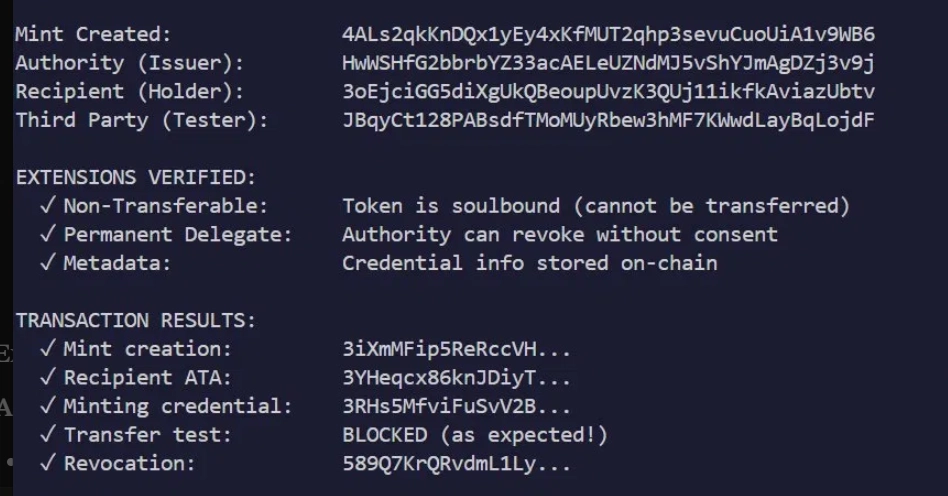
I specced an on-chain credit ledger for a compute network, wrote the mint, and then the token program refused to initialize it. The two extensions I needed (non-transferable credits, plus a hook on every movement so the chain could run the accounting) are mutually exclusive on a single Solana mint. The runtime rejects the initialize instruction. That rejection sent me back to the design, and I came out the other side with the ledger off-chain and only a daily checkpoint on-chain.
This post is why I think that is the right architecture for a usage-accounting ledger in general, not just the workaround for one runtime constraint. It is specific to compute-metering credits (earned for serving inference, spent for consuming it), and most of it generalizes to any high-frequency internal accounting system that someone reaches for a blockchain to secure.
What a credit ledger actually is
Start with the workload, because the workload is what should pick the substrate.
A usage credit ledger is a meter. It has two write paths: a contributor serves a job and earns credits, a user consumes a job and spends them. There is a third, smaller path for verification adjustments and refunds. Writes are append-heavy. Reads are dominated by one question: what is this account's balance right now. Each event carries a tiny value, a fraction of a cent of compute, and the events arrive at a rate set by network traffic rather than by anything financial.