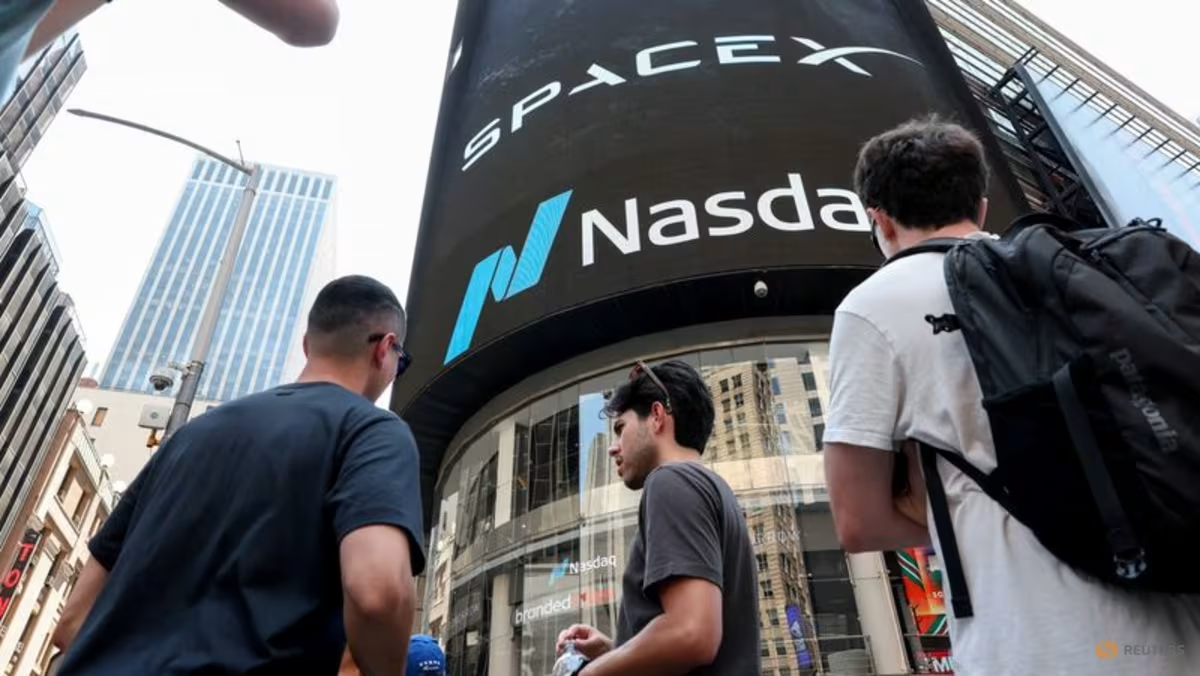
When Mukesh Ambani's Reliance Jio stormed into India’s telecom market a decade ago, it rewrote the rules of competition, forced consolidation and permanently altered the economics of the industry. Elon Musk's Starlink is being seen as a future threat to American telecom giants such as AT&T and Verizon.To be sure, unlike Reliance Jio, Starlink is not poised to disrupt the market through rock-bottom prices. In fact, Starlink often costs more than conventional broadband offerings in the United States. Yet analysts increasingly believe that in future Musk could trigger a major disruption by changing how connectivity is delivered, who controls it and where telecom profits are generated, radically altering the American telecom industry like Jio did in India.Recent analysis by Oppenheimer has sharpened this debate. The investment bank argues that SpaceX is no longer merely a space company with a satellite internet service on the side. Instead, it is emerging as a communications giant capable of challenging the foundations of a $1.6 trillion American communications industry.Also Read | Spacex IPO is said to draw more orders than shares availableFrom satellite internet provider to telecom challengerFor years, Starlink was viewed primarily as a solution for rural communities and remote regions where fiber and cable networks were either unavailable or uneconomical. That perception is rapidly changing.Oppenheimer believes Starlink is evolving into a mainstream communications platform with growing relevance for residential users, enterprises, government agencies and critical infrastructure operators. The brokerage recently raised its estimate for Starlink's US broadband subscriber base in 2030 to 15 million from 10 million previously, reflecting stronger confidence in the service's adoption trajectory.That projection matters because it suggests Starlink is no longer competing only for underserved customers. It is increasingly becoming a viable alternative for users who already have access to conventional broadband services. The implications extend well beyond broadband. Oppenheimer warns that established telecom operators such as AT&T, Verizon and T-Mobile could experience accelerated declines in subscriber growth and revenue as Starlink expands its footprint.Also Read | SpaceX IPO: rockets, AI losses and Musk in controlWhy analysts see a structural threatThe concern is not simply that Starlink may win customers away from incumbent telecom operators. The deeper issue is that it threatens the industry's pricing power. Telecom networks require enormous capital investments. Companies spend billions of dollars building towers, laying fiber and maintaining infrastructure. Once those investments are made, profitability depends heavily on retaining customers and steadily increasing average revenue per user.According to Oppenheimer, Starlink is becoming reliable enough to be used in mission-critical applications, including business continuity systems, backup connectivity and remote work environments. As customers begin to rely on the service for essential functions, switching rates could decline significantly. Lower customer churn would strengthen Starlink's economics while simultaneously increasing competitive pressure on traditional operators. Telecom companies may be forced to offer richer promotions, deeper discounts and more aggressive retention packages to keep subscribers from leaving. Such measures can erode margins for years, particularly in an industry already burdened by high fixed costs.This dynamic explains why analysts view Starlink as more than just another competitor. It has the potential to alter the economic balance of the sector.A business built on different economicsOne reason investors are paying close attention is Starlink's profitability. According to details reported around SpaceX's expected public offering, Starlink generated approximately $11.4 billion in revenue while achieving EBITDA margins of roughly 63 percent. That figure compares favourably not only with traditional telecom operators but also with many of the most profitable companies in the broader technology sector. The significance lies in Starlink's operating model. Unlike conventional telecom companies, SpaceX owns both the launch capability and the satellite network. Its reusable rocket technology has dramatically reduced deployment costs and created a vertically integrated ecosystem that competitors struggle to match.What began as a strategy to lower the cost of accessing space has evolved into a communications business with unusually attractive economics.The power of a growing orbital networkThe scale of SpaceX's infrastructure advantage is difficult to ignore. The company operates a constellation of more than 11,000 satellites and continues to expand that network. Every new satellite strengthens coverage, improves capacity and enhances service quality.Traditional telecom operators are constrained by geography. Expanding coverage requires new towers, additional spectrum and often lengthy regulatory approvals. Starlink, by contrast, can extend connectivity across vast regions through orbital infrastructure.This difference creates a strategic advantage that analysts believe the market is only beginning to appreciate. As network performance improves, Starlink becomes increasingly attractive not just in rural America but also for businesses seeking redundancy, mobility and flexible connectivity solutions. The result is a gradual shift in the competitive landscape from infrastructure tied to specific locations toward infrastructure operating on a global scale.The handset opportunityPerhaps the most ambitious element of the Oppenheimer thesis concerns mobile communications. The brokerage argues that SpaceX could eventually gain access to the roughly half-trillion-dollar handset market as it pursues technologies capable of connecting directly with consumer devices.SpaceX has already demonstrated direct-to-cell capabilities through partnerships with wireless operators. If such technologies mature and become commercially viable at scale, the company could begin competing in areas traditionally dominated by mobile network operators.This possibility helps explain why some telecom companies have chosen cooperation over confrontation. T-Mobile has partnered with SpaceX on direct-to-device services, while Comcast has worked with Starlink to supplement coverage gaps. Such partnerships reflect a growing recognition that Starlink is not merely another internet provider. It is becoming part of the communications infrastructure itself.A valuation that reflects telecom ambitionsThe market's expectations for SpaceX reveal how investors increasingly view the company. Ahead of its anticipated public listing, SpaceX has been associated with valuations approaching $1.75 trillion to $1.8 trillion. At such levels, the company would be worth more than the combined market value of many major aerospace and telecom players.Importantly, much of that valuation is tied not to rockets but to Starlink. Investors are increasingly treating SpaceX as a communications company with a powerful space business rather than the other way around. The growth potential of satellite connectivity, direct-to-device services and future communications applications forms a central part of the investment case.Why the biggest risk is long-termNone of this means that Starlink will suddenly replace fiber networks or cause an immediate collapse of America's telecom giants. Urban fiber connections remain faster and often cheaper. Traditional carriers retain significant advantages in customer relationships, spectrum assets and established infrastructure. Moreover, Starlink's premium pricing limits its appeal for many consumers today.The reason analysts remain concerned is that disruption often begins gradually. The first phase is not market domination but the steady erosion of pricing power, subscriber growth and strategic control. Oppenheimer's warning is essentially that SpaceX is building a communications platform whose influence could extend across broadband, mobile connectivity and future digital services. If that vision materialises, the competitive challenge facing AT&T, Verizon, T-Mobile and cable operators may be far greater than investors currently assume.The comparison with Jio may not hold in terms of pricing strategy. But in terms of reshaping industry structure and forcing incumbents to rethink their business models, Elon Musk's SpaceX could ultimately prove just as disruptive to American telecom giants as Mukesh Ambani's Jio was to India's telecom sector.
Can Elon Musk do to US telecom what Mukesh Ambani did in India?
Elon Musk's Starlink is poised to disrupt American telecom giants like AT&T and Verizon. Analysts believe Starlink could change how connectivity is delivered and who controls it. SpaceX's satellite internet service is evolving into a mainstream platform. This shift could accelerate declines in subscriber growth and revenue for traditional operators.
1,188 words~5 min read