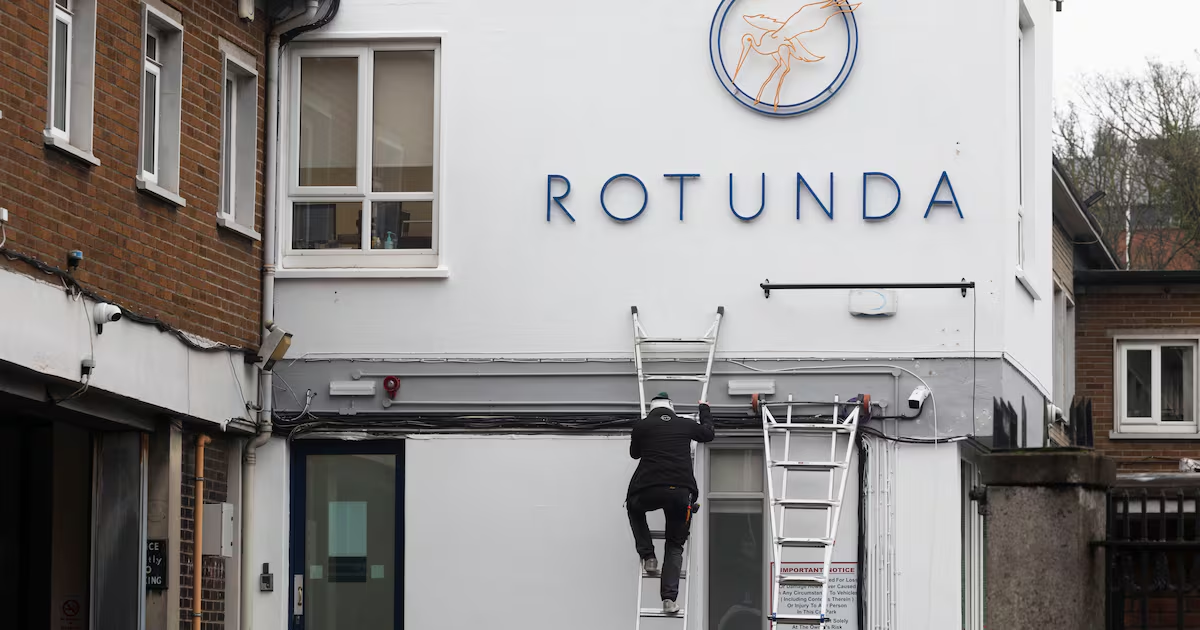
Sinead Murphy Collins, who is 34 weeks’ pregnant, travels from Mullingar in the midlands to a Dublin hospital for her antenatal appointments as a fully private patient. This is her first pregnancy. It is high-risk and she has experienced some complications early on.“I wanted that little bit of control of being able to pick who my consultant was, being able to research what would be best for me and my needs. It wasn’t a decision I made lightly,” she says.She acknowledges that it is “expensive” but put its down to a financial choice for people.“I think many women who plan to go private are making a sacrifice to not spend that money elsewhere,” she says.“I’m sure there’s women for whom it would just be a no-brainer; they can afford it, they don’t even have to blink an eye. But for me, it was a very calculated choice, and one that has been worth it.”The mother-to-be feels frustrated that she and other women have come under pressure to justify their decision to use private healthcare when similar scrutiny doesn’t apply to those who use private health insurance for other kinds of care.“Pregnancy is such a time of your life where you are vulnerable and you don’t have that much control. Where I could get a little bit of control back, I wanted that,” she says.[ Rotunda may owe refunds to women cared for privately, says MinisterOpens in new window ]A national debate about private maternity care has erupted following the decision of the Rotunda Hospital in Dublin to defy both the HSE and the Government publicly. The oldest maternity hospital in the world is claiming it has a right to allow doctors on public-only contracts to continue offering private care on-site, going against the core principle of Sláintecare, the long-term strategy followed by the Government that is designed to move the country’s two-tier health system to a single-tier, universal service.The Rotunda maternity hospital claims it has a right to allow doctors on public-only contracts to continue offering to offer private care on-site. Photo: Sam Boal/Collins photos It has resulted in a threat from both the HSE and the Minister for Health Jennifer Carroll MacNeill to withdraw State funding from the northside hospital.This is a row that has been brewing for more than three years.In 2023, the Rotunda and two other Dublin hospitals – the National Maternity Hospital and the Coombe – along with Cork University Maternity Hospital asked the then minister for health Stephen Donnelly for an exemption from Sláintecare – to continue offering private maternity care in overwhelmingly publicly funded hospitals. “This meeting, to be honest, was quite adversarial and achieved nothing,” Prof Sean Daly, master of the Rotunda, recalled in a letter to the Department of Health on March 12th last.A year ago, there were early warnings that – despite not getting the carveout it sought – the Rotunda was still planning to flout Government policy ahead of a December 31st deadline for all those on public-only contracts to end their on-site private practice. [ Rotunda at loggerheads with Minister over public-only consultants having private patientsOpens in new window ]During a visit to the hospital’s neonatal unit in June 2025, Carroll MacNeill was told by Daly that the hospital planned to allow such consultants continue to offer private care. Carroll MacNeill pushed back and said there would be no exemptions.In February, following the refusal of planning permission for a new neonatal hub on Parnell Square, Carroll MacNeill visited again. She pulled Daly aside and told him she had heard that public-only consultants were still offering private care at the Rotunda and asked him to bring it to an end.The following month, private health insurers told the Department of Health the Rotunda was continuing to offer private care. Daly waved it off, telling the HSE in a letter that “this is to be honest, not an issue for the Rotunda Hospital”. He said that if insurers were selling policies that “include maternity cover and yet they are not providing it”, it was an issue for them.Despite Daly’s devil-may-care attitude, sources within the department said they still had some expectation of compliance. [ Rotunda’s defiance of public policy shows us how some are born more equalOpens in new window ]“Imagine our surprise watching the Oireachtas health committee last week,” one source said. “Not only was he not in compliance, but flatly doing something different.”Relations have now reached a nadir and the Rotunda has been given until Monday to hand over an audit showing the number of consultants who have acted outside of their contracts.The Rotunda’s position is supported by legal advice from law firm Arthur Cox, which prompted Government sources to question whether public funding was used to pay for it. The Rotunda declined to respond when asked about this. When Daly was asked to share that legal advice with the HSE, he responded: “You might confirm if the HSE and the Department of Health are agreeable to sharing their legal advice?”The Rotunda has picked a big battle with the State for reasons that are far more academic than obstetric; the numbers of women and doctors actually affected are tiny. Between January and March of this year there was just one consultant obstetrician on a Sláintecare contract at the Rotunda offering private care. The Rotunda is fighting to set a precedent now, before private maternity services eventually vanish. Photo: Sam Boal/Collins photos This consultant delivered two babies, representing 0.5 per cent of the 373 babies delivered under private care at the hospital in the same period. This is in line with other larger maternity hospitals, where the majority of obstetricians did not sign the new Sláintecare contract.But all those doctors will eventually retire, replaced by younger colleagues on public-only contracts. The Rotunda is fighting to set a precedent now, before private maternity services eventually vanish, though the question is whether it is trying to win a battle it lost years ago. Its consultants chose to sign public-only contracts, knowing the conditions attached. Meanwhile, issues with insurance cover have already emerged. Both private patients who gave birth under a public-only consultant at the Rotunda earlier this year were VHI customers. The insurer refused to process both claims, on the basis that the consultant was on a Sláintecare contract. Minister for Health Jennifer Carroll MacNeill said the Rotunda’s claim that having private consultants on call improved overall safety 'missed the point entirely'. Photo: Sam Boal/Collins Photos A VHI spokeswoman said the health insurer “will not process claims for private activity in a public hospital where consultants hold public hospital only contracts”. The Rotunda did not respond to a question about who was ultimately liable for the cost of the two women’s private treatment.The hospital has told women booking private or semi-private care this year that it has an “exception” under Sláintecare. An information form given to pregnant patients this year said their insurance cover “should apply to all consultants including Sláintecare consultants”.The Rotunda has many quiet supporters across the other three hospitals, hoping a victory for Daly would set a precedent for all of them. Some within the Rotunda feel that commentators and politicians – who almost certainly have private health insurance – are being hypocritical in criticising private maternity care.Another obstetrician took a very different view, feeling their profession has come across as “tone deaf”.One of the arguments adopted by the Rotunda is that private maternity services promote “safe care”, which has been abrasive for midwives, who care for public and private patients equally. One high-profile consultant argued that framing private care as necessary for complex pregnancies could create anxiety for high-risk women who can’t afford it. “The most complex needs are not in our private clinics. The real needs are widely in our public clinics,” they said.One source in Government and another senior figure in maternity services argued that the Rotunda’s attitude was symptomatic of the “power and prestige” associated with obstetrics. “The reality is the people arguing for private care have a vested interest in it continuing,” one medical expert said. Carroll MacNeill told The Irish Times that the Rotunda’s claim that having private consultants on call improved overall safety “missed the point entirely”.“I don’t want people there just for private women,” she said. “I want those consultants who have been trained by the State, in the State, who are being paid by the State to work for all of the women in the Irish State who have risky pregnancies, to be there – and not just because a woman with the opportunity to go private happens to be there.”
Prestige or patient choice? Rotunda resists plan to stop public-only consultants offering private maternity care
Dublin hospital picks public fight with HSE and Minister for Health with threat looming of State funding being withdrawn
1,430 words~7 min read