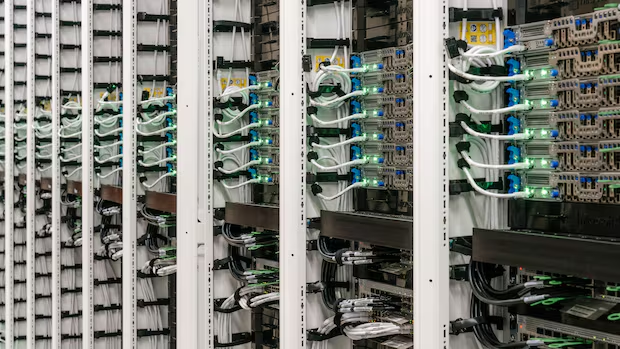
Skip to Content Subscribe Our Offers My Account Manage My Subscriptions FAQ Newsletters Canada Canadian True Crime Canadian Politics Health World Israel & Middle East Financial Post NP Comment Longreads Puzzmo Diversions Comics NP News Quiz New York Times Crossword Horoscopes Life Eating & Drinking Style Sponsored Play for Ontario Travel Travel Canada Travel USA Travel International Cruises Travel Essentials Culture Books Celebrity Movies Music Theatre Television Business Essentials Advice Lives Told Tails Told Shopping Buy Canadian Home Living Outdoor Living Tech Style & Beauty Kitchen & Dining Personal Care Entertainment & Hobbies Gift Guide Travel Guide Deals Savings National Post Store More Sports Hockey Baseball Basketball Football Soccer Golf Tennis Driving Vehicle Research Reviews News Gear Guide Obituaries Place an Obituary Place an In Memoriam Classifieds Place an Ad Celebrations Working Business Ads Archives Healthing Epaper Manage Print Subscription Profile Settings My Subscriptions Saved Articles My Offers Newsletters Customer Service FAQ Newsletters Canada World Financial Post NP Comment Longreads Puzzmo Diversions Life Shopping Epaper Manage Print Subscription HomeCanadaCanadian PoliticsThe federal government is getting into AI data centres. It should expect controversiesAn AI data centre is a facility designed to power artificial intelligence systems You can save this article by registering for free here. Or sign-in if you have an account.Prime Minister Mark Carney touches a pigs lungs at Toronto General Hospital, Thursday June 4, 2026. Photo by Peter J Thompson /National PostOTTAWA — Prime Minister Mark Carney announced Canada’s artificial intelligence strategy on Thursday, with a plan to for “large-scale AI data centres” and a goal of massively increasing the country’s computing capacity by 2030.Enjoy the latest local, national and international news.Exclusive articles by Conrad Black, Barbara Kay and others. Plus, special edition NP Platformed and First Reading newsletters and virtual events.Unlimited online access to National Post.National Post ePaper, an electronic replica of the print edition to view on any device, share and comment on.Daily puzzles including the New York Times Crossword.Support local journalism.Enjoy the latest local, national and international news.Exclusive articles by Conrad Black, Barbara Kay and others. Plus, special edition NP Platformed and First Reading newsletters and virtual events.Unlimited online access to National Post.National Post ePaper, an electronic replica of the print edition to view on any device, share and comment on.Daily puzzles including the New York Times Crossword.Support local journalism.Create an account or sign in to continue with your reading experience.Access articles from across Canada with one account.Share your thoughts and join the conversation in the comments.Enjoy additional articles per month.Get email updates from your favourite authors.Create an account or sign in to continue with your reading experience.Access articles from across Canada with one accountShare your thoughts and join the conversation in the commentsEnjoy additional articles per monthGet email updates from your favourite authorsSign In or Create an AccountorThat means lots of new AI data centres, with the hopes of increasingly keeping Canadian data within the country’s borders.But until recently, developing these facilities has been primarily a matter of local concern for communities where they will be built. As Ottawa ramps up investment in hopes of dramatically scaling up AI compute capability across the country, the federal government is now wading into controversies involving data centres that have primarily played out at the municipal and provincial levels before now.Here’s what you need to know about the concerns and debates involving these facilities.An AI data centre is a facility designed to power artificial intelligence systems by storing data and running the massive computations needed to train and operate AI models.Unlike traditional data centres, which mainly handle web hosting, cloud storage, email, or business software, AI data centres are built around high-performance processors such as graphics processing units and specialized AI chips. They require far more electricity, advanced cooling systems, and ultra-fast networking to manage the intense workloads created by machine learning.AI data centres are optimized for parallel processing and large-scale data movement, making them significantly more energy- and hardware-intensive than conventional facilities.There are just over 300 data centres operating throughout Canada, though most are located in or near major metropolitan areas.When the Trudeau government announced the launch of the Canadian Sovereign AI Compute Strategy in December 2024, the intent was to develop “cutting-edge AI solutions across all sectors of our economy helps Canada remain a destination of choice for investment and top talent.”Then in April 2025, the first budget by the Carney government proposed to provide over $925 million during a five-year period to “support a large-scale sovereign public AI infrastructure” throughout Canada. Updated last month, the AI Compute strategy indicates the government plans to “make strategic investments in public and commercial infrastructure.”The goal of the “sovereign AI” compute strategy is to develop and maintain technical capabilities within Canada to harness the full potential of emerging digital automation technologies.Michel Richer, president of Bell AI, told National Post that “data sovereignty” is primarily about “two pillars.” Those involve “ensuring that no actor outside of the country” either has the ability to access data generated within Canada or to stop Canadian computer systems from operating.According to Richer, establishing data sovereignty within the country helps “guarantee that we are in full control over our access to data and full control over which systems are running or are prevented from running.”Announcing the sovereign AI compute strategy, the federal government said the plan “will make strategic investments in public and commercial infrastructure to ensure that Canadian innovators, businesses and researchers have access to the compute capacity they need.”Initiatives such as zoning approval and implementing tax breaks for AI data centres have been divisive and hotly contested issues for municipal governments throughout Canada and the United States.The small council for the rural municipality of Sherwood near Regina had to exclude the public due to repeated disruptions during a meeting in April during which a proposal for a Bell AI data centre was ultimately approved. Controversy has also erupted in Nanaimo, where an active online petition encourages community members to “push to stop” a prospective data centre “from being built.”Similar debates are playing out across the United States as well, where a recent Gallup poll reports that seven in 10 Americans oppose having AI data centres constructed in their local area. In the small municipality of Independence, Missouri, the two city council members on the ballot for a local election who had previously supported tax breaks for an AI data centre were voted out of office last month. Staunch opposition has also emerged in states such as Virginia and Maine where these facilities have been proposed or built.A report published by the University of Michigan in July 2025 highlights a number of issues that have plagued proposals to develop AI data centres. Increased utility rates driven by higher electricity demand, large volumes of water necessary to cool high-output electronics straining local resources, and tax breaks that fail to deliver economic benefits promised to the local community are a few of the most contentious concerns often raised about these facilities.However, many of the most common objections are based on outdated perceptions of AI data centre models, according to Eliot Ahdoot, president of global technology company Hypertec, which is based in Montreal. Ahdoot told National Post that “the market has adapted to” develop more efficient methods for powering and cooling advanced electronics utilized in data centres.For example, he said many new builds today implement a “closed loop” cooling system that gets filled with a “certain amount of water” that is then recirculated rather than constantly drawing in and discharging massive amounts of liquid. Ahdoot also said Canada has an advantage compared to many places in the United States because colder temperatures provide “a lot of free cooling” that can be put to use in these facilities.According to Ahdoot, local officials and the general public should have a realistic and updated understanding of the “practical sustainability” solutions that have been developed in recent years in response to growing concerns about AI data centres.Heavy investment by the federal government marks a new chapter in the development of these facilities across Canada. Ottawa has so far avoided becoming entangled in disputes over approving and constructing AI data centres, though that may soon change as federal subsidies are increasingly injected to back proposed capital projects.While demands for a moratorium on new data centres grow more popular among critics, proponents insist that onerous restrictions risk sending investment and skilled jobs elsewhere.Riyadh Nazerally of Innovation, Science and Economic Development Canada told National Post that although municipal governments remain “responsible for planning and zoning decisions,” the federal government may nonetheless “engage with partners to share information and support coordination where appropriate, particularly on large infrastructure projects.”With the rapid infusion of federal funding, it remains to be seen whether controversy over AI data centres will be increasingly directed at the Carney government rather than municipal officials as before.As these debates continue to play out across the country, Michel Richer of Bell AI said policymakers should focus on “using the full resources of the different levels of government to help remove roadblocks and accelerate projects” to ensure data sovereignty and AI innovation “translate into economic benefits throughout Canada.”National PostOur website is the place for the latest breaking news, exclusive scoops, longreads and provocative commentary. Please bookmark nationalpost.com and sign up for our daily newsletter, Posted, here. Join the Conversation This website uses cookies to personalize your content (including ads), and allows us to analyze our traffic. Read more about cookies here. By continuing to use our site, you agree to our Terms of Use and Privacy Policy.
The federal government is getting into AI data centres. It should expect controversies
A new dynamic is on the horizon as a string of disconnected local controversies becomes national with federal backing.
1,582 words~7 min read